Most fall cleanup guides assume a hard freeze. San Diego’s useful fall list is fire-weather prep plus irrigation and plant checks. Follow CAL FIRE and your notice, not a county-wide 100-foot recipe from this page. Bloom Pro SD matches independent contractors. We do not clear lots.
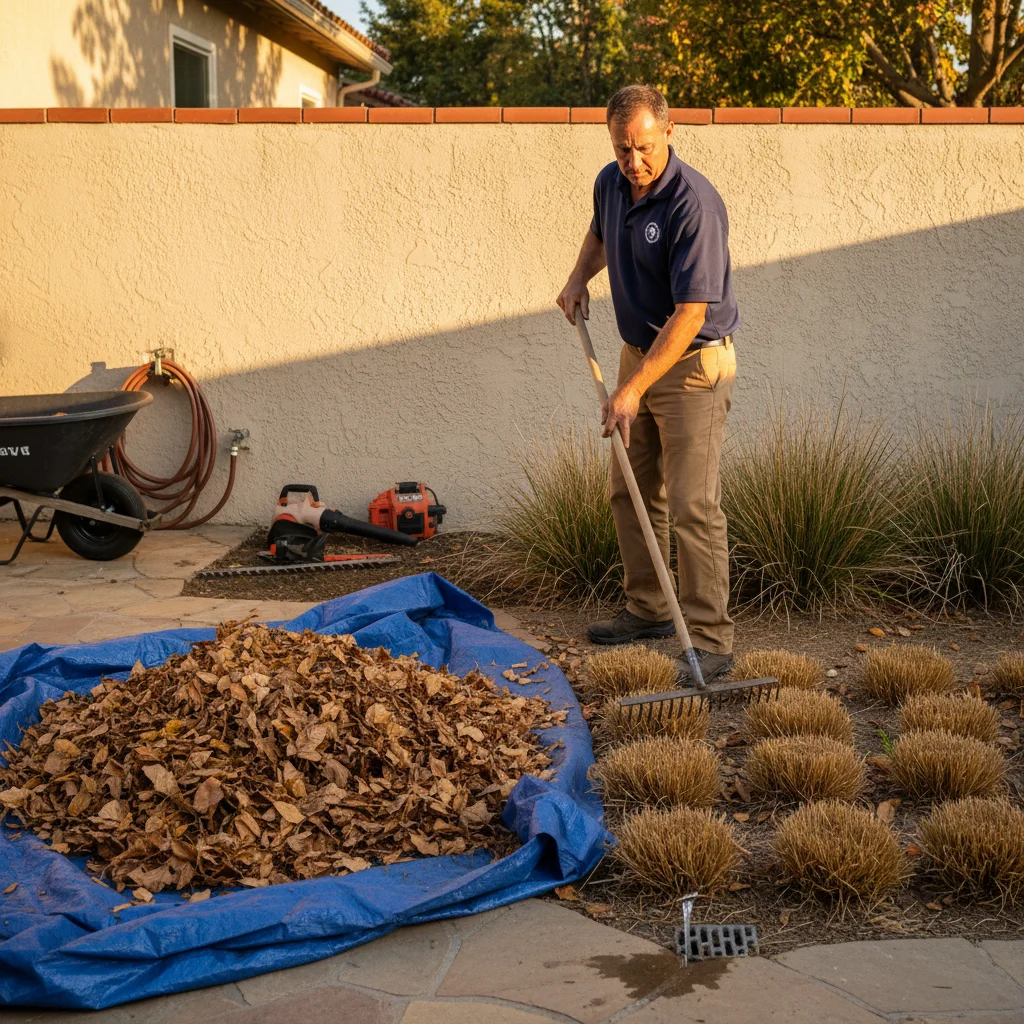
Why SD fall cleanup is really wildfire prep
September through November is Santa Ana season. CAL FIRE calls it one of the highest-risk windows in California, low humidity, strong offshore winds, and dry vegetation combine fast. Your yard is part of that equation.
CAL FIRE defensible-space rules apply to many San Diego lots. Confirm the current zone distances for the address, including any 100-foot requirement that applies to that parcel. Even in established San Diego neighborhoods, the combination of dry chaparral, canyon-adjacent lots, and tile-roofed homes packed close together creates real exposure when wind-driven embers travel.
Practical fall cleanup in San Diego means treating your yard as a fuel-reduction zone first and a tidy garden second. Dead material, overgrown shrubs touching your house, and debris piled against fences all become ignition points during a Santa Ana event. Getting ahead of that in September, before the winds hit, is the goal.
This is also why a referred seasonal cleanup in early fall is structured differently than a spring refresh. The independent professional is not just raking leaves. The usual scope is ladder fuels, egress paths, and anything that connects ground-level growth to eaves or fence line.
Tree limb clearance near chimneys
Confirm current CAL FIRE and local fire-authority chimney and spark-arrestor clearances for the address. Do not treat a remembered foot count as the rule for every parcel.
For most San Diego properties, the trees to watch are eucalyptus, Monterey pine, and Torrey pine, all highly flammable, all prone to dropping limbs or bark in dry conditions. If you have overhanging branches above the roofline, fall is the time to have them pruned back.
The work itself isn’t complicated, but it’s easy to underestimate. A branch that looks trim from the ground can still create a continuous fuel path when you factor in the shrubs below it. Think vertically. If you can draw a line from a shrub, to a low limb, to a higher limb, to your roofline, that’s a ladder fuel problem.
Referred hedge and shrub trimming can include clearing that vertical gap. The crews we match you with pull shrubs back from the base of trees and reduce canopy skirts so ground fire can’t climb.
For any limb removal above 10 feet or near power lines, hire a licensed arborist or landscaping contractor. Check their CSLB license before anyone gets on a ladder at your property: cslb.ca.gov.
Gutter and roof debris timing before the first rains
San Diego’s rainy season typically starts in late November or December, though it can arrive earlier. Gutters full of dry debris are a fire hazard in October and a flooding hazard in December, two months, two problems.
Clean gutters once in October after most of the deciduous material has dropped, and again after any large windstorm. If you have pine trees overhead, do a quick check in November too, because pine needles compact into a mat that holds water and blocks drainage.
Roof valleys, the low points where two roof planes meet, collect debris fast and are hard to see from the ground. A quick visual from a second-story window or a careful look with binoculars can tell you whether there’s buildup. Wet debris sitting in a roof valley through winter promotes moss, rot, and eventual leaks.
Timing matters here: don’t clean gutters too early. If you do it in August, you’ll have a full load of debris again by the time the first rain hits. Early-to-mid October is the right window for most San Diego properties.

Cutting back ornamental grasses and perennials
This is where San Diego diverges sharply from national gardening calendars. Most guides say cut ornamental grasses to the ground in late fall. Here, that timing can actually stress plants or leave them vulnerable through a cooler January.
The better approach depends on the plant:
Ornamental grasses
Grasses like Muhlenbergia rigens (deer grass) and Nassella pulchra (purple needlegrass) are California natives that handle dry conditions well. Cut them back by about one-third in October, enough to remove dead tips and improve appearance, but not so hard they’re left bare heading into cooler months. Non-native ornamental grasses like pampas grass (which is invasive, worth considering replacing) can take a harder cut in fall.
Perennials
Many San Diego-appropriate perennials, salvias, black-eyed Susans, agapanthus, can be deadheaded and lightly shaped in October. Full cutback usually waits until February or March when you can see what’s truly dead versus dormant. Cutting too early removes material that can protect the crown from the occasional cold snap we do get in January.
The UC Master Gardeners of San Diego County publish zone-specific pruning calendars that are worth bookmarking. They’re free, well-maintained, and specific to our Mediterranean climate in a way that national gardening resources usually aren’t.
Irrigation winterization for our mild winter
“Winterizing” irrigation in San Diego isn’t the same as blowing out lines in Denver. We don’t get hard freezes. What we do need to do is recalibrate the system for shorter days, lower evapotranspiration rates, and the arrival of rain.
By early November most yards need less water than in summer. Follow the San Diego County Water Authority’s conservation guidance and your own agency’s days, not a remembered percent of summer volume.
Practical steps for fall irrigation:
- Lower run times as days shorten. Use your controller’s seasonal adjust and your water agency’s current days, not a remembered percent.
- Switch to a weather-based schedule if your controller supports it
- Check each zone for broken heads or misdirected spray, it’s easier to spot and fix before the rainy season masks problems
- Turn off any drip zones covering succulents or drought-tolerant plantings entirely, they don’t need supplemental water once rains begin
If you have an older controller that doesn’t allow seasonal adjustment, fall is a reasonable time to upgrade. Check EPA WaterSense for certified models and the San Diego County Water Authority plus your retail agency for any current controller rebate. This page does not promise qualification or a dollar offset.
Any heads that aren’t seating properly or zones that aren’t shutting off cleanly should be fixed before you reduce your oversight of the system through winter. A referred irrigation repair professional can do a full audit if you’re not sure where the system stands.
What to skip, chores that don’t apply here
A lot of fall gardening content is written for USDA hardiness zones 5 and 6. San Diego is zone 10–11 in most neighborhoods. Several standard fall tasks simply don’t translate.
Don’t mulch for frost protection. We occasionally dip into the low 40s, but ground frost is rare in coastal and inland valley locations. Deep mulching for cold protection isn’t something most SD yards need. A 2–3 inch layer is always good for moisture retention and weed suppression, but you’re not protecting roots from a hard freeze.
Don’t plant spring bulbs expecting a chill period. Tulips and hyacinths need pre-chilling in a refrigerator before planting here, the soil doesn’t get cold enough to do it naturally. If you want spring color, look at ranunculus, freesias, and anemones, which perform reliably in SD without any extra steps.
Don’t shut down irrigation entirely. Even in winter, a dry spell can last three or four weeks. Newly planted material and lawns still need occasional water between rains. Fully shutting off and ignoring the system through winter is how people end up with dead plants in February.
Don’t rake aggressively under natives. Leaf litter under California natives acts as natural mulch and habitat. A light clear of fire-hazard debris is appropriate, but don’t strip the soil bare under a toyon or lemonade berry. Leave some of that organic material in place.
Frequently asked questions
What should a San Diego fall cleanup actually cover?
Treat it as wildfire prep, not leaf raking. September through November is Santa Ana season. Confirm current CAL FIRE and local fire-authority distances for the address. The core tasks are ladder-fuel clearance, limb pruning near the roof, gutter clearing, and recalibrating irrigation for shorter days.
How far should tree branches be from the chimney?
Confirm current CAL FIRE chimney clearance for the address rather than a remembered Zone 1 foot count. Eucalyptus, Monterey pine and Torrey pine are the trees to watch, all highly flammable and all prone to dropping limbs and bark in dry conditions.
When should I clean gutters in San Diego?
Once in October after most deciduous material has dropped, and again after any large windstorm. Dry debris in the gutter is a fire hazard in October and a flooding hazard once the rains start in late November or December. If you have pine overhead, check again in November, because needles compact into a mat that holds water.
Should I cut ornamental grasses back to the ground in fall?
No, and this is where national gardening calendars mislead San Diego gardeners. Cut California natives like deer grass and purple needlegrass back by about a third in October, enough to remove dead tips without stressing the plant through a cooler January. Perennials such as salvias and agapanthus get deadheaded and lightly shaped in October, with full cutback waiting until February or March.
Do I need to winterize irrigation in San Diego?
Not the way colder climates do. We do not get hard freezes, so there are no lines to blow out. What you do need is recalibration: by early November most yards need less water than in summer, because days are shorter. Follow SDCWA and your own agency, not a remembered percent of summer volume.
When to call us
Fall cleanup that doubles as defensible space prep involves work that’s easy to underestimate, ladder fuel clearance, roof-adjacent limb pruning, and irrigation diagnosis all benefit from a trained eye and the right equipment. If your property sits near a canyon, has significant tree canopy over the structure, or hasn’t had a professional cleanup in more than a year, it’s worth having a crew handle it. Call us at (760) 400-6355 to get matched. The independent professional quotes the work.