If you are holding a weed-abatement notice or an insurance letter about vegetation near the house, start with the document itself. The deadline, required work, and inspecting authority are on that notice, not in a generic county timeline. Defensible space is the buffer between a structure and surrounding fuel. Bloom Pro SD matches homeowners with licensed independent landscapers. We do not inspect for fire agencies, set clearance prices, or promise that a policy will be renewed.
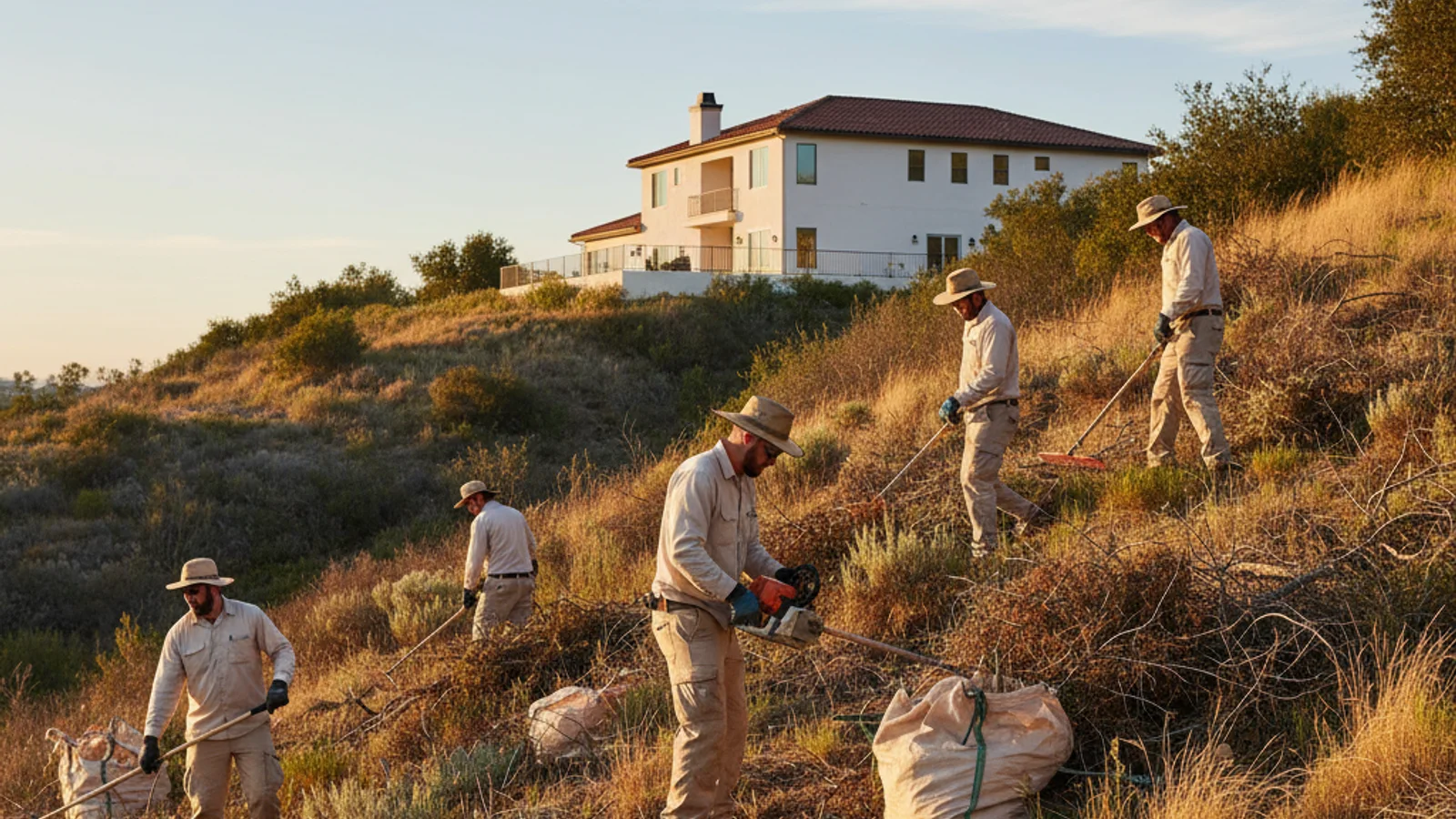
What defensible space actually means: zones 0, 1, and 2
CAL FIRE describes defensible space around homes and publishes Zone 0 as a 5-foot non-combustible buffer next to the structure. Its Zone 0 materials call for removing vegetation including overhanging branches, removing wood mulch, addressing combustible fences, and replacing combustible ground cover with rock, pavers, or stepping stones. Read the current rule from CAL FIRE’s defensible space and PRC 4291 page and any local fire-district handout attached to your notice.
Treat zone distances and plant lists on a notice as controlling for that property. State law, a county weed-abatement standard, and an insurer’s inspection list can differ. Follow the authority that issued your letter, then confirm whether additional local rules apply.
Zone 0 (ember-resistant, typically 0 to 5 feet). Keep this band free of combustible debris and combustible mulch against the foundation. CAL FIRE’s Zone 0 guidance is about reducing ignition next to the wall. Do not treat a blog as a substitute for the current agency diagram.
Lean, clean, and reduced-fuel areas farther from the house. Notices often require mowing dry grass, removing dead shrubs, breaking continuous fuel paths, and thinning denser brush farther out. Limbing height, canopy spacing, and the exact outer distance belong in the written standard for your address. Do not assume one county-wide 100-foot recipe covers every lot.
What a brush-clearance scope should name
When you request a fire-clearance quote, ask the contractor to write the work, not a vague “mow.” A useful scope for San Diego County often includes:
- Dead and dry vegetation. Named plant material, height limits, and the distance from structures listed on the notice.
- Ladder fuels. Whether low vegetation under trees will be removed, and any limbing height the fire authority specified.
- Canopy and roof clearance. Whether branches near the roof, chimney, or structure will be cut, and who is responsible if a tree-care license is required.
- Combustible mulch near the house. Whether wood mulch in the first few feet will be removed and what non-combustible cover, if any, will replace it.
- Roof, gutter, and under-deck cleanout. Confirm whether those surfaces are in the landscaping scope or a separate trade.
- Hauling and disposal. Where green waste will go. Do not assume it fits in household bins.
This overlaps with seasonal cleanup and follow-up weed control. Clearing once does not keep a lot in compliance if new growth returns.
How to read your notice and the cure window
A weed-abatement notice comes from a city, county, or fire district. It should name the hazard and the compliance date. If you miss it, the agency may hire its own contractor and bill you. Use the dates printed on the letter. Do not substitute a generic 10-to-30-day window.
An insurance inspection or non-renewal letter is a separate document. Some carriers ask for photos or a re-inspection after clearance. Clearing vegetation can help a re-inspection, but Bloom Pro SD cannot promise that a policy will be saved, written, or priced differently.
Find the deadline, list the required work, and schedule with enough time for weather, access, and a written quote. Do not wait until the last day on the letter.
What changes a brush-clearance bid
Brush clearance is priced by the contractor after seeing the lot. Slope, density, access, dump fees, and whether trees, decks, or roofs are included all move the number. Bloom Pro SD does not publish a rate card. Compare itemized quotes that name:
- Lot area and slope actually being cleared
- Distance from structures and which zones are in scope
- Limbing, tree work, and any separate arborist
- Hauling, disposal, and whether gravel replacement in Zone 0 is included
- Who contacts the fire district or insurer, if anyone
Why steep-lot DIY clearance is high risk
Clearing dry fuel on a grade with power equipment is a common injury and spark hazard. CAL FIRE tells residents to avoid clearance work on hot, dry, windy afternoons. Disposal of a large clearance can exceed household green-waste rules. For a deadline-driven job on a steep or overgrown lot, an independent contractor with the right equipment and a dump plan is usually the safer path. Our overgrown yard cleanup guide covers how to compare that kind of scope.
Scheduling around a notice
Call with the address and the date on the letter. We will match you with a licensed local professional who can quote the property. The contractor sets the schedule. Bloom Pro SD does not guarantee same-week availability or that the finished lot will pass an inspector or carrier review. Ask the contractor to work from the notice language and to photograph before and after work.
Frequently asked questions
How much defensible space does San Diego County require? Follow PRC 4291, CAL FIRE, and the fire authority named on your notice. Distances and plant rules can differ by zone designation and jurisdiction. Read the current CAL FIRE page and the letter you received rather than a single county-wide number from this article.
Will clearing brush help my home insurance? It can help a re-inspection if the letter asks for one. Keep before-and-after photos. An outcome for the policy is the carrier’s decision.
How fast can a contractor clear my property? That depends on the contractor’s calendar, lot size, access, and weather. Share the notice date when you request a match. No network-wide response time applies.
What’s the difference between weed abatement and brush clearance? Weed abatement often means cutting dry weeds and grasses to a required height. Brush clearance is broader when the notice also requires shrubs, ladder fuels, and thinning. Use the definitions on your letter.
Do I need to remove mulch against my house? CAL FIRE’s Zone 0 materials treat wood mulch next to the structure as a problem to remove. Confirm the current diagram and any local overlay before replacing it with rock or other non-combustible cover.
When to call us
If you have a notice with a deadline, a steep or large lot, or a clearance that is more than a simple mow, call (760) 400-6355. We will match you with a licensed local pro. The homeowner contracts with that professional directly.