Decomposed granite runs $3 to $6 per square foot installed in San Diego, interlocking pavers run $20 to $35, and the right pick depends on which part of your yard you’re building, not just the price tag. DG wins on paths, slopes, and drought-tolerant zones. Pavers win on patios, driveways, and anywhere furniture and daily foot traffic pile up.
At a glance
| Decomposed granite | Interlocking pavers | |
|---|---|---|
| Installed cost | $3 to $6 per sq ft | $20 to $35 per sq ft |
| Best for | Paths, slopes, side yards, xeriscape | Patios, driveways, pool decks |
| Drainage | Permeable, water passes through | Mostly impermeable surface |
| Furniture and foot traffic | Ruts and shifts under heavy use | Handles daily wear and weight |
| Repairs | Top-up and re-compact | Lift and reset individual pieces |
| Lifespan before major work | A few years between top-ups | Decades |
The real cost gap on a full project
The price difference isn’t small. On a 1,000 square foot area, decomposed granite lands somewhere between $3,000 and $6,000 installed. The same footprint in pavers runs $20,000 to $35,000. That’s a gap of roughly $17,000 to $29,000 for the exact same square footage, which is why so many San Diego homeowners try to use DG everywhere and regret it once furniture legs start sinking into it.
DG needs a stabilizer binder mixed into the material during installation. Skipping it saves about $1 per square foot upfront, but the result is loose, gravelly DG that spreads past its edges and washes toward the low point of your yard the first time it rains hard. Most homeowners who skip the stabilizer end up calling us within a year to fix it. It’s one of the few corners that’s never worth cutting.
Pavers cost more because you’re paying for a compacted base, edge restraint, individually cut units, and labor that has to get every joint tight. That upfront cost buys you a surface that can carry a loaded dining set in Rancho Bernardo or a hot tub in Poway without shifting. Both materials fall under our hardscaping work, and pairing them correctly is most of what separates a yard that holds up from one that needs redoing in two years.
Where decomposed granite wins in a San Diego yard
DG is the right call in a handful of specific zones, and it’s worth naming them instead of treating DG as a cheap paver substitute.
Pathways and side yards. Narrow side yards in Scripps Ranch or Rancho Bernardo, the kind that connect a front gate to a backyard, are classic DG territory. You get a finished look without paying paver prices for a five-foot-wide strip nobody parks furniture on.
Slopes. DG handles a mild grade better than most people expect, especially with stabilizer mixed in. On steeper hillside lots around Escondido or Poway, we’ll often pair a DG surface with a low retaining wall to hold the grade rather than fighting the slope with material alone.
Xeriscape and drought-tolerant zones. DG is permeable, so it works with San Diego’s water-conscious landscaping instead of against it. Rainwater soaks through instead of running off, which matters for rebate programs and for keeping runoff off your neighbor’s property in denser lots.
Dog runs and budget projects. If you’ve got a dog that needs a dedicated area, DG is forgiving, easy to rake clean, and cheap enough to redo if it gets torn up. For homeowners stretching a landscaping budget across a full yard, DG lets you finish more square footage without draining the whole project fund on one patio.
Where pavers win: patios, driveways, pool decks
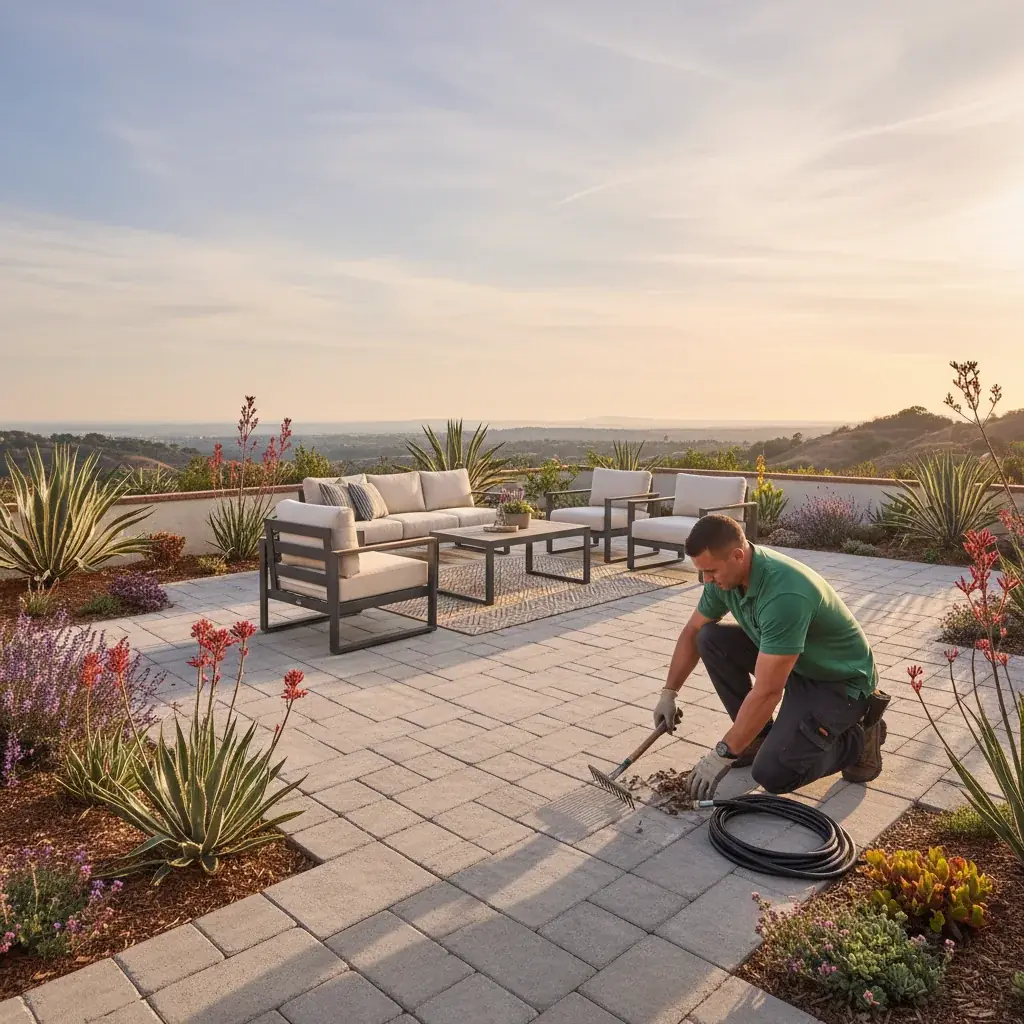
Pavers earn their price on anything that takes real load or daily wear. Main patios in Carlsbad or entertaining spaces in La Jolla need a surface that won’t rut under a grill, a sectional couch, and a crowd of people standing in one spot during a party. That’s a job for pavers, not gravel.
Driveways are the clearest case. A car is thousands of pounds concentrated on a few square inches of tire contact. DG will rut and displace under that kind of repeated point load. Pavers, set on a properly compacted base, are built to carry it.
Pool decks are another place where pavers make sense over DG. Loose material tracks into the pool and clogs filters, and wet DG doesn’t give you the same stable footing that a paver surface does around water.
The other advantage: pavers are individually replaceable. If one settles or cracks, we lift it, fix the base underneath, and reset it without touching the rest of the patio. That’s part of why a well-installed paver surface can last decades with only minor upkeep.
Maintenance over time
DG needs periodic top-ups as material compacts, migrates, and gets tracked away on shoes. Depending on foot traffic, that might mean refreshing the top layer every couple of years and re-compacting after heavy rain. It’s also worth knowing DG will track indoors if it’s right next to an entry door, something worth planning around before you commit to it there.
Pavers ask for less ongoing attention. An occasional rinse, joint sand refresh, and the ability to lift and reset a single piece if it settles is about all a well-built paver surface needs.
Matching the material to your yard’s zones
Most San Diego properties end up mixing both materials, and that’s usually the smartest call. A typical layout might use pavers on the main patio and entry walkway, then DG for a side yard path or a slope planting bed accented with river rock at the transitions. Zoning the materials this way keeps your budget realistic while putting the durable, expensive surface only where it’s actually needed.
Colors and finish options
DG comes in a handful of common tones across San Diego suppliers: tan, red, gray, and gold. Tan and gold read warm and blend into most native and drought-tolerant plant palettes. Gray reads more contemporary against modern architecture. Red DG shows up less often but pairs well with terracotta and warm stucco tones common in older San Diego neighborhoods.
Frequently asked questions
Is decomposed granite always cheaper than pavers?
Per square foot, yes, DG installed runs $3 to $6 against $20 to $35 for pavers. But DG needs more upkeep over time, so the lifetime cost gap is smaller than the install-day gap looks.
Will decomposed granite wash out when it rains?
Only if the stabilizer binder was skipped during installation. Properly stabilized DG holds up through San Diego’s rainy season with occasional re-compaction, not a full redo.
Can I use decomposed granite and pavers in the same yard?
Yes, and most of our San Diego projects do exactly that. Pavers on the patio, DG on paths and slopes, is a common and cost-effective split.
How long does a paver patio last compared to decomposed granite?
A well-installed paver patio can last decades with minor maintenance. DG needs periodic top-ups and re-compaction over the same timeframe, so it’s a lower upfront cost but more recurring attention.
Does decomposed granite work under patio furniture?
It’s not ideal. Furniture legs concentrate weight on small points and can rut DG over time. If you’re planning to put a dining set or lounge furniture on a surface, pavers hold up better.
When to call us
If you’re staring at a yard with three or four different zones and trying to figure out where DG makes sense and where you need pavers, that’s exactly the kind of walkthrough we do every week across San Diego County. We’ll look at your slope, your traffic patterns, and your budget, then give you a straight recommendation instead of upselling pavers everywhere. Call us at (760) 400-6355 for a same-day estimate.