San Diego’s climate demands smart landscaping choices. If you’re currently using traditional spray sprinklers for your garden beds, a significant portion of your irrigation water might be evaporating or blowing away before it ever reaches your plants. Converting to a drip irrigation system can stop this costly waste, helping you save money on water bills and conserve a vital local resource.

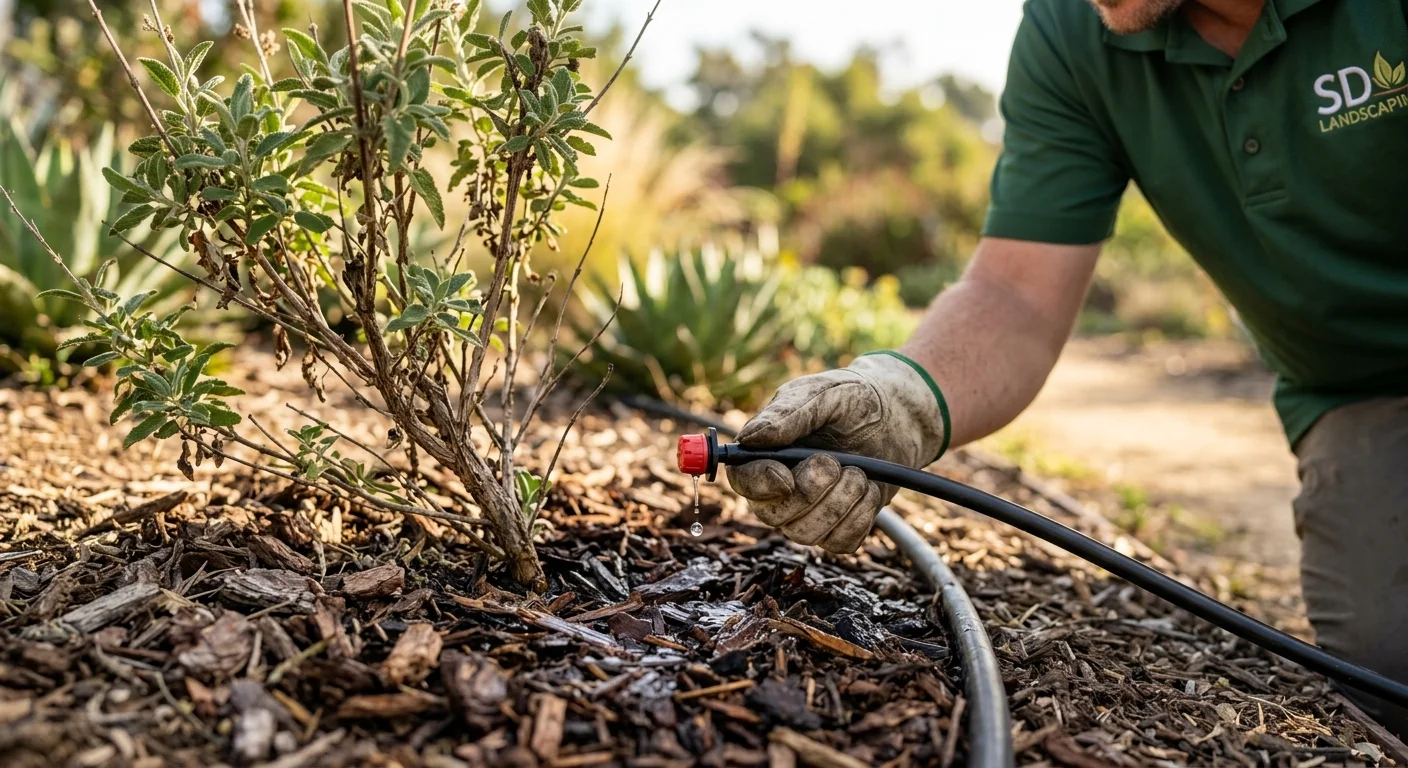
Close-up of a drip emitter dripping water onto mulch at the base of a drought-to

Why spray loses 30% to wind and evaporation in SD

Our beautiful San Diego County is known for its sunshine and ocean breezes. While enjoyable, these elements are not friendly to traditional spray irrigation. Spray sprinklers work by launching water into the air, creating a wide fan pattern to cover an area. In our dry, often breezy environment, this method has serious drawbacks.

First, wind drift is a major culprit. Even a gentle breeze can carry sprinkler spray away from your plants and onto sidewalks, driveways, or even your neighbor’s property. This means your plants get less water than intended, leading to under-watering, while other areas are unnecessarily soaked. Second, the sheer act of spraying water into the air means a good portion of it never makes it to the ground. Evaporation takes its toll before the water hits the soil surface, and then quickly from any puddles that form. Industry estimates suggest that up to 30% of the water used by spray systems can be lost this way in arid climates like ours.

This inefficiency translates directly into higher water bills for you and increased demand on San Diego’s water supply. It also leads to stressed plants, dry spots, and the need for more frequent irrigation repair as you try to compensate for the lost water. For garden beds, shrubs, and trees, spray irrigation is simply not the most effective or economical method.

Drip components: emitters, tubing, filters, and pressure regulators

A drip irrigation system might seem complex, but it’s built from a few key components designed for precision watering. Understanding these parts helps you see why drip is so much more efficient than spray.

Key drip system components

  • Tubing: This forms the backbone of your system. It typically starts with a thicker main line (often polyethylene) that branches into smaller feeder lines, usually 1/4-inch or 1/2-inch, which run directly to your plants. This tubing carries water from your existing sprinkler valve or faucet to where it’s needed.
  • Emitters: These are the heart of a drip system. Small devices inserted into the tubing, emitters deliver water slowly, drop by drop, directly to the plant’s root zone. They come in various flow rates, typically measured in gallons per hour (GPH), like 0.5 GPH, 1 GPH, or 2 GPH. The right emitter size depends on the plant’s water needs and soil type. Some are pressure-compensating, ensuring consistent flow even on sloped terrain.
  • Filters: Water from the municipal supply can contain tiny sediment or debris. A filter is crucial to prevent these particles from clogging the small openings in drip emitters. Without a filter, your system would quickly become ineffective.
  • Pressure Regulators: Spray sprinkler systems operate at relatively high pressure, typically 30-50 PSI (pounds per square inch). Drip systems, however, need much lower and more consistent pressure, usually 15-30 PSI, to function correctly and prevent blow-outs or uneven watering. A pressure regulator reduces and stabilizes the water pressure coming into your drip lines.

Other essential components include various fittings (tees, elbows, couplings), end caps to seal off lines, and stakes to hold the tubing in place. While assembling these parts is straightforward for smaller projects, designing a balanced system for optimal plant health often benefits from professional knowledge.

Conversion cost ranges by zone count and yard size

The cost to convert your existing spray irrigation to drip in San Diego varies widely. It depends on factors like the number of zones you’re converting, the size and complexity of your yard, and whether you choose a DIY approach or professional installation. We’ll break down the ranges for both options.

DIY conversion costs

If you’re handy and enjoy tackling home projects, converting a small, simple zone to drip can be a rewarding DIY task. For a single small zone (e.g., 100-200 sq ft with a few shrubs), you might spend $50 to $100 on materials alone. This includes tubing, emitters, a pressure regulator, filter, and basic fittings. For a medium zone (300-500 sq ft with more diverse plantings), material costs could rise to $100 to $180. DIY saves on labor, but requires your time, research, and attention to detail to ensure proper setup.

Professional installation costs

Opting for professional installation means peace of mind and an efficient, reliable system from day one. Landscaping companies typically quote per zone or based on the total area. For a typical small zone conversion in San Diego, you can expect to pay $250 to $400. A medium-sized zone might range from $350 to $550. These costs cover high-quality materials, expert labor, system design, and testing.

Factors that increase professional installation costs include:

  • Number of existing zones: More zones mean more connection points and complexity.
  • Yard size and plant density: Larger areas with many plants require more tubing and emitters.
  • Accessibility: Difficult-to-reach areas or rocky soil can add to labor time.
  • Current system condition: If existing valves or main lines need significant upgrades, it affects the price.
  • Component quality: Higher-grade, commercial-quality drip components last longer but cost more.

For an average San Diego home with 3 to 5 irrigation zones, a full professional conversion could range from $750 to $2,750. While a larger upfront investment, this ensures optimal water delivery and maximizes your long-term savings.

{{infographicAlt}}

Water savings math: gallons and dollars per year

The financial benefits of converting to drip irrigation in San Diego are substantial and measurable. Beyond conserving water, you’ll see a noticeable difference in your utility bills. Let’s look at some real numbers.

Consider a typical San Diego residential yard with three spray irrigation zones covering garden beds and shrubs. Each zone, roughly 500 square feet, might operate for 15 minutes, three times a week during warmer months. A standard spray head might disperse 1.5 gallons per minute (GPM). With six heads per zone, that’s 9 GPM.

  • Spray System Use (per zone): 9 GPM x 15 minutes = 135 gallons per watering.
  • Weekly Use: 135 gallons x 3 waterings = 405 gallons per week.
  • Annual Use (20 weeks active watering): 405 gallons x 20 weeks = 8,100 gallons per zone annually.

Now, recall that spray systems can lose up to 30% of this water to wind and evaporation in our climate.

  • Annual Water Waste (per zone): 8,100 gallons x 30% = 2,430 gallons wasted per zone, per year.
  • Total Annual Waste (3 zones): 2,430 gallons/zone x 3 zones = 7,290 gallons wasted annually.

San Diego water rates are tiered, meaning you pay more as you use more. Depending on your water district and usage tier, water can cost roughly $7 to $10 per HCF (100 cubic feet, which equals 748 gallons).

  • Converted HCF: 7,290 gallons / 748 gallons/HCF = ~9.7 HCF.
  • Annual Dollar Savings: 9.7 HCF x $8/HCF (average) = $77.60 saved per year just from stopping waste.

This is a conservative estimate, as drip systems also allow for more precise watering schedules, potentially reducing overall water use beyond just preventing waste. By pairing drip with drought-tolerant landscaping, you can multiply these savings. Plus, properly watering your plants with drip can prevent issues that lead to costly water waste from irrigation repair. Over a few years, these savings quickly add up, often recouping your initial conversion cost.

Rebate offsets for drip retrofits in SD water districts

San Diego County is a leader in water conservation, and its water agencies often provide incentives for homeowners to make water-efficient upgrades. While the most well-known rebates focus on turf removal, there are often opportunities to offset the cost of drip irrigation conversions.

Many local water districts throughout San Diego County, including the City of San Diego, Helix Water District, and Olivenhain Municipal Water District, participate in regional and local rebate programs. These programs are frequently coordinated through the San Diego County Water Authority (SDCWA).

How rebates can help

  • Turf Replacement Programs: Most significant rebates are offered for replacing thirsty lawns with drought-tolerant landscapes. Drip irrigation is almost always a mandatory component of these new water-efficient landscapes. So, if you’re planning a full turf removal project, the cost of your drip system is often indirectly subsidized by the larger rebate.
  • Water-Efficient Irrigation Upgrades: Some districts offer specific rebates for upgrading to water-efficient irrigation, though these are less common than turf removal. It’s always worth checking your specific water district’s website or the SDCWA website (sdcwa.org) for current programs.
  • Smart Irrigation Controllers: While not directly for drip components, installing a smart irrigation controller is an excellent complement to a drip system. These controllers optimize watering schedules based on local weather and plant needs, maximizing drip efficiency. Many San Diego water districts offer rebates for smart controller installation, typically ranging from $100 to $300. We detail how to access these savings in our guide to the smart irrigation controller rebate in San Diego.

Always verify the latest rebate availability and eligibility requirements with your specific water provider before starting any project. These programs can significantly reduce your upfront investment, making the switch to drip even more financially appealing.

DIY versus pro install: where the line is

Deciding whether to tackle a drip irrigation conversion yourself or hire a professional depends on your comfort level, project size, and desired outcome. There’s a clear line where DIY savings can turn into costly mistakes.

When DIY makes sense

If you have a small, straightforward garden bed, good handiwork skills, and plenty of time, a DIY conversion might be a good option. You save on labor costs and gain a deeper understanding of your irrigation system. This is best for:

  • Single, small zones: Converting one isolated area with a few plants.
  • Existing accessible valves: When you can easily connect to an existing sprinkler line.
  • Simple plant layouts: Areas with uniform plant types and water needs.
  • Learning experience: You want to learn how drip systems work.

You’ll need basic tools like tubing cutters, a punch tool for emitters, and perhaps a screwdriver. There are many online resources and kit instructions to guide you.

When to call a professional

For most homeowners, especially for larger yards or multiple zones, professional installation is the smarter choice. An experienced landscaping company like Bloom Pro SD brings crucial expertise to the table:

  • Optimal design: Pros understand hydraulics, plant water needs, and soil types to design a system that waters efficiently and effectively. This prevents over or under-watering, which can harm your plants.
  • Correct pressure regulation: Ensuring consistent, low pressure is vital for drip systems. Professionals properly size and install pressure regulators to prevent blowouts and ensure even distribution across all emitters.
  • Leak prevention: Correctly installing fittings and sealing connections prevents leaks, which are both wasteful and damaging. Professionals have the tools and experience for durable, watertight connections.
  • Efficiency and speed: A professional team can complete the conversion much faster and more cleanly than a DIY approach, minimizing disruption to your yard.
  • Warranty and support: Most professional installations come with a warranty on parts and labor, providing peace of mind.
  • Complex projects: If you have multiple zones, varying plant types, sloped terrain, or want to integrate with smart controllers, professional help is invaluable.

The line is drawn when you value a precise, reliable, and trouble-free irrigation system over the potential initial cost savings of DIY. Investing in professional conversion ensures your system works perfectly for years to come, maximizing your water savings and protecting your landscaping.

When to call us

If you’re ready to upgrade your San Diego landscape to an efficient drip irrigation system, we’re here to help. Our team can assess your property, provide a clear cost estimate for conversion, and ensure your new system delivers water precisely where it’s needed. We handle everything from design to installation, giving you a beautiful, water-wise yard. Call us at (858) 925-5546 for a same-day estimate.