Tree choice is a site decision: mature size, utilities, fire rules, and the species record on Calscape or the nursery. Ask the grower or the independent professional for expected growth on that site. This page does not publish a feet-per-year ranking.
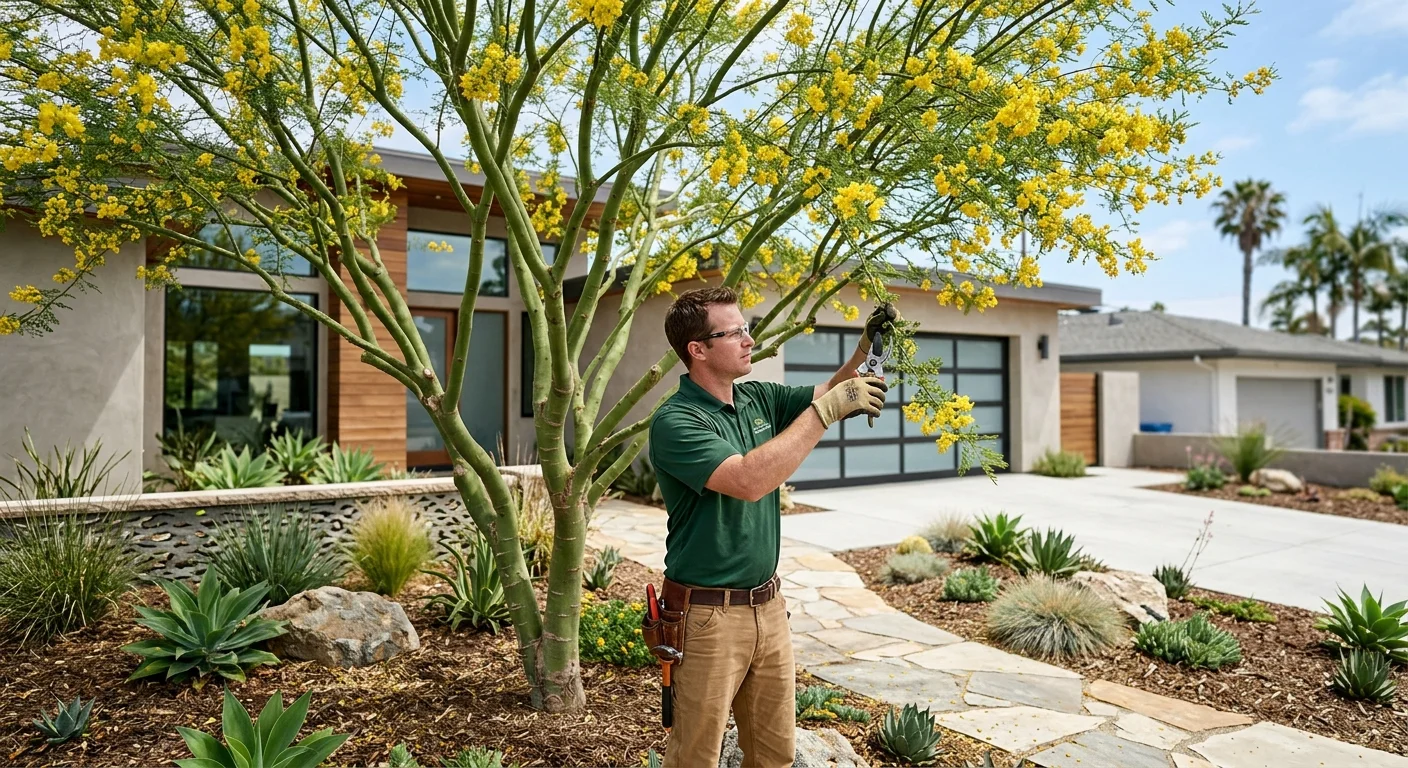
Fast-growing trees for San Diego
If you need shade sooner, ask the nursery for documented growth for the named cultivar in a similar climate. Tipu, chitalpa, palo verde, jacaranda, oak, and carob are names people compare. An oak is a long-term tree, not a five-year privacy screen. Verify setbacks and roots with the installer, not a blog.
Speed usually means softer wood and more aggressive roots. Plant Tipu and Chitalpa well away from foundations, pools, and sewer laterals. Confirm setback with the independent professional and any local utility rules, not a remembered foot count. Embracing drought-tolerant landscaping still means matching the tree to the lot, not only to the calendar.
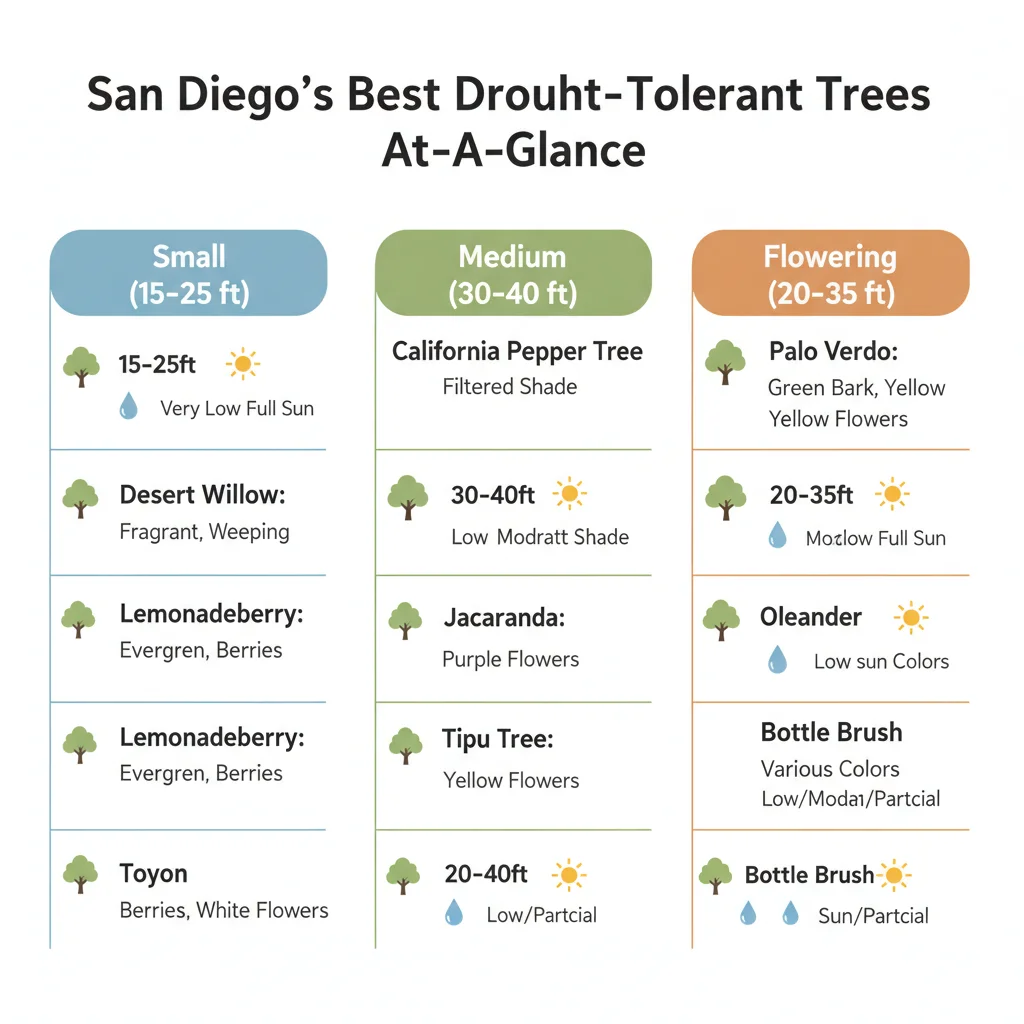
This guide then covers small patio trees, medium shade trees, and flowering low-water picks by size.
What to consider when choosing a tree for your yard
Selecting the perfect tree involves more than just aesthetics; it’s about understanding its long-term needs and how it will interact with your specific environment. In San Diego, water conservation is a primary concern, so prioritizing drought tolerance is key. Beyond that, here are several crucial factors to weigh for a successful tree selection.
First, consider the mature size of the tree. A small sapling can quickly become a giant, potentially overwhelming a small yard, interfering with power lines, or damaging foundations. Research the tree’s anticipated height and canopy spread, and ensure it has ample room to grow without becoming a problem. Think about both above-ground space and potential root spread. For instance, a dense root system near a patio or driveway could cause future issues.
Next, assess your site’s conditions. What kind of sun exposure does the area receive? Most drought-tolerant trees prefer full sun, but some may tolerate partial shade. Evaluate your soil type. San Diego soils vary widely, from sandy coastal loam to heavy clay inland. While many drought-tolerant trees are adaptable, some have specific soil preferences. Also, consider drainage; good drainage is vital for most low-water plants.
Water needs are paramount. Beyond “drought-tolerant,” understand if a tree requires very low, low, or moderate water once established. Even drought-tolerant trees need regular watering during their establishment period, typically the first year or two. After that, their supplemental water needs will vary. Checking local resources like the San Diego County Water Authority website can provide valuable insights into water-wise gardening.
Finally, think about the tree’s purpose. Are you seeking shade for a patio, a privacy screen, a focal point, or a tree to attract local wildlife? Different trees offer different benefits. A flowering tree provides seasonal color, while an evergreen offers year-round foliage. Consider leaf litter, fruit production, and potential allergies. A well-chosen tree enhances your landscape and contributes positively to the local ecosystem without becoming a maintenance burden. If you’re undertaking a larger redesign project, professional landscape design can help you integrate the perfect trees into your outdoor vision.
Our top 5 small trees for patios and small spaces
Even compact yards or patio areas can benefit from the charm and character a small tree provides. These varieties offer beautiful foliage, unique forms, or seasonal interest without overwhelming limited space, all while being excellent choices for low-water landscapes.
1. Desert Willow (Chilopsis linearis)
- Photo concept: A slender Desert Willow with delicate, trumpet-shaped pinkish-purple flowers, graceful weeping branches.
- Size: 15-25 feet tall, 10-20 feet wide.
- Water Needs: Very low once established.
- Sun Exposure: Full sun.
- Key Facts: This deciduous tree offers beautiful, orchid-like flowers from spring through fall, attracting hummingbirds. Its airy canopy provides light shade, and its narrow form makes it ideal for tight spaces. It’s truly a desert gem that thrives in our dry climate.
2. ‘Littleleaf’ Palo Verde (Parkinsonia microphylla)
- Photo concept: A ‘Littleleaf’ Palo Verde tree with its characteristic smooth, green bark and thorny branches, showing tiny leaves and bright yellow flowers.
- Size: 15-20 feet tall, 15-20 feet wide.
- Water Needs: Very low once established.
- Sun Exposure: Full sun.
- Key Facts: Known for its striking green trunk, this native Southwestern tree is extremely tough and water-efficient. It offers a sparse, architectural look, producing a burst of yellow flowers in spring. Its small leaves and green bark allow for photosynthesis even when leaves drop during extreme drought.
3. Texas Olive (Cordia boissieri)
- Photo concept: A Texas Olive tree adorned with large, crinkly, pure white flowers and dark green foliage.
- Size: 15-20 feet tall, 10-15 feet wide.
- Water Needs: Low to moderate once established.
- Sun Exposure: Full sun.
- Key Facts: This evergreen or semi-evergreen tree is prized for its prolific, showy white flowers that resemble crepe paper, appearing for much of the year. It provides lovely shade and a lush appearance with surprisingly low water use. It also produces edible, olive-like fruit that birds enjoy.
4. Pineapple Guava (Feijoa sellowiana)
- Photo concept: A dense Pineapple Guava shrub or small tree with grey-green leaves, showing its unique, showy red and white flowers.
- Size: 10-15 feet tall, 10-15 feet wide (can be pruned into a tree form).
- Water Needs: Low to moderate once established.
- Sun Exposure: Full sun to partial shade.
- Key Facts: A versatile evergreen, the Pineapple Guava is often grown as a large shrub but can be trained into a charming small tree. It features distinctive fleshy white and red flowers in spring, followed by edible, aromatic fruit in fall. Its silver-backed leaves add year-round appeal.
5. Not a tree: Red Yucca (Hesperaloe parviflora)
- Photo concept: A clump of Red Yucca plants, showing its grass-like foliage and tall, arching stalks with coral-red, bell-shaped flowers.
- Size: 2-3 feet tall (foliage), flower spikes up to 5 feet.
- Water Needs: Very low once established.
- Sun Exposure: Full sun.
- Key Facts: Red Yucca is a succulent, not a tree. It still shows up on drought-tolerant plant lists because it gives vertical form with very little water. Its architectural form, paired with tall spikes of coral-red flowers that bloom for months, makes it a pollinator magnet. It’s incredibly resilient and perfect for desert-themed or modern landscapes.
Best medium-sized trees for shade and curb appeal
Medium-sized trees are often the unsung heroes of a San Diego landscape. They offer substantial shade and visual impact, boosting curb appeal without growing to an unmanageable scale. These drought-tolerant options are perfect for providing a canopy over a patio, a driveway, or a central lawn area, creating a comfortable and attractive outdoor living space.
1. African Fern Pine (Afrocarpus falcatus)
- Photo concept: A tall, slender African Fern Pine with fine-textured, dark green foliage, growing upright.
- Size: 30-60 feet tall, 15-25 feet wide.
- Water Needs: Low once established.
- Sun Exposure: Full sun to partial shade.
- Key Facts: This elegant evergreen has a graceful, airy appearance with finely textured, dark green leaves. It’s a fast-growing tree that provides excellent shade and works well as a street tree or a screen. Its non-invasive roots and clean growth habit make it a popular choice for many San Diego yards.
2. Chitalpa (Chitalpa tashkentensis)
- Photo concept: A Chitalpa tree in full bloom, showcasing large clusters of trumpet-shaped, white to pinkish-purple flowers.
- Size: 20-30 feet tall, 15-25 feet wide.
- Water Needs: Low once established.
- Sun Exposure: Full sun.
- Key Facts: A hybrid cross, the Chitalpa offers the best of both worlds: the showy flowers of a Catalpa and the drought tolerance of a Desert Willow. It produces beautiful clusters of trumpet-shaped flowers in shades of white, pink, and lavender from late spring through fall. It’s deciduous, providing a welcome splash of color for months.
3. Western Redbud (Cercis occidentalis)
- Photo concept: A Western Redbud tree with bare branches covered in vibrant magenta-pink flowers in early spring, before leaves emerge.
- Size: 10-20 feet tall, 10-15 feet wide.
- Water Needs: Low once established.
- Sun Exposure: Full sun to partial shade.
- Key Facts: This beautiful California native is a standout in early spring when its bare branches erupt in a profusion of brilliant magenta-pink flowers. Heart-shaped leaves follow, turning yellow-orange in the fall. It’s a stunning, multi-season performer, perfect for adding native charm and color with minimal water.
4. Carob Tree (Ceratonia siliqua)
- Photo concept: A mature Carob tree with its dense, dark green evergreen canopy and thick, gnarled trunk.
- Size: 30-50 feet tall, 30-40 feet wide.
- Water Needs: Low once established.
- Sun Exposure: Full sun.
- Key Facts: The Carob tree is an exceptionally hardy evergreen that offers dense, dark green shade. It’s very tolerant of heat, drought, and poor soils, making it an excellent choice for challenging San Diego conditions. While it produces seed pods, many varieties are available that are less messy or non-fruiting. It creates a dense, long-lived canopy.
5. Coast Live Oak (Quercus agrifolia)
- Photo concept: A majestic Coast Live Oak with its characteristic gnarled branches, dark evergreen leaves, and wide-spreading canopy.
- Size: 20-70 feet tall, 30-60 feet wide.
- Water Needs: Very low once established. Crucial Note: Do not irrigate within the drip line of established oaks in summer to prevent disease.
- Sun Exposure: Full sun.
- Key Facts: A quintessential Southern California native, the Coast Live Oak is an iconic evergreen that provides invaluable shade and habitat. While it can grow large, it’s a slow grower and crucial for native landscapes. Its water needs are extremely low once established, but it is sensitive to summer irrigation, so plan surrounding plants carefully. It’s an investment in local biodiversity.
Flowering trees that add color without high water use
Who says a drought-tolerant garden can’t be vibrant and full of color? Many beautiful flowering trees are perfectly adapted to San Diego’s climate, offering spectacular blooms without demanding excessive irrigation. These selections provide eye-catching displays, attracting pollinators and enhancing your garden’s aesthetic appeal throughout various seasons. Pairing them with other drought-tolerant plants San Diego is a great way to create a cohesive, colorful, and water-wise landscape.
1. Jacaranda (Jacaranda mimosifolia)
- Photo concept: A large Jacaranda tree completely covered in stunning lavender-purple, trumpet-shaped flowers, creating a carpet of blooms on the ground.
- Size: 25-50 feet tall, 20-40 feet wide.
- Water Needs: Moderate to low once established.
- Sun Exposure: Full sun.
- Key Facts: The iconic Jacaranda is synonymous with San Diego springs, painting the city in shades of lavender-purple. While it appreciates some water, it’s surprisingly drought-tolerant once established. It’s deciduous, creating a breathtaking floral display before its fern-like foliage emerges. Be aware of the fallen flowers and seed pods.
2. Crape Myrtle (Lagerstroemia indica)
- Photo concept: A Crape Myrtle tree with peeling bark, showing abundant clusters of crinkled, vibrant pink, purple, or white flowers.
- Size: Varieties range from 8-30 feet tall, 6-20 feet wide.
- Water Needs: Low to moderate once established.
- Sun Exposure: Full sun.
- Key Facts: A summer-blooming superstar, Crape Myrtles offer an explosion of crinkled flowers in white, pink, red, or purple. Beyond their blooms, they feature attractive peeling bark, providing year-round interest. They are very adaptable and relatively low-maintenance, thriving in San Diego’s heat. Choose a cultivar suited to your desired size.
3. Tipu Tree (Tipuana tipu)
- Photo concept: A large Tipu tree with its broad, spreading canopy, covered in bright golden-yellow, pea-like flowers.
- Size: 25-50 feet tall, 25-40 feet wide.
- Water Needs: Low once established.
- Sun Exposure: Full sun.
- Key Facts: This fast-growing, semi-deciduous tree provides welcome shade and a stunning floral show in late spring to early summer. Its canopy becomes covered in masses of bright golden-yellow, pea-like flowers. It’s an excellent choice for a large specimen or shade tree, tolerant of a wide range of conditions once established.
4. Desert Museum Palo Verde (Parkinsonia ‘Desert Museum’)
- Photo concept: A Desert Museum Palo Verde tree, similar to ‘Littleleaf’ but larger, with exceptionally showy yellow flowers covering its green branches.
- Size: 20-30 feet tall, 20-30 feet wide.
- Water Needs: Very low once established.
- Sun Exposure: Full sun.
- Key Facts: A superior hybrid Palo Verde, ‘Desert Museum’ offers the best traits of its parents: a beautiful green trunk, thornless branches, and an extended, profuse display of large, bright yellow flowers in spring. It’s a faster-growing, more floriferous option than the ‘Littleleaf’, making it an excellent focal point for a low-water garden.
5. Silk Floss Tree (Ceiba speciosa)
- Photo concept: A dramatic Silk Floss Tree with a swollen, thorny green trunk and large, showy pink or white flowers, possibly with a few seed pods.
- Size: 30-60 feet tall, 20-40 feet wide.
- Water Needs: Low once established.
- Sun Exposure: Full sun.
- Key Facts: For a truly dramatic statement, the Silk Floss Tree is hard to beat. In fall, after shedding its leaves, it bursts into spectacular bloom with large, showy pink or white flowers. Its most striking feature is its green, often thorny, swollen trunk. It’s deciduous and truly magnificent, though it does need space to shine.
Native trees vs adapted imports
True San Diego natives, Coast Live Oak, Western Redbud, Desert Willow, support local birds and pollinators in a way imported species can’t, and once established they generally need zero summer water in coastal and transition zones. The adapted imports on this list (Palo Verde, Carob, Crape Myrtle, Jacaranda) come from similar dry climates and behave well here, but if habitat value is part of why you’re planting, start with the natives. The California Native Plant Society’s Calscape tool shows which natives fit your exact zip code. Our California native plants guide for San Diego covers the native trees, shrubs, and perennials worth pairing with them.
Frequently asked questions
What is a common shade-tree pick when you want canopy sooner?
Tipu is often chosen when people want a wide canopy sooner than a Coast Live Oak. Tradeoffs are spring litter and vigorous surface roots, so give it room. If habitat value is the goal and you can wait, Coast Live Oak is the longer-term native pick. Confirm growth on that lot with the nursery sheet, not a remembered feet-per-year figure.
What trees should I avoid planting in San Diego?
Avoid high-water species that struggle without constant irrigation: liquidambar, birch, coast redwood (outside the immediate coast), and most maples. Also think twice about ficus (invasive roots that break hardscape), eucalyptus near structures (limb drop and fire concern in canyon zones), and fan palms if you want shade, they give you none for the water they take.
How much water does a drought-tolerant tree need once established?
Most trees on this list need a deep soak once or twice a month in summer after their 1-2 year establishment window, and many natives (Coast Live Oak, Desert Willow) can go all summer on zero irrigation in coastal and transition zones. Compare that to a fescue lawn, which uses more applied water over a year. Use your bill and the contractor’s irrigation plan, not a remembered inch count. Replacing that turf with a tree and mulch removes the lawn irrigation on that patch. It does not come with a guaranteed bill cut.
What are the fastest-growing drought-tolerant trees for San Diego?
Growth rate and water demand pull against each other, so the fast growers on this list are the ones worth knowing precisely because they are the exception. Match the pick to the job first: a small patio tree, a mid-size specimen or a large shade provider are three different decisions, and choosing a fast grower for a spot that wanted a small tree just means you prune it forever.
Tips for planting and establishing new drought-tolerant trees
Proper planting and establishment are critical for your drought-tolerant tree’s long-term success, even if it’s a low-water species. Giving your new tree a strong start means it will be more resilient and require less water in the future. Here’s what you need to know.
First, dig the right size hole. It should be two to three times wider than the root ball, but no deeper. The goal is to give the roots plenty of loosened soil to spread into laterally. The top of the root ball should be level with, or slightly above, the surrounding soil grade. This prevents the tree from settling too deep, which can lead to root rot.
Before planting, gently tease apart any circling or matted roots at the edge of the root ball. This encourages outward growth. Place the tree in the center of the hole, ensuring it’s straight, then backfill with the soil you removed, breaking up any large clods. Do not add amendments like compost or fertilizer to the backfill, as this can discourage roots from growing into the surrounding native soil.
Watering is the most crucial step during establishment. After planting, create a watering basin around the tree with a soil berm to hold water directly over the root ball. Water deeply and slowly immediately after planting, allowing the water to soak in thoroughly. For the first 6-12 months (or even up to 2 years for larger trees), your drought-tolerant tree will need regular, deep watering to encourage a strong root system. The frequency will depend on the species, soil, and weather, but typically once or twice a week is a good starting point. Check the soil moisture before watering again; it should be dry a few inches down. Consider using a drip irrigation system for efficient, targeted watering.
Mulching is another vital practice. Apply a 2-4 inch layer of organic mulch (like wood chips) over the entire watering basin, keeping it a few inches away from the tree trunk. Mulch helps retain soil moisture, suppresses weeds, and moderates soil temperature, all of which benefit a young tree.
Monitor your tree closely for the first year. Look for signs of stress, such as wilting, yellowing leaves, or stunted growth. Adjust your watering schedule as needed. Patience is key; while these trees are designed for low water, they need initial care to develop the deep root systems that make them truly drought-resilient.
When to call us
Choosing, planting, and establishing large trees correctly can be a complex task, especially when considering San Diego’s specific climate and water conservation needs. If a tired or dead tree has to come out before the new planting goes in, a professional tree removal crew handles that part first. If you want low-water trees or a landscape redesign, call us at (760) 400-6355 to get matched. The independent professional quotes the work.