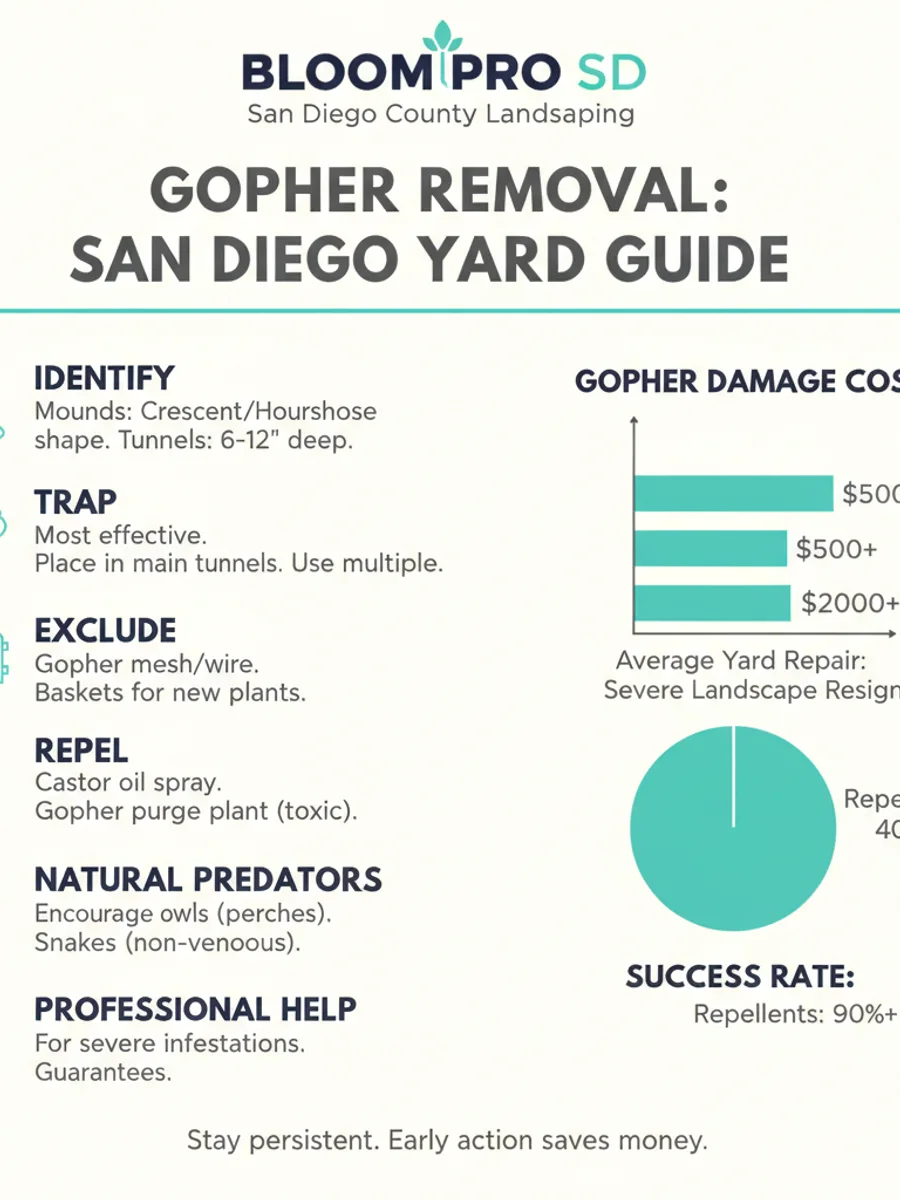
The fastest, most reliable way to get rid of gophers is to set traps directly in the main tunnel. Placed correctly, they produce results within one to three days. Waiting them out, flooding, or dropping repellents into holes rarely works. Gophers are territorial, so trapping the resident animal removes the problem at the source. Everything else is secondary.
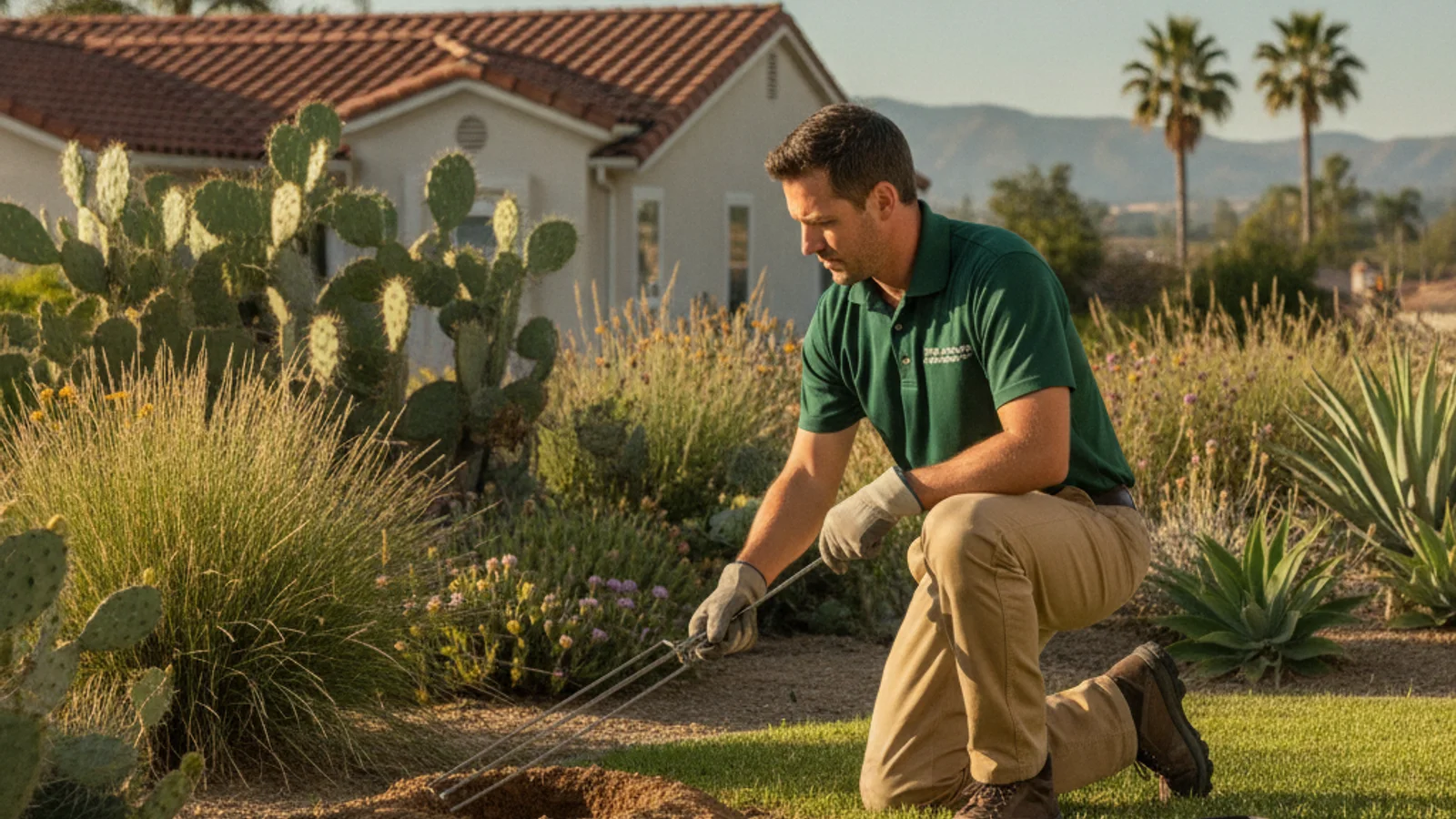
San Diego County has a lot of gopher pressure. The foothills from Escondido to Ramona, the slopes above La Jolla and Del Mar, the newer sod installs in Chula Vista and Santee. Gophers find all of it. The mild winters mean populations never crash hard, so if you have one active animal, there will be more.
How to tell it’s a gopher and not a mole or ground squirrel
Identifying the pest first saves you from setting the wrong trap or buying the wrong bait.
Gopher mounds are fan-shaped or crescent-shaped, usually 6 to 12 inches across, pushed up in a rough half-circle. The critical detail: there’s a plugged hole on one side of the mound where the gopher sealed the tunnel after it came up. The plug is a small, firm dirt cap, sometimes slightly offset from center. Gophers dig lateral tunnels 6 to 18 inches below the surface and rarely come above ground themselves, so you’ll see mounds but almost never the animal.
Mole mounds are more symmetrical, almost volcano-shaped, and the central hole is usually open or only lightly covered. Moles are much rarer in San Diego County than gophers. They eat grubs and worms, not roots, so plant damage points away from moles and toward gophers.
Ground squirrels are common across inland San Diego and look completely different. They dig open burrow holes at the soil surface with loose dirt scattered around the entrance. You’ll see the animal in daylight, usually near the burrow. Ground squirrels are handled under different California wildlife rules and typically need a pest control company rather than a landscaping fix.
If you’re finding wilted or missing plants, particularly newly installed drought-tolerant shrubs or vegetable starts that seem to get pulled underground overnight, that’s gopher feeding behavior. They sever roots from below and sometimes pull small plants straight down into their tunnels.
Trapping: the method that actually works
Trapping is the foundation of gopher control, whether you’re doing it yourself or hiring someone. Here’s how it works.
Find the main tunnel. Probe the soil 6 to 12 inches from the mound at roughly 45 degrees using a rod, screwdriver, or commercial gopher probe. You’ll feel the probe drop through the tunnel roof when you hit it. The main tunnel runs roughly horizontally, 6 to 18 inches down. The lateral feed tunnels that spur off it are smaller, so you want the main run.
Place two traps facing opposite directions in the main tunnel. Pincer-style traps (Macabee or Cinch are the most common) work well in sandy and loamy SD soils. Wire the traps to a stake above ground so you can retrieve them. Cover the hole loosely with a board or dark cloth to block light, since gophers are sensitive to light intrusion and may avoid an exposed opening.
Check every 24 hours. If nothing in 48 hours, relocate. Gophers often reroute, so check for fresh mound activity nearby.
Trapping is effective because it removes the actual animal. A single pocket gopher holds a territory of 200 to 2,000 square feet, so one successful trap often solves the current infestation. The harder challenge is preventing the next gopher from moving in.
Baits, flooding, repellents, and what’s worth your time
There are a lot of gopher-control products on the market. Here’s an honest look at what works and what doesn’t.
| Control method | What it is for | Best for |
|---|---|---|
| Trapping (Macabee/Cinch) | High | Active infestations, fastest results |
| Poison bait (zinc phosphide, diphacinone) | Moderate to high | Multiple animals, large areas |
| Underground exclusion wire | High (prevention) | New plantings, raised beds, slopes |
| Flooding tunnels with water | Low | Rarely effective alone |
| Vibrating stakes / ultrasonic | Low | Not reliable, often no effect |
| Castor oil / predator urine repellents | Low to moderate | May shift activity temporarily |
| Gopher-repellent plants (gopher spurge) | Low to moderate | Anecdotal, not a standalone fix |
Baits can be effective when placed directly in the tunnel system according to label directions. California-legal rodenticide baits require careful placement to protect raptors, pets, and non-target wildlife. If you’re not comfortable handling rodenticides, a licensed pest control company is the right call.
Flooding occasionally flushes a gopher from a single tunnel system but doesn’t work on an established network. Gophers can close off sections of tunnel and simply wait it out.
Repellents and deterrents may move a gopher’s activity to a different part of your yard, but they don’t remove the animal. They can be worth using temporarily while you set up permanent exclusion, but they’re not a solution on their own.
Protecting plants and new lawns with gopher exclusion
Removal fixes today’s problem. Exclusion prevents the next one.
Gopher wire (also called gopher baskets or hardware cloth) is the most durable long-term protection. The standard spec is half-inch galvanized hardware cloth or purpose-made gopher basket mesh. When planting new trees, shrubs, or perennials in gopher-prone areas, line the planting hole with a basket of wire before dropping the rootball in. For drought-tolerant landscaping installs in hillside or inland areas, this is worth doing on every significant plant.
For lawns, a wire barrier installed 12 to 18 inches below the sod prevents gophers from tunneling up through the root zone. It adds labor cost at sod installation time, but it’s far less expensive than replacing a new lawn that gophers destroy. Slopes above 15 degrees are particularly vulnerable because gophers prefer to tunnel along the slope rather than down it, which puts them right in the root zone of new plantings.
SD-specific risk zones for gopher damage:
- Sandy loam and decomposed granite soils (easy to tunnel), common in Poway, Santee, and east county
- New sod installs with freshly watered, loose soil
- Hillside landscaping in Del Mar, Rancho Santa Fe, and the foothills
- Vegetable gardens and raised beds anywhere in the county
If you’re doing lawn maintenance on a property that’s had prior gopher activity, install wire barriers during any major regrade or replanting project rather than treating it as an add-on later.
Repairing the damage gophers leave behind
After the gopher is gone, the yard still needs work. Gophers leave behind collapsed tunnels, dead patches where roots were severed, and disturbed soil that compacts unevenly.
Collapsed tunnels. Probe the area around former mounds and press down on soft spots to collapse remaining tunnel voids. Rake smooth, add topsoil if needed, and tamp firm. Leaving tunnel voids under a lawn creates sunken spots that trap water and kill grass above.
Dead patches. If roots were severed, the grass above that area is dead, not dormant. The tug test confirms it: dormant grass holds; dead grass pulls out by the handful. Our guide on reviving damaged lawns covers that diagnosis in detail. Dead patches need reseeding or resodding. Watering them won’t bring back what has no roots.
Bare soil. Freshly disturbed mound soil is an invitation for weeds, especially in late spring and fall when weed seeds are actively germinating in San Diego. Overseed bare spots quickly to out-compete weeds, or apply a pre-emergent if the area won’t be seeded.
Large active infestations that have been running for a season can leave a patchwork of damage across the whole lawn. At that scale, a full soil assessment and resod is often faster than trying to patch spot by spot. For context on what other San Diego lawn pests can layer on top of gopher damage, that overview covers grubs, chinch bugs, and sod webworms too.
If the gopher damage shows up as brown patches, a root cause check matters before assuming it’s gopher-related. Our breakdown of brown patch causes in San Diego lawns helps distinguish gopher severing from fungal, irrigation, and heat stress damage.
How Bloom Pro SD helps
The landscapers we connect you with across San Diego County handle the lawn-recovery side of gopher damage: collapsing tunnel voids, grading and topping damaged areas, reseeding or resodding dead patches, and installing gopher wire baskets when replanting shrubs or laying new sod.
For heavy active infestations, a wildlife or pest specialist traps the animals first. Once the activity stops, the crews we match you with come in to repair what’s left. They can also wire new planting holes as part of any drought-tolerant planting or sod install if you’re in a high-risk area.
If the damage is minor, the independent professional should say so. If it needs a walkthrough, they quote the repair.
Call (760) 400-6355 to get matched. Landscape repair after gopher damage is quoted by the independent professional. Pest control is a separate trade.
Frequently asked questions
How much does professional gopher control cost in San Diego?
Trapping or other control is priced by the pest or landscape contractor after seeing the activity. Lawn repair is a separate scope. Get an assessment before choosing reseeding or sod.
How fast does gopher trapping work?
Set correctly in the main tunnel, traps catch active gophers within 24 to 72 hours in most cases. If you’re seeing fresh mound activity daily, the animal is still moving. No new mounds after three to four days of trapping typically means the resident gopher is gone.
What’s the difference between a gopher and a mole in San Diego?
Gophers are herbivores that eat roots and bulbs, leaving fan-shaped mounds with a plugged hole on one side. They cause direct plant damage. Moles are insectivores that eat grubs and worms, leaving more symmetrical volcano-shaped mounds with an open center hole. Moles cause indirect damage by disrupting root zones while tunneling. Moles are less common than gophers in San Diego County. Ground squirrels, which are very common here, are a different animal entirely. They leave open burrow holes at ground level and are active above ground during the day.
Are gophers dangerous to pets or children?
Gophers rarely come above ground and don’t pose a direct bite risk to pets or people. The main hazard is secondary: poison baits left in tunnels can be accessed by dogs that dig, and collapsed tunnel voids are a trip and ankle hazard across the lawn. Keep dogs away from active baited areas and probe for tunnel voids before letting kids run the yard after an infestation.
What’s the best way to stop gophers from coming back?
Gopher wire exclusion is the most durable prevention. Half-inch hardware cloth buried 12 to 18 inches below new plantings and sod keeps tunneling animals from reaching roots. Beyond that, there’s no permanent repellent. Gopher populations in San Diego are stable year-round, so adjacent properties or open space nearby will always have pressure. The practical goal is protecting your plants with wire and trapping new arrivals quickly when fresh mounds appear.