You’ve decided the yard needs lighting. Now you want a real number before you call anyone. That’s a reasonable thing to want, and the answer isn’t “it depends”, it’s a range with clear drivers on each end.

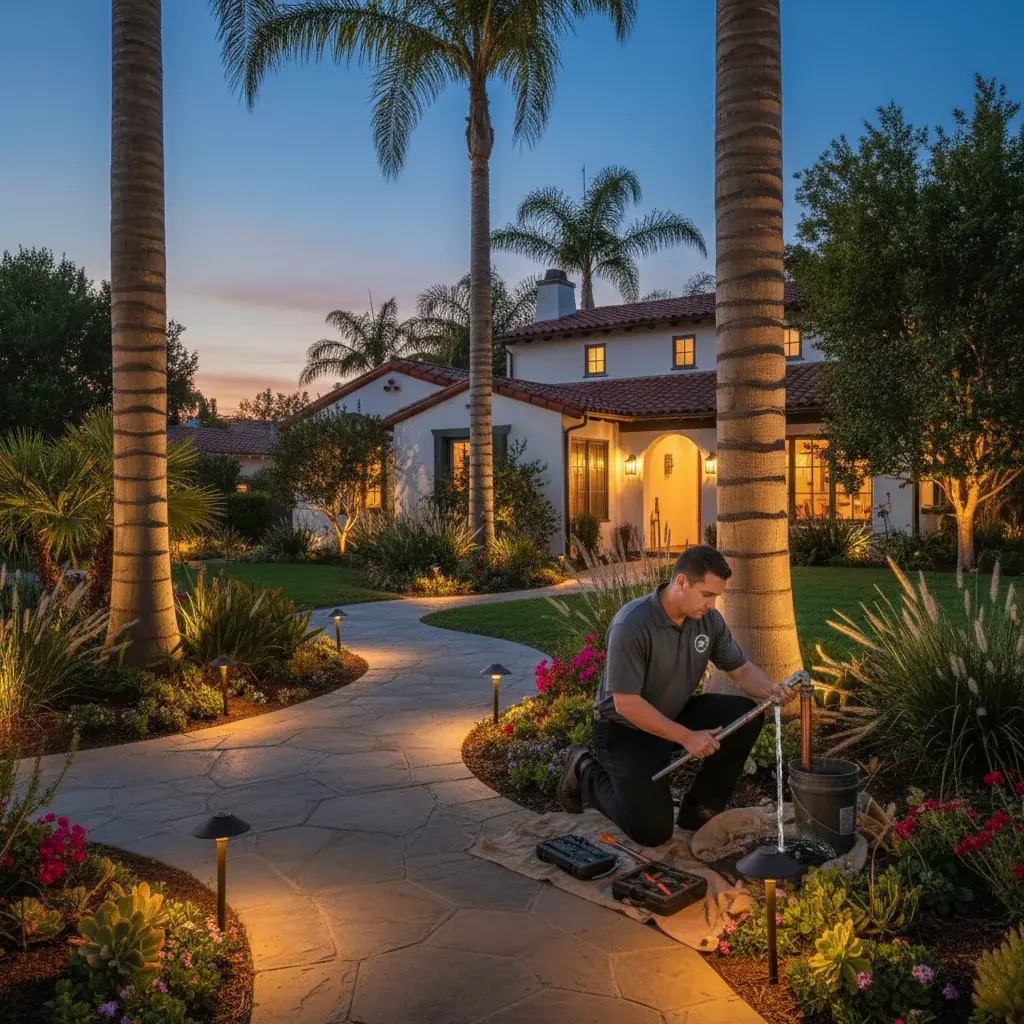
San Diego front yard at dusk with warm low-voltage LED path lights and uplights illuminating palm trees and a Spanish-style home

For most San Diego homes, a professionally installed low-voltage LED system lands between $1,800 and $6,500. Small front yard with eight path lights and a basic transformer: closer to $1,800. Full-property design with uplights, hardscape accents, smart controls, and conduit runs through existing planting beds: closer to $6,500 or above. Our landscape lighting installation service covers all of it, here’s what actually moves the number.

Per-fixture pricing and what it covers

Labor and materials together is the honest way to think about fixture cost. A single fixture installed, wire pulled, connection made, angle set, runs $85 to $200 per light depending on type and placement complexity.

That range covers:

  • The fixture itself (typically $20–$80 for quality brass or aluminum)
  • 10–15 feet of low-voltage wire run from the nearest connection point
  • The time to bury or conceal that wire
  • Aiming and testing at night

Cheap fixtures cost less upfront and more later. Plastic housings crack in San Diego’s UV exposure within two to three years. Brass and die-cast aluminum last 15-plus years in coastal and inland conditions alike. If a contractor quotes you $40 per fixture installed, ask what the housing material is.

Most residential projects involve 8 to 20 fixtures. An 8-fixture front yard install comes in around $800–$1,200 in fixture labor alone, not counting the transformer or any trenching.

Transformer sizing and why it matters for cost

The transformer is the hub of your system. It steps 120V household current down to 12V, protects the circuit, and, in modern installs, acts as the smart-home brain. Expect to spend $150 to $600 on the transformer itself, plus $150–$300 for installation.

Sizing matters. A 150-watt transformer running LED fixtures is usually fine for 8–12 lights. Scale to 20+ fixtures and you’re looking at a 300-watt unit minimum, or a multi-zone 600-watt transformer if the property has distinct lighting areas (front yard, back yard, pool deck).

Undersizing causes flickering, premature LED driver failure, and zones that dim inconsistently. Oversizing costs more upfront but gives you room to add fixtures later without buying new hardware.

Higher-end transformers from brands like VOLT, Kichler, and FX Luminaire include built-in timers, photocell sensors, and Wi-Fi modules. That circuitry costs $300–$600 for the transformer alone but eliminates the need for a separate smart controller add-on. If you’re planning to automate the system later, buying a capable transformer now is almost always cheaper than retrofitting one.

Path lights vs uplights vs hardscape lights: where the budget goes

Three landscape lighting fixtures on a workbench, bronze path light, brass uplight, and hardscape paver light with dimension labels

Not all fixtures are the same price to buy or to install. Here’s how the three most common types break down.

Path lights

$85–$130 installed per fixture. These are the mushroom-cap or bollard-style lights that line a walkway. Quickest to install, spike into the ground, connect the wire. Most homeowners want 6–12 of them. Budget $700–$1,500 for a well-lit front path.

Uplights

$120–$200 installed per fixture. Uplights sit at the base of a tree, wall, or architectural feature and aim upward. They’re more work: you’re often digging around existing root systems, setting the fixture low to the ground, and spending time at dusk adjusting the beam angle. San Diego yards with mature palms, oaks, or bougainvillea typically use 4–8 uplights. That’s $480–$1,600 for this fixture type alone.

Hardscape lights

$150–$250 installed per fixture. These are the step lights, wall-wash lights, and paver-inset lights that integrate into built surfaces. Installation is significantly more involved, you’re routing wire through retaining walls, cutting into pavers, or threading conduit through block columns. If your property has retaining walls or a stacked-stone patio (common in hillside neighborhoods like Tierrasanta or Rancho Penasquitos), budget for the premium here. Our team handles retaining walls and hardscaping alongside lighting, which simplifies the coordination when both scopes are happening at once.

For a deeper look at fixture selection and design principles, our landscape lighting guide for San Diego walks through beam angles, color temperatures, and layering techniques.

Wiring complexity: trenching, conduit, existing landscape

Wire runs are where estimates diverge most. A clean install on a freshly landscaped yard, open soil, no established root systems, beds not yet mulched, is fast. Existing mature landscaping is a different story.

Basic wire burial (no trenching): $0.50–$1.00 per linear foot. Installer uses a flat spade to create a narrow slot, tucks the wire 3–4 inches down, and closes it. Fine for most turf and mulch areas.

Trenching through hardscape or compacted soil: $3–$8 per linear foot. If wire needs to cross a concrete driveway, a flagstone path, or hard caliche soil common in East County neighborhoods, a saw cut or jackhammer is involved. A 20-foot driveway crossing can add $150–$300 to the quote by itself.

Conduit in high-traffic or code-required zones: adds $1.50–$3.00 per linear foot on top of labor. Under driveways and near pool equipment, conduit is effectively required for long-term reliability and may be required by your local inspector.

Navigating established planting: add 20–40% to labor estimates when beds are mature. Root systems, irrigation lines, and dense groundcover all slow the work. Always confirm that an estimate was written after a site visit, not over the phone.

Smart controllers and Wi-Fi add-ons in 2026

In 2026, most homeowners asking for landscape lighting also want some form of app control. The good news: it’s not expensive relative to the total project cost.

Photocell-only systems run lights dusk to dawn automatically with no app needed. This is built into most mid-range transformers and adds nothing to the cost.

Timer-based zones let you set different on/off schedules for front and back. Also standard on quality transformers, no add-on required.

Wi-Fi-enabled transformers (VOLT Genius, Kichler Connect, FX Luminaire LuxOR) add $150–$300 to transformer cost but give you full app control: dimming, scheduling, color temperature adjustment on compatible fixtures, and integration with Google Home or Amazon Alexa. Worth it if you already use a smart-home platform.

Third-party smart controllers like the Brilliance or Sylvania SMART+ hub can be retrofitted to existing transformers for $100–$200. These work, but native transformer integration is cleaner and more reliable.

Most projects we see are adding basic Wi-Fi control for $200–$350 total over a standard install. It’s one of the better dollar-per-convenience upgrades in the outdoor space.

Real project ranges: small front yard to full property

Here’s how those individual costs stack into real project totals.

Small front yard, 8 path lights, basic transformer, no trenching Fixtures: $800 | Transformer + install: $400 | Wire: $100 | Total: $1,200–$1,500

Medium front and side yard, 6 path lights, 4 uplights, 300W transformer, one driveway crossing Fixtures: $1,400 | Transformer + install: $500 | Wire + trenching: $350 | Total: $2,100–$2,800

Full property, front yard, backyard, pool deck, hardscape step lights, smart transformer Fixtures (18–24 mixed): $3,000–$4,200 | Transformer + smart controls: $800 | Wire, conduit, trenching: $600–$1,000 | Total: $4,500–$6,500

These ranges assume quality fixtures and a licensed contractor. California requires a C-10 (electrical) or C-27 (landscaping) license for this work. You can verify a contractor’s license before signing anything at the CSLB license lookup.

One more note: if your project is part of a larger yard renovation, pairing lighting with a landscape design and installation scope usually reduces overall labor cost, since the ground is already open.

When to call us

Low-voltage LED lighting is licensed work in California, and the transformer connection to your 120V panel should always be handled by someone with a C-10 or C-27 license. If you’re pricing a system, doing a site visit before writing numbers is the only way to quote accurately, any estimate built on square footage alone will miss trenching and wiring complexity entirely.

Call us at (760) 400-6355 for a same-day estimate.