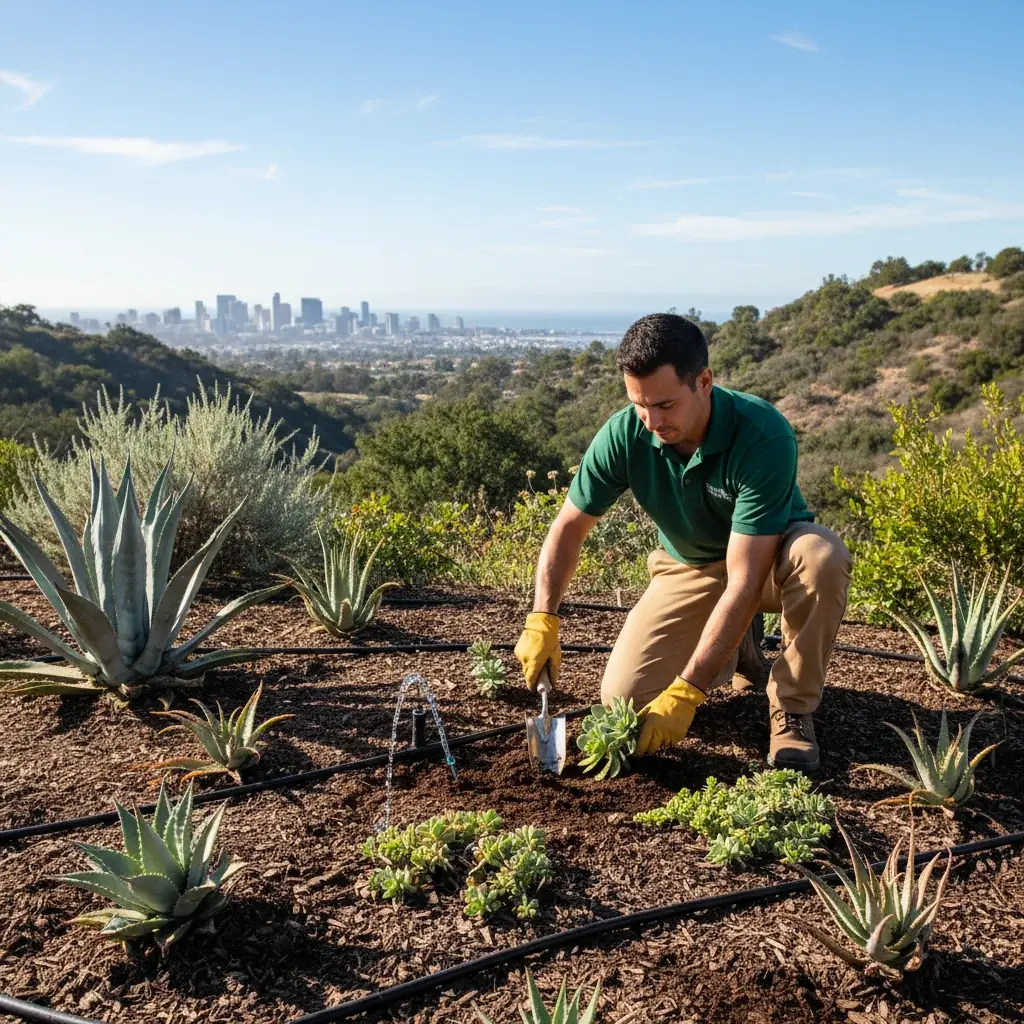
The best California native plants for San Diego include Coast Live Oak, Ceanothus, Toyon, Cleveland sage, Lemonade Berry, California fuchsia, and deergrass. These plants are indigenous to San Diego’s coastal chaparral and coastal sage scrub, so once established after roughly one full growing season, most need zero supplemental water from October through June and only a deep monthly soak, if anything, through July and September.
Native plants are a distinct category from generic drought-tolerant plants. Mediterranean shrubs like lavender or westringia are also low-water, but they don’t feed local bees, hummingbirds, and butterflies the way species that evolved here do. If you’ve been researching drought-tolerant plants for San Diego broadly, this guide focuses specifically on the native layer.
Why California natives are the right choice for San Diego
San Diego sits at the edge of one of the most biodiverse plant regions on the continent. Coastal sage scrub and chaparral communities here evolved over millennia to survive on seasonal rainfall that stops entirely in summer. The plants have deep root systems, waxy or silver-gray leaves that reflect heat, and bloom cycles timed to winter rains, not irrigation. They’re not just drought-tolerant; they’re drought-adapted.
Habitat and pollinator value. Ceanothus alone supports over 100 native bee species. Toyon berries feed cedar waxwings and hermit thrushes through winter. California fuchsia is one of the only plants in bloom when hummingbirds migrate through in fall. No non-native shrub, however well-adapted, carries that ecological load.
Water. SDCWA data shows San Diego households spend 50 to 70 percent of their outdoor water budget on ornamental landscaping. A correctly established native plant bed can cut that to nearly zero beyond the first year.
Fire-wise landscaping. Many California natives are naturally adapted to fire cycles. Ceanothus, manzanita, and toyon have fire-responsive seeds or resprout from root crowns. San Diego County’s defensible space requirements favor lower-fuel, water-retentive native groundcovers over dense ornamental plantings. See our drought-tolerant shrubs guide for plants that double as fire-resistant screening.
Rebates. Natives installed as part of a lawn conversion qualify for MWD turf replacement incentives currently running up to $3 per square foot removed. Use the Calscape tool at calscape.org to generate a native plant list specific to your ZIP code, then check sdcwa.org for current rebate availability before purchasing plants.
Native plant guide: trees, shrubs, and perennials for San Diego
“Water need” in this table is supplemental water required after full establishment, roughly 12 to 24 months for shrubs, 24 to 36 months for trees.
Native trees
| Tree | Sun | Water need | Mature size | Bloom / interest | SD note |
|---|---|---|---|---|---|
| Coast Live Oak (Quercus agrifolia) | Full / part | None after yr 3 | 30-70 ft × 30-70 ft | Acorns attract wildlife | Native to SD canyons and foothills; no summer water once roots reach groundwater |
| Western Redbud (Cercis occidentalis) | Full / part | Very low | 10-18 ft × 10 ft | Magenta, Feb-Mar | Brilliant late-winter bloom; best in inland SD (Lakeside, Ramona, Alpine) where it gets cold dormancy |
| Desert Willow (Chilopsis linearis) | Full | Very low | 15-25 ft × 15 ft | Pink/lavender, May-Sep | Not a true willow; long summer bloom period; thrives in inland heat |
| Toyon (Heteromeles arbutifolia) | Full / part | Very low | 6-15 ft × 8 ft | White, Jun-Jul; red berries, Nov-Feb | Thrives in coastal canyons and foothills; berries feed birds all winter |
Native shrubs
| Shrub | Sun | Water need | Mature size | Bloom | SD note |
|---|---|---|---|---|---|
| Ceanothus (C. ‘Concha’ / C. ‘Dark Star’) | Full | None after yr 2 | 4-8 ft × 6-8 ft | Blue/purple, Feb-Apr | Native to SD coastal sage scrub; top hummingbird and native bee plant in the county |
| Lemonade Berry (Rhus integrifolia) | Full / part | None after yr 2 | 8-15 ft × 10 ft | Pink clusters, Feb-Apr | Indigenous to SD coastal bluffs; holds slopes, tolerates salt spray in La Jolla and Encinitas |
| Manzanita (Arctostaphylos spp.) | Full | None after yr 2 | 3-6 ft × 4-6 ft | White/pink, Jan-Mar | ’Howard McMinn’ and ‘Dr. Hurd’ perform well in Rancho Santa Fe and El Cajon inland |
| Coffeeberry (Frangula californica) | Full / part | Very low | 4-8 ft × 5 ft | Inconspicuous; berries ripen Jul-Nov | One of the few natives that tolerates afternoon shade; good under large oaks |
| Cleveland Sage (Salvia clevelandii) | Full | Very low | 3-5 ft × 4 ft | Purple, Apr-Jun | Native to SD foothills; the most versatile all-zone native shrub in the county |
Native perennials and groundcovers
| Plant | Sun | Water need | Mature size | Bloom | SD note |
|---|---|---|---|---|---|
| California Fuchsia (Epilobium canum) | Full | Very low | 1-3 ft × 4 ft | Red, Aug-Nov | Blooms when almost nothing else does; critical fall hummingbird food source |
| Coyote Bush (Baccharis pilularis) | Full | None after yr 2 | 1-3 ft spreading | White, fall | One of the fastest-spreading native groundcovers; excellent for SD slopes |
| Deergrass (Muhlenbergia rigens) | Full / part | Very low | 3-4 ft × 3 ft | Tan plumes, summer | Year-round structure; tolerates both coastal and inland conditions |
| White Sage (Salvia apiana) | Full | None after yr 2 | 3-5 ft × 4 ft | White, May-Jul | Slow to establish but almost zero water once rooted; alkaline-soil tolerant |
Coastal vs. inland natives: what changes
San Diego’s 30-mile depth from ocean to foothills spans several distinct microclimates. Matching the plant to the zone is more important with natives than with more adaptable non-native choices.
Coastal strip (La Jolla, Del Mar, Encinitas, Carlsbad, Oceanside): Fog moderation keeps summers mild but soils are often sandy and salt-laden. Lemonade Berry and coyote bush are genuine natives here and handle salt spray that kills many other species. Ceanothus ‘Concha’ and California fuchsia also do well. Avoid white sage close to the coast; it prefers the lower-humidity inland conditions where it naturally grows in SD’s foothills.
Inland valleys and foothills (El Cajon, Santee, Lakeside, Ramona, Alpine): Hotter summers and occasional freezes below 28°F. Western Redbud performs best here because it needs some winter chilling for a full bloom. Desert Willow thrives in the heat. Manzanita ‘Howard McMinn’ is especially suited to the drier, better-drained soils in these zones.
Mid-county canyons and hillsides (Escondido, San Marcos, Poway, Rancho Bernardo): Native oaks are the right canopy anchor for canyon-adjacent properties. Coast Live Oak resprouts after fire and needs no summer water once its roots reach soil depth. Coffeeberry is one of the best understory choices under existing oak canopy because it tolerates the dry summer shade an established oak creates.
For a broader look at native and drought-adapted trees, see our drought-tolerant trees guide for San Diego.
Establishing California natives: the right first year matters most
The common mistake with native plants is treating them like conventional landscaping during establishment. Over-watering is the leading cause of native plant failure in San Diego gardens, not drought.
Year one establishment schedule:
- Weeks 1 to 4: water every 3 to 4 days, deep and slow (30 to 45 minutes via drip)
- Months 2 to 4: water every 7 to 10 days
- Months 5 to 12: water every 10 to 14 days in summer, every 3 to 4 weeks in winter
- Year 2 onward: most shrubs need only a deep monthly soak in July and August, nothing from October through May
Plant from October through February whenever possible. The rainy season does most of the establishment work for you. Plants put in during May or June face their first summer in peak heat with shallow roots, and they need 2 to 3 times as much supplemental water to survive.
Mulch matters more with natives than with any other plant type. A 3-inch layer of wood chip mulch over the root zone holds soil moisture between waterings, moderates soil temperature, and suppresses weeds that compete with natives during establishment. Do not let mulch touch the crown of the plant.
For slope-specific planting, coyote bush and ceanothus groundcover types root deeply and stabilize grades over 20 percent. See our groundcovers for San Diego slopes guide for planting depth and spacing on steep banks.
Where to find California natives locally and how Calscape helps
Calscape (calscape.org) is the most useful tool for San Diego native plant selection. Enter your ZIP code and it returns a ranked list of plants native to your specific area, with notes on sun, water, size, and wildlife value. It cross-references CNPS (California Native Plant Society) data and is updated regularly. Use it before purchasing plants to confirm a species is genuinely native to your county, not just California broadly.
San Diego has several specialty nurseries that stock true locals. Theodore Payne Foundation’s annual plant sales, Water Conservation Garden at Cuyamaca College, and several local native plant nurseries in the county carry species you won’t find at general garden centers. Many also stock provenance-appropriate seed stock, which establishes more successfully than generic California material grown elsewhere.
One practical note: natives from general nurseries are sometimes grown from seed sources outside San Diego County. Plants from local genotypes establish faster and are better adapted to local pests. It’s worth asking the nursery about seed source if you’re planting a large area.
Rebate documentation. If you’re replacing turf with a native plant bed, document the before-state with photos and save all plant receipts. MWD and SDCWA rebate applications require both. Our drought-tolerant landscaping service includes rebate paperwork support on every qualifying conversion.
Frequently asked questions
What California native plants grow well in San Diego?
Ceanothus, Cleveland sage, Lemonade Berry, Toyon, and Coast Live Oak are the most reliable California natives for San Diego. All are indigenous to San Diego County’s coastal chaparral or sage scrub communities, so they’re already adapted to alkaline soils, winter rain, and dry summers. California fuchsia and deergrass perform well across most zones. The Calscape tool at calscape.org generates a native list specific to your ZIP code.
Do California native plants really need no summer water?
Established California natives need little to no summer water, but the first 12 to 18 months require consistent deep watering to build root systems. Shrubs like ceanothus and white sage typically need only a monthly deep soak through their second summer, then nothing from October through June. Trees take longer, usually two to three seasons before they’re fully self-sufficient. Over-watering during this window does more damage than under-watering.
What are the best native trees for San Diego?
Coast Live Oak is the top native tree for San Diego, with Toyon and Desert Willow as the best mid-size options. Coast Live Oak provides year-round shade, supports hundreds of wildlife species, and needs no irrigation once established. Western Redbud is the best choice for a smaller tree with a dramatic bloom in inland SD areas like Lakeside and Ramona.
Do California native plants qualify for San Diego water rebates?
Yes, many California natives qualify for SDCWA WaterSmart and MWD turf replacement rebates when installed as part of a lawn conversion. Ceanothus, Lemonade Berry, Cleveland sage, and deergrass have historically appeared on the approved plant lists. Rebate programs open and close seasonally, so check current availability at sdcwa.org before purchasing. Save all plant receipts and before-photos for the application.
How is a California native plant different from a drought-tolerant plant?
All California natives are drought-tolerant, but not all drought-tolerant plants are California natives. Mediterranean shrubs like lavender and rosemary are low-water but were not part of San Diego’s original plant communities. The practical difference is ecological: native plants support local birds, insects, and pollinators far more effectively than non-natives because they co-evolved with the local fauna. For rebate purposes, some programs prioritize or require CA natives specifically.
Where can I find California native plants for sale in San Diego?
Calscape.org lists nurseries that stock natives by region, and the Water Conservation Garden at Cuyamaca College holds native plant sales seasonally. Several local specialty nurseries carry provenance-correct plants grown from San Diego County seed stock, which establish faster than generic California material. Ask the nursery about seed source when buying for a large planting area.
When to call us
Selecting the right natives for your specific zone, soil, and sun exposure takes a site walk. What works in Encinitas coastal fog behaves differently in Santee heat, and what thrives under a canyon oak won’t work in a full-sun front yard. We design and install native plant landscapes across all of San Diego County and handle MWD turf rebate paperwork as part of every qualifying conversion.
If the native planting is part of a full redesign, our landscape design service starts with a scaled plan and irrigation zoning. Already have the plant list and need installation? We work with native gardens at any scale.
Call us at (760) 400-6355 for a same-day estimate.