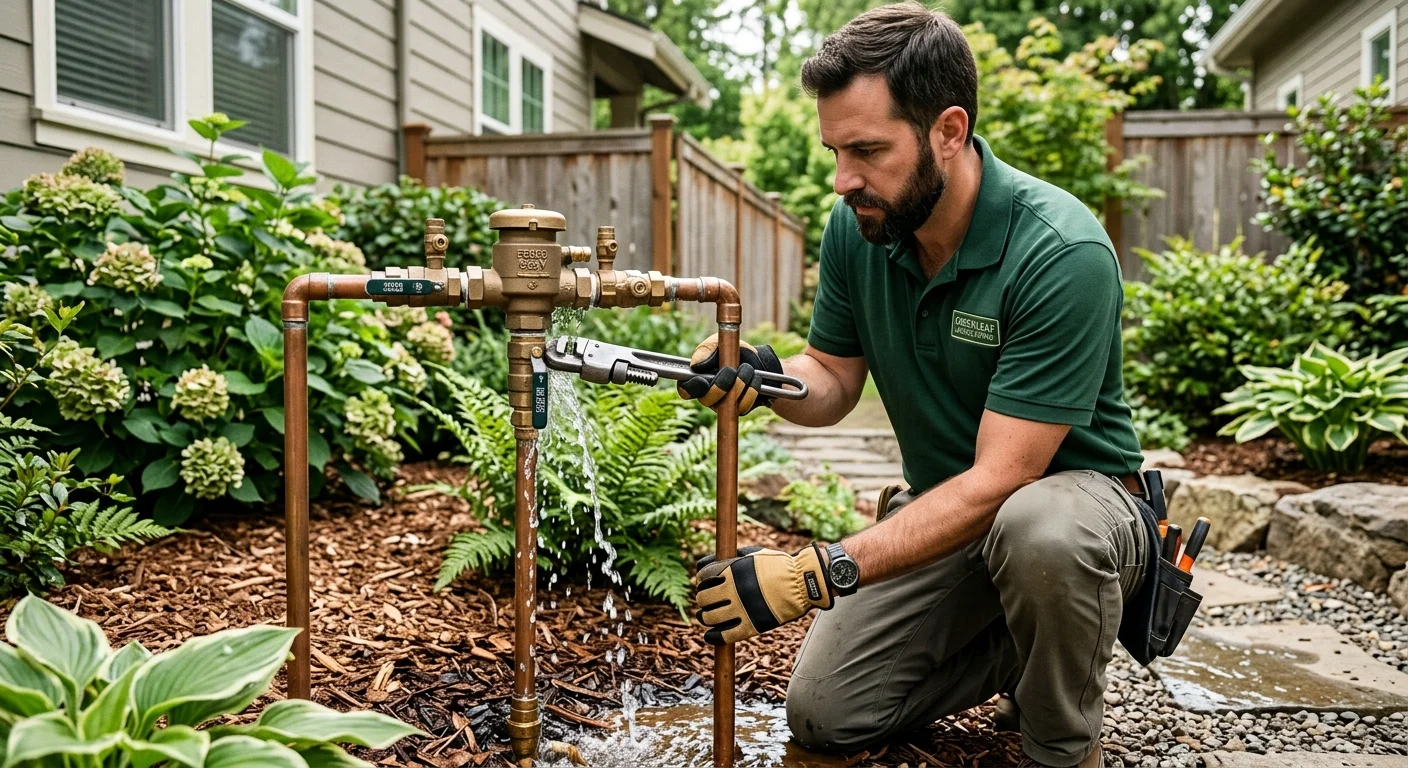
Water around a backflow assembly is a symptom, not a complete diagnosis. The source could be on the device, at a nearby connection, or elsewhere along the irrigation line. Document where the water appears and when it starts before anyone opens the assembly.
This guide stays focused on visible clues. Bloom Pro SD’s approved research doesn’t contain a verified pressure target, test procedure, repair sequence, or local backflow rule. Those details must be confirmed for your property by the appropriate water agency and licensed professional.
Where does a backflow preventer fit in an irrigation system?
Start by confirming which assembly you’re looking at. Don’t assume every exposed pipe, valve, or brass fitting beside the house is an irrigation backflow preventer. Take one photo of the entire setup, then closer photos of labels and wet areas.
Trace only the visible route without loosening or removing anything. Note whether the assembly appears near the water service, irrigation valves, controller wiring, hose connections, or a valve box. These landmarks help a contractor understand how the suspected device relates to the sprinkler system.
The property’s jurisdiction and water provider also belong in your notes. San Diego County includes the central city, coastal communities, inland areas, East County, and the South Bay. A rule published for one service area shouldn’t be treated as a countywide rule.
For example, the City of San Diego’s permanent water-use restrictions apply within its Public Utilities Department service area. Properties served by another agency may follow different requirements. Check the water bill for the provider before relying on a city webpage.
A contractor may also need to determine whether the wet component belongs to the irrigation side or another part of the water system. That distinction affects who should handle it. Our sprinkler and irrigation repair referral service connects homeowners with licensed independent landscaping pros, but Bloom Pro SD doesn’t diagnose or repair the assembly.
What clues show water is coming from the device?
The strongest clue is the precise exit point. “The area is wet” leaves several possible paths. “Water appears at the top fitting while the sprinklers run” gives the contractor a much clearer starting point.
Watch from a safe distance without taking the assembly apart. Record whether water appears:
- While every irrigation program is off
- When a particular sprinkler zone begins
- During more than one zone
- Immediately after irrigation stops
- At a fitting, valve, opening, or damaged-looking surface
- From the soil beside the assembly rather than the assembly itself
- Near a valve box, wall, walkway, or electrical equipment
Timing matters because two leaks can collect in the same low spot. Water can also travel across paving or along disturbed soil before becoming visible. A close photo of the puddle alone may hide that context. Include the surrounding bed, wall, valve box, and visible pipe route.
Look for a separate wet trail leading toward buried irrigation piping. If the assembly looks dry but the nearby ground stays saturated, the source may need broader sprinkler system leak detection. If water collects inside a box, compare those symptoms with our guide to an irrigation valve box filling with water.
Don’t describe the leak as “high pressure” based only on sound or spray. Pressure needs proper testing, and the approved claims ledger doesn’t provide a verified target range. Report what you can see instead: steady flow, pulsing water, mist, dripping, or water that appears only during a programmed cycle.
How do pressure, valves, and worn parts change the diagnosis?
Pressure, valve operation, connections, and component condition are possible parts of the diagnosis. A visual symptom doesn’t prove which one is responsible. Several conditions can produce water in nearly the same place.
Tell the contractor whether the pattern changes when irrigation starts or stops. Water that appears during one zone gives different evidence than water present while the controller is idle. If the symptom began after valve work, controller changes, digging, or landscaping near the line, include that history without declaring it the cause.
Nearby irrigation valves deserve separate attention. A valve problem can coincide with wet ground near another component. It can also create symptoms that homeowners describe as a sprinkler backflow problem. Our guide to sprinkler valve problems explains what observations to collect around that part of the system.
Visible condition matters too. Photograph any split-looking surface, loose-looking connection, corrosion, missing cover, or damaged surrounding pipe. Don’t tighten, plug, cap, or bypass a component based on appearance alone. A licensed professional should identify the part and decide what work falls within the proper trade.
Avoid internet instructions built around one pictured device. Your assembly may not match that model or arrangement. Bloom Pro SD’s verified ledger contains no approved device-specific disassembly steps, pressure settings, replacement intervals, or claims about which internal part commonly fails.
That gap is intentional. A made-up specification can turn a useful symptom check into a bad repair decision. Use the photographs, timing, controller status, and property information to help the matched contractor narrow the source.
When should you stop troubleshooting and call a contractor?
Stop at observation when you can’t identify the source without opening, adjusting, or bypassing the assembly. The same applies when water keeps flowing with irrigation off, spreads toward a structure, reaches a walking surface, or appears near electrical equipment.
Don’t keep running irrigation solely to recreate a large leak. Note the last known controller setting and which zone was active. If you’re confident using the controller, leave it off until the professional advises otherwise. Don’t dismantle plumbing or make an improvised cap.
City rules can also affect how quickly a known leak needs attention. Within the City of San Diego Public Utilities service area, permanent restrictions require water leaks to be repaired or stopped within 72 hours of discovery or city notification. Those rules also prohibit irrigation runoff onto adjacent property, non-irrigated areas, walkways, roadways, parking lots, or structures. Confirm that the property is actually within that service area before applying those requirements.
Other San Diego County water agencies may publish different directions. Check the provider shown on the water bill and use its official website. No countywide backflow repair deadline or permit rule was confirmed in the approved ledger for this article.
When hiring, verify the professional’s current status through the official CSLB license check. Ask whether the observed component falls within that contractor’s scope. If it doesn’t, ask which licensed trade or water-agency contact should handle the next step.
What should you report before requesting a match?
A useful intake report is short, specific, and based on observation. Start with the property address, water provider, and location of the suspected irrigation backflow preventer. “North side yard beside the garage” is more helpful than “outside.”
Then describe the leak in plain language. Include:
- The exact point where water first becomes visible
- Whether it drips, pulses, sprays, or flows steadily
- Whether it appears with irrigation off
- The zone running when the symptom appears
- The date you first noticed it
- Any recent irrigation, digging, planting, or controller work
- Whether a nearby valve box is wet
- Whether water reaches paving, neighboring property, or a structure
- Any label or model information visible without removing parts
Send one wide photo and several close views. A short video can show timing and flow more clearly than a still image. Don’t crop out nearby pipes, valves, walls, or ground conditions.
Mention any action already taken. Tell the contractor if you changed the controller, stopped an irrigation program, or contacted the water provider. That prevents repeated steps and gives the professional a clearer picture of the current condition.
Don’t guess at pressure, internal damage, or code compliance. Those conclusions require information this article can’t confirm. You can also review common sprinkler leak clues in San Diego before calling, especially when the visible water may be coming from buried piping.
Bloom Pro SD will take these details and match you with a licensed independent local landscaping professional. The contractor will confirm the scope and price with you before work starts. You contract with and pay that professional directly.
When to call us
If water keeps escaping, reaches a walking surface, or the source isn’t clear, the job needs a licensed landscaping pro. Bloom Pro SD handles intake and referral, while you contract with the independent professional directly. Call us at (760) 400-6355 and we’ll match you with a licensed local pro.