A Poway yard cooks through summer, sheds water down granite slopes, and often sits under an HOA packet before a single plant goes in. Searching landscaping Poway is a site problem first: heat, grade, water agency, and architectural rules. Get those four right, then the crews we send can design a yard that holds up east of I-15.
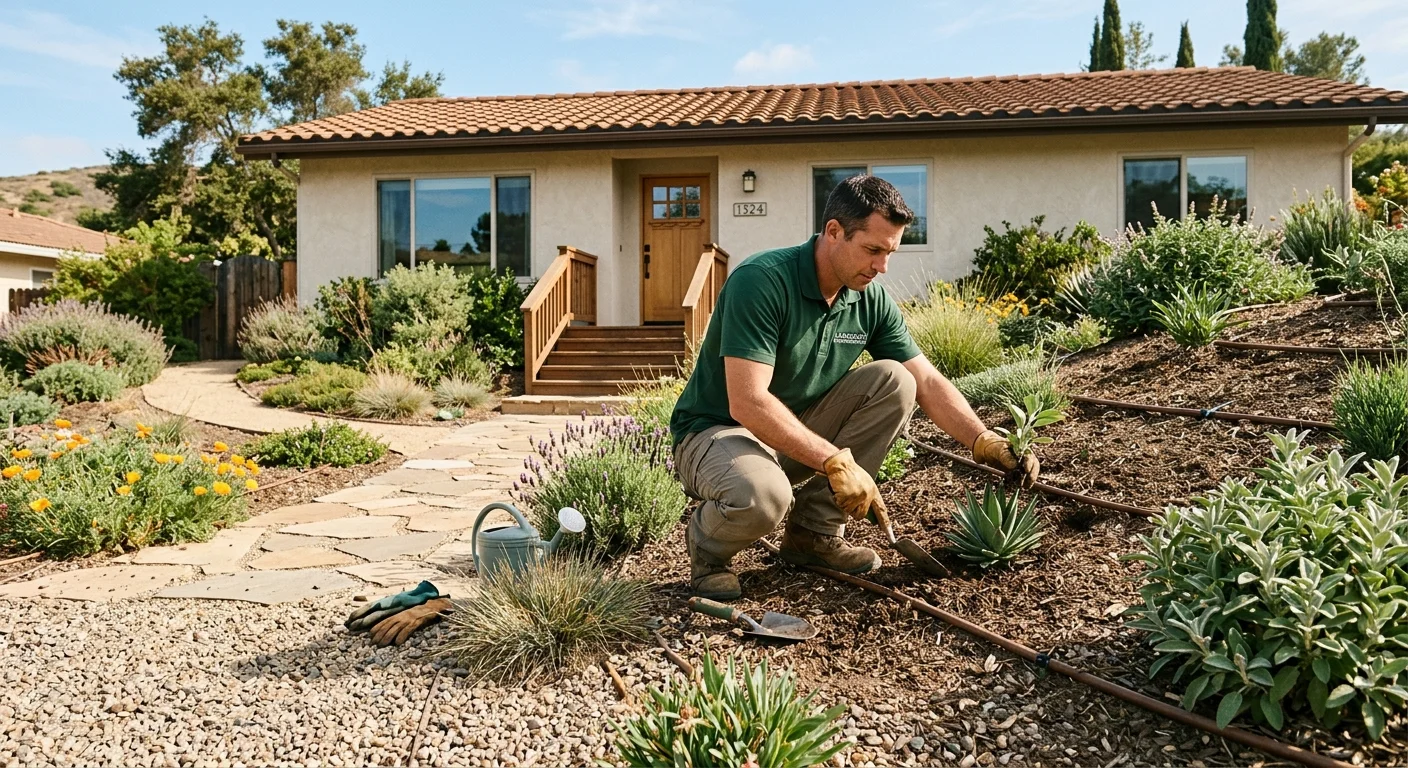
How Poway heat and slopes differ from the coast
Poway sits in inland North County, up Pomerado, Espola, and Poway Road, with Lake Poway and Blue Sky Ecological Reserve on the wildland edge. Marine layer burns off earlier here than it does in Encinitas or Carlsbad. Afternoon sun stays on west-facing banks. Cool-season turf and thirsty annual color that look fine near the bluffs stress hard on a Twin Peaks or Green Valley lot.
The ground is part of the story. A lot of Poway sits on decomposed granite, clay pockets, and rock close to the surface. Water either sheets off a cut slope or sits in a compacted pad. Coastal sandy soils drain; inland fill can crust. Planting holes, drip layout, and any patio base have to respect that, or the first hot week shows the miss.
Slopes are common on Old Coach, Stoneridge, and the canyons that drop toward Sycamore. A modest front grade still needs a path that doesn’t wash, planting that roots into the bank, and irrigation that doesn’t run downhill into the gutter. Steeper cuts may need walls or terraces. City of San Diego retaining-wall bulletins do not govern inside Poway. Ask City of Poway Development Services what height, surcharge, and engineering trigger a permit on your address.
Escondido is inland too, and it is a different heat pattern. Escondido’s valley floor holds more still, orchard-style heat. Poway mixes tract lots with larger “city in the country” parcels and more grade. If you want that valley comparison in one place, read landscaping in Escondido. For shade, hardscape, and summer-use ideas that fit inland yards in general, see inland San Diego backyard ideas.
Evening use matters on these lots. A slope and a dark entry need lighting that reads the grade, not a coastal flat pad. The existing guide to landscape lighting in Poway covers path and entry light on this same inland pattern.
How HOA rules and lot size change the plan
Many Poway streets sit in planned communities with architectural review. The CC&Rs can limit turf conversion, rock color, fence height, tree species, and visible drip hardware. A plan that fits City of Poway rules can still fail the HOA. Pull the design guidelines before the contractor draws a plant list. Ask for the submittal checklist, the meeting calendar, and whether a turf-to-mulch change needs a plot plan.
Lot size changes the work as much as the HOA does. A compact tract yard off Community Road is a planting-and-irrigation job. A half-acre bank off Espola is grading, access, and water zones. Large lots also sit closer to chaparral. If the parcel is in a State Responsibility Area or a locally mapped high fire hazard zone, California Public Resources Code 4291 calls for 100 feet of defensible space where the lot allows it. CAL FIRE’s Zone 0 is the first 5 feet from structures (ember-resistant). Zone 1 runs to 30 feet (lean, clean, and green). Zone 2 runs from 30 to 100 feet (reduce fuel). Confirm the map with the City of Poway Fire Department or CAL FIRE. Do not treat a plant list as “fire-proof.” The statute is about spacing and dead-fuel maintenance.
Front yards carry the HOA’s eye. Back yards carry heat, play, and drainage. Keep those as separate scopes on the bid so a reviewer can stamp the street face without freezing the private yard.
Hourly talk shows up in every Poway bid conversation. Published neighborhood notes on this site put install-crew labor around $55 per hour inland (Lakeside) and around $95 per hour in Rancho Santa Fe. Those are market notes, not a Bloom Pro SD price list. A $100-per-hour line can sit near the high end of that published band, or it can be a one-person specialist rate. It is not a verdict by itself. What matters is the written scope: demolition, grade, irrigation, planting, and who pulls any permit. The contractor you hire confirms the price with you before work starts.
Match planting, irrigation, and hardscape to the site
Start with water, then plants, then stone. Drought-tolerant landscaping is the default for most Poway lots because summer demand is high and slopes waste spray. UC Master Gardeners of San Diego County note that California native plants need minimum water and little or no fertilizer once established. Warm-season grasses (bermuda, zoysia) need about 25% less water than cool-season types. That 25% figure compares grass to grass, not natives to turf. Nothing in the yard is drought-proof. Establishment water still matters.
Low-maintenance plantings here are usually natives, Mediterranean shrubs, and groundcovers that take heat once roots are in. Group by water need. Put thirsty color, if you keep any, in a small, drip-fed bed you can see from the hose bib. Keep spray off slopes and off the house. Convert overhead spray to drip, micro-spray, bubblers, or rotating nozzles on rehab work. EPA WaterSense is a clean place to check controller and nozzle labels.
A design habit people call the “rule of 3” is grouping plants in odd numbers so beds look planted, not lined up. That is taste, not code. The rebate rule that actually binds a turf conversion is different: SoCal Water$mart requires at least three plants per 100 square feet of project area. Existing trees that remain count. The program also requires a stormwater feature (rain garden, rock garden, dry river bed, swale, berm, rain barrel, or cistern), a surface that stays permeable to air and water, and approval to proceed before any turf is removed. Dead turf and bare dirt do not qualify. Synthetic turf is not an approved conversion. Check those rules on the SoCal Water$mart turf program page, and run your Poway address through the rebate estimator. Metropolitan Water District’s residential rate is $2.00 per square foot of removed turf, up to 5,000 square feet per household per year. Local water agencies may add a top-up. Amounts change with funding.
Kurapia is one lawn alternative some inland lots use. The grower specifies plugs 12 to 15 inches on center, and that spacing can fill in within about two months in warm weather. Confirm the HOA will accept it before you order plugs.
Hardscape should work with the slope. Permeable paths, a compact paved entry, and walls only where the grade needs them. Concrete cannot replace turf in a rebate project. Broken-concrete paths with sand filler can. Patio covers, gas lines, and fire features each have their own permit path. City of San Diego fireplace and recreational-fire rules do not automatically apply in Poway. Ask Poway Development Services and the fire department for the local setback and fuel rules.
A licensed C-27 landscape contractor is the right classification for work that improves grounds aesthetically, horticulturally, or functionally. In California, landscaping with an aggregate contract price of $1,000 or more generally requires a licensed contractor (Business and Professions Code section 7048, as amended effective January 1, 2026). Verify any license on the CSLB lookup.
Which permit and water-provider questions to confirm
Write these down before anyone prices the job.
Water agency. Poway addresses sit outside the City of San Diego Public Utilities service area. The city’s year-round watering hours (potable irrigation only before 10:00 AM or after 6:00 PM, and no watering during or within 48 hours after measurable rain) apply inside that city system. They do not automatically bind a Poway meter. Read the agency on your bill, then confirm outdoor watering rules on the City of Poway water pages. A specific Poway watering-day calendar was not confirmed in the approved claims ledger for this site. Treat the bill and the city’s current notice as the authority.
Rebates. Ask whether the lot is eligible for the SoCal Water$mart turf replacement and weather-based controller programs. Controller rebates start at $80 per controller for landscapes under 1 acre, or $35 per station over 1 acre, and they apply only to active stations. Amounts vary by agency and funding.
Landscape ordinance. California local agencies must adopt the Model Water Efficient Landscape Ordinance or an equivalent local ordinance. Specific square-footage triggers and water-budget percentages were not verified in the claims ledger. Ask City of Poway whether your new or rehabilitated landscape needs a water-efficient landscape review, and get that answer in writing.
Grading and walls. Confirm retaining-wall height measurement (top of footing to top of wall is the usual method in nearby jurisdictions), surcharge from a driveway, and whether a California-licensed engineer is required. Do not import a City of San Diego or unincorporated-county number onto a Poway permit.
HOA and lighting. If the association reviews exterior lights, include fixture style and shield direction in the same packet as the planting plan.
MWELO paperwork, rebate photos, and HOA boards all want a drawn plan. That is landscape design work, not a plant-store sketch.
What to share before requesting a contractor match
We match you with a licensed independent pro. The homeowner contracts with that pro and pays that pro. A clear intake keeps the match honest.
Send the street address and whether the lot is on a slope. Note sun: west bank, boxed courtyard, or oak shade. Photograph the meter, backflow, and controller. Photograph the HOA cover sheet if you have one. Mark what you want to keep (tree, wall, play lawn) and what you want gone (thirsty turf, failing spray heads). If fire maps or a defensible-space letter already exist, attach them.
Say whether you want a turf rebate path. That choice bans synthetic turf in the converted area and locks in plant density, drip, and a stormwater feature. Say whether you need evening lighting on the slope. Say if a wall, patio, or gas line is in the wish list, so the pro we send can tell you which Poway permits sit with that scope.
Keep the first call about the lot, not a number you saw online. Crew rates move with access, rock, and haul-off. Weekly mowing on a small lot is a different product from a full redesign. Published notes on this site put weekly lawn service on lots under 1,500 square feet around $120-$180 per month. That band is for ongoing mow work. It does not price a Poway rebuild.
What are some low-maintenance landscaping plants for Poway?
Choose plants that take inland heat with drip once established. California natives, from the UC Master Gardener Program of San Diego County, are the usual starting list because they need minimum water and little or no fertilizer. Pair them with a mulched surface and grouped hydrozones. Skip “drought-proof” claims. Confirm any species against your HOA list and against defensible-space spacing near the house.
Is $100 an hour too much for landscape work?
It depends on the crew, the rock, and what is in the hour. Published neighborhood figures on this site show inland install labor around $55 per hour and Rancho Santa Fe around $95 per hour. A $100 line can be high for simple planting on an open pad, and it can be ordinary for a small specialized crew on a walled slope. Ask for a written scope and a confirmed price before work starts. Bloom Pro SD does not set contractor rates.
Where can I find landscape design services in San Diego County?
Call Bloom Pro SD. We serve Poway and the rest of San Diego County’s cities on the service list, and we match you with licensed, insured independent landscaping professionals. For design-and-install scope, start on our landscape design page. Check the contractor’s C-27 status on the CSLB site before you sign.
What is the rule of 3 in landscaping?
Designers often plant in threes (or other odd counts) so a bed looks composed. That is a visual habit. For a Poway turf rebate, the binding “three” is three plants per 100 square feet of converted area, plus the stormwater and permeability rules on the SoCal Water$mart page.
When to call us
Call when the Poway lot needs a licensed landscaping pro for design, drought-tolerant planting, irrigation conversion, slope work, or an HOA-ready plan. Call us at (760) 400-6355 and we’ll match you with a licensed local pro.