Mulch that keeps sliding onto a Chula Vista sidewalk is usually a bed with no real edge. Plastic landscape edging is the strip people search for when they want that line held without a mason. It can do that job on a shallow, curved bed. Heat, UV, and irrigation decide whether it still looks like a line after one inland summer.
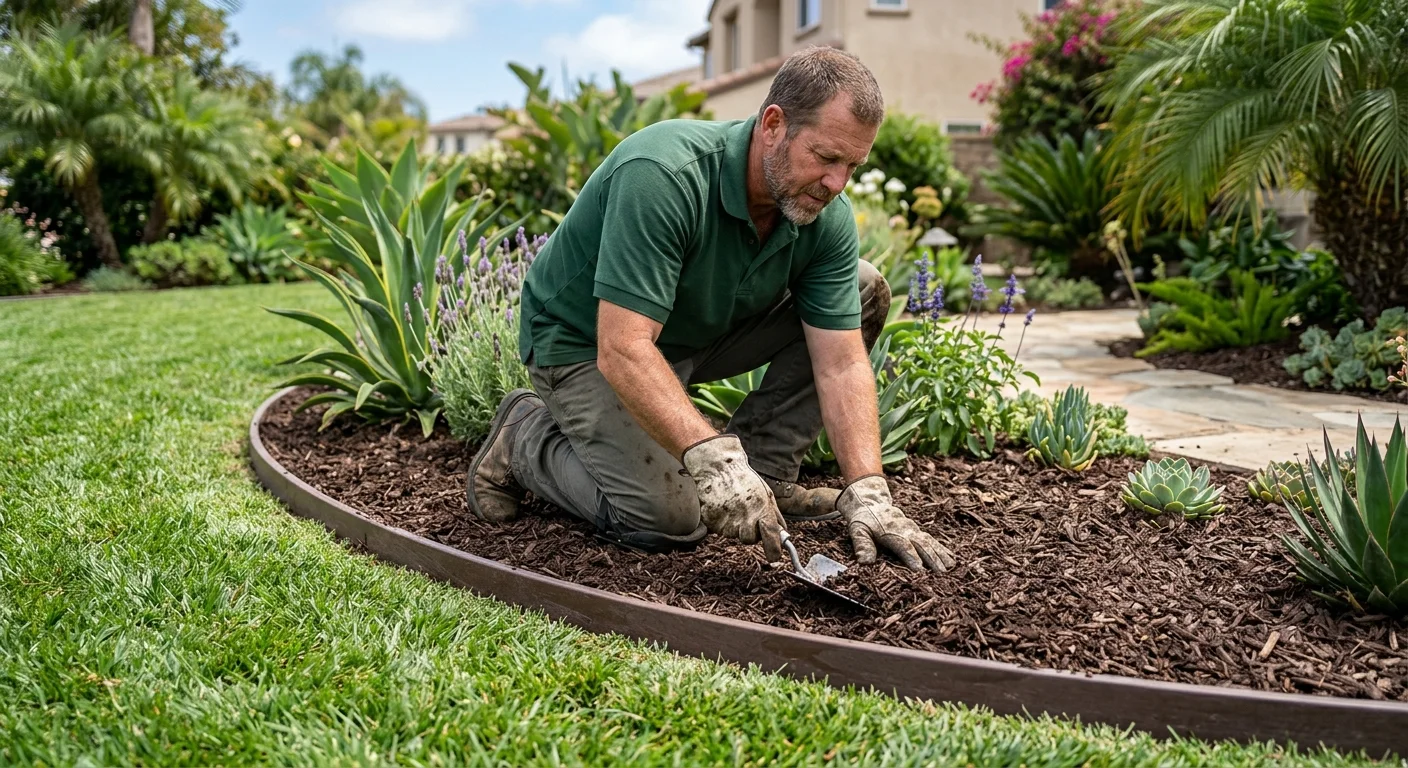
Where plastic edging helps in a San Diego yard
Plastic landscape edging is a flexible strip that keeps soil, mulch, or gravel on one side and lawn on the other. Coastal lots from Imperial Beach through Encinitas often want that thin line to follow a curve. Coil and interlocking sections bend around a bird-of-paradise clump or a decomposed-granite path. That is the honest use: a light bed, a mowable lawn edge, a mulch dam that stops bark from washing onto concrete.
Inland yards in El Cajon, Santee, Escondido, and Poway ask for the same landscaping border plastic for a different reason. They want a fast border on a small bed. The climate is harder on the strip there. Full sun on a west wall in Lakeside is not a marine-layer morning in Solana Beach. South Bay clay in Chula Vista and National City holds water after a winter storm. A shallow plastic lip can pond against the turf if the grade is wrong.
East County lots near Alpine and Ramona sit in fire country. CAL FIRE’s Zone 0, the ember-resistant zone, runs 5 feet from structures and calls for keeping combustible materials out of that band. Plastic is a combustible product. Ask the matched contractor and the local fire authority before anyone sets a plastic border against the house in a high-hazard area.
Plastic helps when the bed is shallow, the line is curved, and the edge is not holding a slope. It is a border, not a wall. Bermuda and kikuyu stolons, common on San Diego lawns, run under a shallow strip and pop up in the bed. If the soil is more than a low planting, the job has already left this product.
A landscape design pass is the right first step when beds, lawn, and hardscape still need a plan. Edging is a line in that plan, not the plan itself.
How heat, UV, and irrigation change the material
San Diego sun is not a freeze-thaw problem. Coils sold for frost heave are solving a winter most county yards do not get. Wear here is heat, UV, and water.
Inland summer sun sits on dark plastic all afternoon. The strip can soften, bow, or pull off stakes. UV fades the color and makes the top bead brittle. Coastal lots get less of that heat, then get salt air and damp. No verified lifespan for landscape plastic edging is on file for this site, so a contractor should not promise one. Ask what the product sheet says, then treat that as the maker’s claim, not a local warranty.
Irrigation is the other wear. In the City of San Diego Public Utilities service area, outdoor watering with potable water is allowed only before 10:00 AM or after 6:00 PM. Watering during rain, and within 48 hours after measurable rain, is prohibited. Runoff onto sidewalks, driveways, parking, and the street is not allowed. A proud plastic lip that kicks spray onto the walk is a runoff problem, not just a messy look. Other water agencies in the county set their own rules. Check the one that bills the address.
Heads that hit the edge every cycle stain, undercut, and lift the strip. Drip in the bed and a firm mow edge on the lawn side keep water off the plastic. EPA WaterSense is the right place to start if the irrigation itself needs a redesign. The UC Master Gardener Program of San Diego County is the local horticulture desk when the plants, not the border, are the real issue.
Mowers and string trimmers nick the top bead. Once the skin cracks, UV gets into the core faster. The written scope should say who resets a lifted run after the first summer: the homeowner or the crew the contractor sends.
How plastic compares with metal, stone, and brick
People search for the best plastic landscape edging as if one coil wins. It does not. The fit is the yard.
Plastic bends, handles light, and hides in a mulch bed. It is weak against mower hits, inland UV, and any real grade. No-dig kits sit on top of soil. They look fast. They also lift when spray undercuts them. Buried coil needs a true trench and stakes. Interlocking sections need joints that actually lock, then soil packed on both faces.
Metal is a thinner, stiffer line. It holds a straight run and a tight radius when the crew stakes it well. It still needs a trench. Read the metal landscape edging guide when the look you want is a hard, low ribbon, not a rounded bead.
Brick and concrete paver borders add mass and a mowable cap. They change the grade and the drainage. They belong in a hardscape bid. See landscape bricks for borders when the edge is a soldier course or a low sitting wall, not a hidden strip.
Stone and larger rock read as coastal or drought-tolerant. They do not flex around a tight curve the way plastic does. They also do not depend on a manufactured profile that UV can chalk.
For a wider set of edge types, use landscape edging ideas that last. That page is the category map. This page stays on plastic.
Inexpensive is the other search. Material cost is only part of the bid. Trenching, staking, haul-off, and irrigation work often dwarf the coil. The contractor confirms the price with you before any work starts. This brand does not publish a price list.
When edging becomes part of a larger hardscape job
A coil around a rose bed is a border. The same product jammed against a patio, a driveway, or a slope is pretending to be hardscaping.
City of San Diego retaining walls need a building permit when height exceeds 3 feet from the top of the footing, when backfill is steeper than 1.5 horizontal to 1 vertical, when the wall carries surcharge (a driveway, walk, or footing), or in certain tiered layouts. Unincorporated county rules in PDS 083 are in the same family: walls under 3 feet that do not support surcharge are the usual permit exception. Plastic landscape edging is not a retaining wall. If the soil needs holding, the contractor should stop calling it edging and bid a wall. The pro you are matched with pulls any permit the jurisdiction requires.
Paver edges need restraint under or beside the pavers. Thin lawn coil is the wrong profile for that. Paver-specific plastic or metal restraint is a different product.
Turf replacement under SoCal Water$mart pays $2.00 per square foot, up to 5,000 square feet of converted yard per year, with local top-ups that change and funds that can run out. Synthetic turf does not qualify. The converted area must stay permeable, include a stormwater feature, and plant at least three plants per 100 square feet. A thin border does not make or break that rebate. Replacing lawn with an impermeable slab would. Confirm the current rules at SoCal Water$mart before anyone tears out turf.
HOA design notes in places like 4S Ranch, Scripps Ranch, and Rancho Bernardo often care about the visible edge more than the material name. Get the architectural note in writing. The matched contractor does not speak for the HOA.
What a contractor’s written scope should confirm
Bloom Pro SD is a referral service. We match you with a licensed, independent landscaping pro. The crew that contractor sends does the work. You contract with that pro, and you pay that pro.
The scope should name the product type: buried coil, interlocking sections, no-dig, or paver restraint. It should give linear feet, the height of the profile, and how the run meets driveways, sidewalks, and the house. It should say trench depth, stake type, and stake spacing, taken from the product sheet, not from a guess.
It should say what happens at irrigation: heads moved, drip added, or a mow strip built. It should say who owns a reset if summer heat lifts a run. It should say whether the edge is the whole job or a line inside a larger bed, patio, or wall package.
Verify the contractor on the CSLB license check. Licensed and insured is the baseline in California, not a bonus.
Is plastic landscape edging a good fit
It is a good fit on a curved, shallow San Diego bed that only needs to keep mulch off the lawn. It is a weak fit on a west-facing inland slope, against a house in Zone 0, or as the restraint for a patio. Plastic is a line, not a structure.
What is the 3 inch edging rule
No San Diego city or county rule we can point to sets a 3-inch plastic-edging height or bury depth. The phrase shows up in national how-to copy as a bury depth or a visible height. Treat it as folklore until the product sheet and the contractor’s drawing agree on a number. If they cannot write that number on the scope, the job is not specified.
When to call us
Call when the border is part of a bed rebuild, a patio, or a slope, or when HOA and fire-zone questions sit on the same line. Call us at (760) 400-6355 and we’ll match you with a licensed local pro.