The line between turf and a planting bed is where San Diego yards get messy. In Clairemont, Bermuda slides under a loose strip and the bed disappears. In El Cajon, clay lifts a cheap border after the first real rain, and gravel walks onto the lawn. Metal garden edging is the thin hold that keeps that line in place when soil, salt, and irrigation all work against it.
Where metal edging helps in a San Diego yard
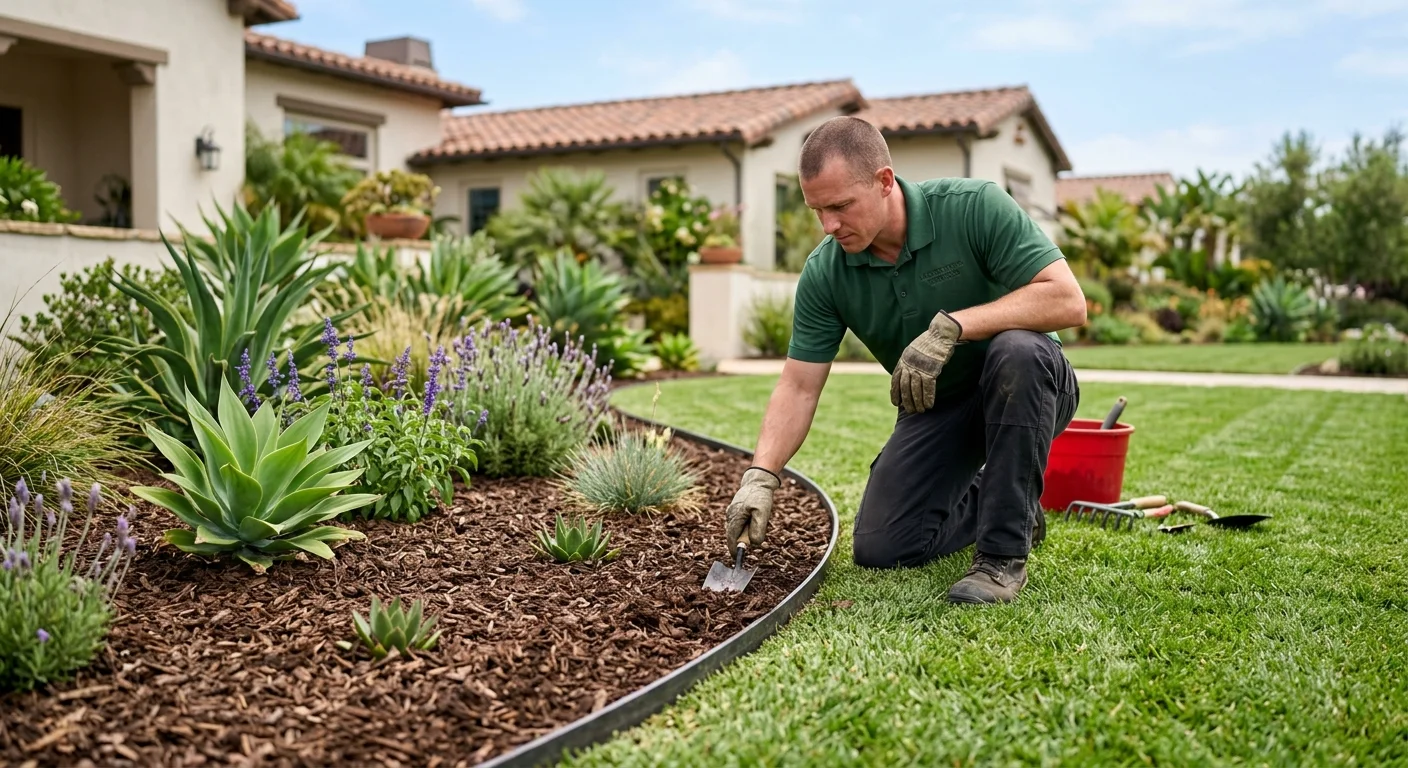
Metal garden edging earns its keep where a wide masonry curb would fight the design. A North Park front yard that wants a tight lawn panel and a drought-tolerant strip along the sidewalk needs a thin hold, not a second wall. The same is true on a Chula Vista side yard where a drip bed sits next to a mow strip, and on an Encinitas backyard where natives meet a path.
The strip is a barrier, not a terrace. It keeps mulch from washing onto concrete in a hard rain. It keeps decomposed granite from mixing into turf. It gives a mower a hard edge so the operator is not scalping the first row of plants. On lots that already have a plan for landscape edging ideas that last, metal is the option when you want the border almost invisible from the street.
It also helps when irrigation zones change at a line. Turf on spray, shrubs on drip, and a metal landscape border between them is easier to see and easier to maintain than a painted mark that fades. That layout belongs in the landscape design conversation before anyone orders material.
Where it does not help is a grade change. If the soil on one side sits well above the other, you are no longer talking about garden edging. That is a small retaining condition, and it needs a different product and a different review. A steel plate used as a terrace on a slope in La Mesa is hardscaping, not a bed trim.
Coastal lots and inland lots use the same word and a different job. A Coronado parkway strip fights salt, sand, and damp air. A Lakeside backyard fights clay that shrinks in September and swells when the first storm hits. The contractors we send read that difference on site. They do not pick a national aisle card and hope the county climate matches the photo.
How steel, aluminum, and similar products differ
Landscaping edging metal is not one product. The three families you will hear on a bid are steel, aluminum, and coated or specialty alloys. They look similar in a catalog. They behave differently once they are in San Diego soil.
Steel is the heavy, crisp line. It stays straight on a long run along a driveway in Scripps Ranch. Bare steel rusts. Galvanized and painted coatings slow that down. Weathering steel is sold because the rust is the finish. Rust stain on pale stucco, white gravel, or a new broom-finished walk is a real adjacent-surface problem. Ask the contractor how the strip meets those materials, and whether a coating or a gap is part of the detail.
Aluminum is lighter. It does not make iron rust stains. It can kink if a tire, a mower deck, or a shifting clay pocket hits a poorly staked run. On a curved bed in Mission Hills, aluminum is easier to radius. On a dead-straight lawn panel in Rancho Bernardo, steel is usually the product that holds the geometry.
Do not treat “metal” as a quality grade. Thickness, stake pattern, joint type, and the top profile all change how the edge mows and how it looks from the sidewalk. A rolled top is kinder to a line-trimmer string than a raw sheet. A hidden stake system is a different labor item than a spike you can see.
This page is not a product review, and Bloom Pro SD does not sell a brand. The matched contractor should name the metal, the finish, and the profile in writing. If the bid only says “metal edging,” you do not yet know what is going in the ground.
Brick, concrete curb, and plastic are different conversations. If you already know you want masonry, read our note on landscape bricks for borders. Metal is the thin option. Brick is the one you see from the street and can build as a seat.
What soil movement, salt air, and irrigation change
San Diego County is not one soil and not one air. That is why a metal landscape border that works in Del Mar can fail in Escondido.
Along the coast, from Oceanside through Carlsbad and Encinitas, then La Jolla, Point Loma, Coronado, and Imperial Beach, salt sits on metal. Marine layer keeps surfaces damp for hours after sunrise. Sandy fills drain fast, then a poorly aimed rotor still soaks the same edge every cycle. Coatings and drainage matter more here than they do in Alpine. Ask the contractor what finish they are specifying for a lot that smells like the ocean, and how they will keep irrigation from pooling against the strip.
Inland, the problem is movement. Clay in Escondido, El Cajon, Santee, and Lakeside swells when it is wet and cracks when it is dry. A metal garden edging run that is only set in loose topsoil will heave, open at the joints, and let Bermuda or kikuyu cross the line. Stakes, compacted base, and overlapping joints are the install details. We do not publish a required stake spacing. The written scope should.
Irrigation is the third climate. Inside the City of San Diego Public Utilities service area, outdoor watering with potable water is allowed only before 10:00 a.m. or after 6:00 p.m., and it is prohibited during and within 48 hours after measurable rainfall. Irrigation also must not run off onto sidewalks, streets, or the neighbor’s lot. A metal edge that kicks spray onto a walk is a water-waste problem, not a style problem. Other water agencies in the county set their own rules, so the contractor should check the address.
Drip on the bed side and a tight turf edge on the other side is a common San Diego layout. The strip should not pinch or bury the tubing. If you are converting spray to drip as part of a water-wise plan, the EPA WaterSense program is a useful independent check on fixtures and controllers. Local planting questions can go to the UC Master Gardener Program of San Diego County.
Hot inland sun heats exposed metal. Keep plant crowns and emitters off a strip that bakes in Poway in August. That is a placement note, not a product ban.
When edging becomes part of a larger hardscape job
A short bed line on an existing lawn can be its own small job. A backyard that also gets a patio, a gravel court, and new planting is not. Once metal garden edging meets pavers, steps, or a grade change, it belongs on the hardscaping scope so one crew owns the elevations.
The failure mode is a patio in Carmel Valley with an edge added later that misses the finished grade. Mulch then sits too high against stucco, or too low so the metal shows like a fence. The landscape design pass should set the lawn height, the patio height, and the bed height before anyone cuts a trench.
If the metal is holding back soil, stop calling it edging. In the City of San Diego, a retaining wall needs a building permit when its height exceeds 3 feet, measured from the top of the footing to the highest point on the wall, and in other cases as well, including surcharge loads such as a driveway above. In unincorporated county, construction of retaining walls requires a permit except those less than 3 feet in height and not supporting surcharge. Other cities use their own counters. The pro we match you with checks the jurisdiction. Bloom Pro SD does not pull permits.
Turf replacement projects add another overlay. SoCal Water$mart pays a per-square-foot rebate for qualifying conversions, with rules on plant count, permeability, and irrigation. Metal edging is not a rebate requirement we can confirm on that program’s pages. If the yard is on a rebate path, the edge still has to leave the converted area permeable and planted. Confirm the current rules on the SoCal Water$mart site for that address before soil is removed.
Keep connected patio, wall, and border work on one licensed scope so drainage and finished heights are owned by one contractor. The homeowner contracts with that licensed landscaping professional, not with Bloom Pro SD.
What a contractor’s written scope should confirm
A useful bid for landscaping edging metal is boring on purpose. It names the product, the path, and the conflicts.
Ask for the metal (steel, aluminum, or other), the finish, the profile, and the linear footage. Ask how joints are made and how ends die into a driveway, a gate, or a wall. Ask what happens at irrigation heads, valve boxes, and drip tubing. Ask who restores the turf or the mulch after the trench is closed.
Ask how the strip is staked and what sits under it. Inland clay and coastal fill are not the same base. If the contractor shrugs at soil, they have not walked the lot.
Ask how the edge will be mowed. A proud metal lip that catches a mower deck on a weekly lawn route becomes a bent edge by summer. The top should meet the turf the way the maintenance crew actually works.
Verify the contractor. The pros we connect you with are licensed and insured. You can confirm a license number, classification, and status on the CSLB license check. Bloom Pro SD is a referral service. We match you with independent local landscaping professionals. We do not install the edge, own the material, or warrant the product.
The contractor confirms the price with you before any work starts. There is no brand price list for metal garden edging, because lots, access, demolition, and irrigation repair are not the same from Clairemont to Ramona.
If the written scope is only a one-line “install metal edging,” send it back. You want the material and the interfaces in sentences you can walk with a tape.
When to call us
When the border has to meet irrigation, a patio, or a slope, you want a licensed landscaping pro on the scope. Call us at (760) 400-6355 and we’ll match you with a licensed local pro. We take the job details and connect you with an independent contractor who contracts with you directly.