A boxed kit for two raised beds is not a finished garden drip irrigation system. If you’re replacing hose watering, adding new plantings, or building drip into a new landscape, the written scope is what keeps the job honest. It names the parts, the zones, and the work that is not included.
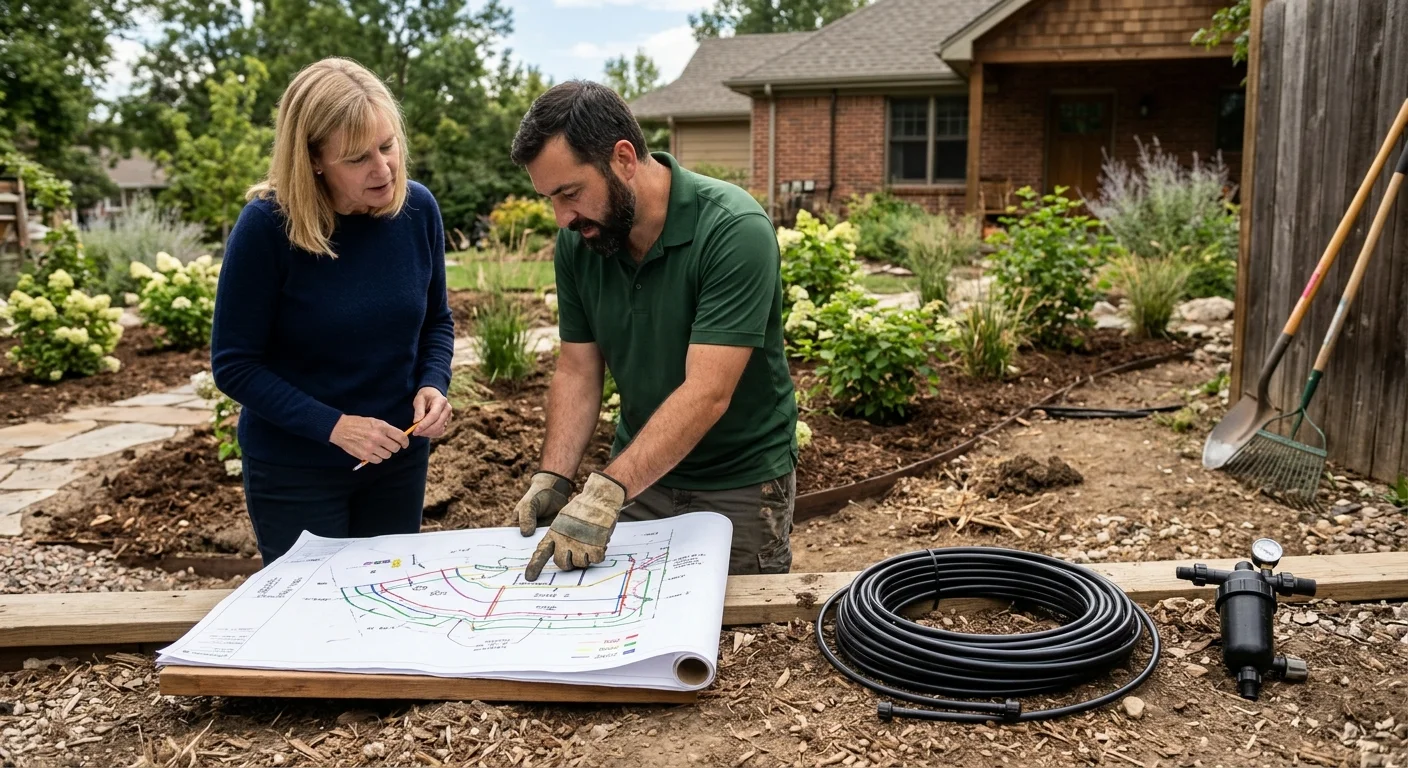
When a new drip system is the right conversation
A new drip install is the right talk when the yard has no low-volume system yet. You’re still dragging a hose. New beds, trees, or pots have nowhere to drink from except a sprinkler that soaks the sidewalk. A landscape plan already calls for shrubs and vegetables that should never share a lawn zone.
It’s the wrong conversation if the real job is a leak, a dead valve, or a head that floods the driveway. That work lives under sprinkler and irrigation repair. It’s also the wrong conversation if spray already covers those beds and you only want those heads converted. That’s a spray-to-drip conversion, with leftover laterals and leftover overspray problems.
San Diego County is not one watering climate. A coastal bed in Encinitas or Solana Beach sits in marine layer for much of the year. An inland bed in El Cajon, Escondido, or Lakeside bakes through Santa Ana winds and hotter nights. The same tomato cage in Chula Vista does not drink like a citrus row in Valley Center. A new drip system has to be zoned for those differences, not copied from a two-bed kit.
A sprinkler system and an irrigation system are not the same thing. Irrigation is the whole setup: the meter, the valves, the controller, and the way water reaches plants. Sprinklers are one delivery method. Drip is another. Lawn still usually needs spray or rotors. A garden drip irrigation system is for soil at the root, not for turf you walk on. If the yard needs both, the scope should say so, and it should separate those zones. For the spray side of that split, read what a sprinkler install should include.
A boxed kit can water two or three raised beds off a hose bib. A yard-wide install is a different job. It ties into a dedicated valve, a filter, a regulator, and a controller. The contractors we send treat that as a designed system, not a weekend parts bag.
If you want to assemble a small hose-end layout yourself, start with our DIY drip guide. If the work is a new system across beds, trees, and slopes, stay on this page and get the scope in writing.
What a written drip install scope should name
Ask for a written scope before anyone opens a trench. The contractor you hire confirms the price with you before work starts. The paper should still list the work in plain parts, not a one-line “install drip.”
It should name the point of connection. That might be a hose bib, an existing irrigation manifold, or a new valve off the main. It should name backflow protection as something to confirm with your water agency, not as a guess. A single county-wide backflow rule for residential drip could not be confirmed here. Your City of San Diego, Otay, Helix, Vista, or Olivenhain account sets that, and the matched contractor should check it with them.
It should name the filter and where it sits, because emitters clog. It should name pressure regulation, because household pressure is too high for drip parts. It should name each valve and which plants sit on it. Mix a lawn leftover, a vegetable bed, and a mature avocado on one station and the garden loses.
It should name tubing size and route: the larger supply line, the smaller lines to plants, and whether those lines are staked on the surface under mulch or buried. It should name emitter type by area. Point-source drippers for individual shrubs. Inline dripline for rows and tightly planted beds. Micro-spray only where a designer can justify the extra wetting. It should name emitter count or dripline spacing per bed, not “enough drippers.”
It should name flush points at the ends of lines. Grit has to leave the system somewhere. It should name the controller: station count, indoor or outdoor cabinet, and whether it’s a weather-based model. EPA WaterSense lists weather-based controllers as a water-saving tool. It does not replace a zoned design.
It should name restoration. Disturbed paths, cut turf, and opened valve boxes need a line on the page. And it should name exclusions in the same breath: lawn spray, existing leaks, electrical panel work, plant install, and hardscape repair. If it isn’t written, it isn’t in the job.
Finish with a walkthrough and a simple as-built sketch of zones. You want to know which station waters the citrus and which waters the tomatoes when something fails in July.
How zones, emitters, and filtration get planned
Zones come first. Group plants that drink alike, sit in the same sun, and share the same soil. Coastal succulents in Carlsbad do not belong on a station with inland lawn-edge roses in Santee. Raised beds filled with imported mix drain faster than heavy clay in East County. Sandy pockets near the beach send water down in a narrow column. Clay holds it and spreads it. The layout has to match that, or the uphill plants stay dry.
Trees are not a kit. There is no single “best” garden drip irrigation system for a tree. What belongs in the scope is a ring of emitters at the canopy drip line, not a single dripper against the trunk. As the tree grows, that ring has to grow with it. The contractors we send should leave a way to add emitters later. Avocados in Escondido, citrus in Fallbrook, and street trees on a small City Heights lot all need that expandable loop. A 4-by-8 bed kit will not do it.
Vegetable rows and flower beds usually take inline dripline, with the lines spaced so the wet spots meet under the soil. Containers and wine barrels take their own drippers, often on a separate valve, because pots dry out faster than in-ground soil. Micro-spray has a place on tight groundcover, but it gives up some of drip’s point-source habit. If the scope uses it, it should say why.
Filtration is not optional copy. Emitters have tiny openings. City water still carries grit. Wells and some unincorporated East County sources carry more. The scope should name the filter screen or disc, a place you can actually reach it, and a flush routine after install. Skip that, and you’ll be hunting uneven flow by the first warm stretch.
Drip has real limits. Lines clog. Gophers and rabbits in Poway, Lakeside, and canyon lots chew tubing. A failed emitter is easy to miss because the rest of the bed still looks wet. Drip is a poor fit for lawn. Filters and flush caps need occasional attention. Those five tradeoffs are why a written scope matters more than a parts list. You’re buying a system that has to be checked, not a hose you forget.
How you water with drip is slow on purpose. A five-minute daily run, the way people run sprinklers, often wets only the top inch. The goal is to wet the root zone, then let the soil breathe. Runtime belongs to the plant, the soil, and the season. The UC Master Gardener Program of San Diego County is the place to check local watering habits. Do not copy a Central Valley or Utah schedule onto an Encinitas bed.
Which permit and water-provider questions to confirm
Permits and watering rules are local. They are not one San Diego County stamp. If a rule could not be confirmed against a primary source, this page will say so and point you at the agency that actually sets it.
Inside the City of San Diego Public Utilities service area, outdoor watering with potable water is allowed only before 10:00 a.m. or after 6:00 p.m. Watering is prohibited during measurable rain and for 48 hours after. Irrigation must not run off onto sidewalks, streets, or the neighbor’s lot. Leaks must be repaired or stopped within 72 hours of discovery or city notice. Those are year-round city rules, not a drought-stage slogan. Report waste through the city’s Get It Done tools or [email protected].
If your bill comes from Otay Water District, Helix Water District, Vista Irrigation District, Olivenhain, or another SDCWA member, those city hours may not be yours. No single alternate schedule was confirmed here. Read the watering rules on your agency’s site, or call the number on the bill, before anyone sets a controller.
A dedicated drip permit for a typical residential garden could not be confirmed as a county-wide requirement. Plumbing, backflow, or electrical permits may still apply when a new valve, a new connection, or a new controller circuit is part of the job. The matched contractor, not Bloom Pro SD, checks that with the city or county and with your water provider. Coastal Zone lots, environmentally sensitive lands, and some HOAs add their own paper. Encinitas bluff lots and Coronado small lots are common examples. Ask, don’t assume.
If the drip work is part of taking out turf, SoCal Water$mart turf replacement requires overhead spray on the converted area to be changed to drip, micro-spray, bubblers, or rotating nozzles, or the heads capped. Synthetic turf does not qualify. Approval has to come before turf comes out. Local agencies may add money on top of the Metropolitan baseline, and amounts change with funding. Check your address in their estimator.
A weather-based controller can be part of a new drip install. SoCal Water$mart rebates start at $80 per controller for landscapes under 1 acre, or $35 per station over 1 acre, only for active stations on a working system. Amounts vary by water agency. Confirm current figures on the program site before you count on them.
California’s Model Water Efficient Landscape Ordinance applies to new and rehabilitated landscapes over size thresholds that local cities adopt. The exact square footage trigger could not be confirmed against the full regulatory text in our claims ledger, so this page will not invent one. Ask the city planning counter if your project is large enough to fall under MWELO or a local WELO.
License status is easier. Landscaping work of this kind is typically licensed contractor work. Verify the person at the CSLB license lookup by name or license number before you sign.
What to share before requesting a contractor match
Bloom Pro SD is a referral service. We answer the line, take the job details, and match you with a licensed, independent landscaping pro. You contract with that contractor. You pay that contractor. We don’t own the trucks, hold the license, or set the price.
Send what a designer actually uses. Photos of the beds, trees, and the meter or hose bib. A rough sketch with dimensions, even a phone photo of a notepad. Your water agency, if you know it. Whether the source is city water or a well. Where the controller lives now, or that there isn’t one.
Name the plants. Tomatoes, citrus, natives, and a new hedge do not share one valve happily. Note slopes, retaining walls, and any bed that sits above a neighbor in East County or North County inland. Note HOA rules if you have them. Note pets that dig and kids who play in the same beds.
Say what you want excluded. If the lawn spray stays, write that. If you only want the parkway, write that. If a future vegetable garden is coming on the side yard, say so now so the mainline can reach it.
The contractor confirms the price with you before any work starts. A clear intake is what makes that conversation useful. When you’re ready, we match you with a licensed local pro who can put the garden drip irrigation system on paper first.
When to call us
Call when the job is a new drip system across beds, trees, or a whole garden, not a hose-end kit and not a single broken head. That’s licensed landscaping work, and the homeowner needs a written scope before anyone cuts pipe. Call us at (760) 400-6355 and we’ll match you with a licensed local pro.