A coastal plant list fades on an El Cajon Valley lot once summer heat settles in. The marine layer that cools Encinitas often never reaches Fletcher Hills, Bostonia, or Granite Hills, so landscaping El Cajon yards means designing for inland sun, heavier soil, and a city permit path that is not the City of San Diego’s. Bloom Pro SD matches you with licensed, independent landscaping pros for that work. We take the job details. The contractor you choose does the install.
How does El Cajon heat differ from the coast?
El Cajon sits in a valley east of La Mesa, along I-8, with SR-67 heading north toward Lakeside and Santee. Coastal lots in Encinitas still catch afternoon marine air on many summer days. That layer often dies on the western hills before it reaches Main Street, Magnolia Avenue, or a Bostonia cul-de-sac. The result is a hotter afternoon, a brighter sky, and soil that dries faster between irrigations.
Night cooling can be stronger in the valley than on the sand. Warm-season grasses use that swing better than cool-season fescue. UC guidance is that warm-season grasses such as Bermuda and Zoysia need 25% less water than cool-season types. If the plan is to keep a lawn, start with that species choice and read our lawn care in El Cajon notes for mowing and seasonal care. If the plan is to shrink turf, design the conversion for heat first.
Fletcher Hills sits higher, toward the La Mesa line. It can feel a touch less boxed-in than the valley floor, and it still is inland. Granite Hills and the eastern foothills add slope, rock, and more sun on south and west faces. Downtown and the older El Cajon Valley tracts sit in the bowl, where heat collects. Adjacent Rancho San Diego and Singing Hills share the same inland pattern. None of this is a bluff lot in Encinitas.
Inland San Diego backyard ideas that work with East County shade, evening use, and low-water planting apply here. Escondido inland-heat landscaping is a useful comparison, not a template. Escondido is inland North County. El Cajon is the El Cajon Valley. Same county, different air, different hills.
El Cajon is a working East County city. You’ll find modest valley lots, hillside streets, and everything in between. Income stereotypes don’t design a yard. Sun angle, slope, and any HOA paper do.
Do not copy City of San Diego watering hours onto an El Cajon clock. Those permanent City of San Diego Public Utilities rules apply inside that city’s service area. Helix Water District serves much of El Cajon. Confirm the agency on your bill, then read that agency’s current outdoor rules before you set a timer.
How do soil, slopes, and HOA rules change the plan?
Many El Cajon Valley lots sit on heavier clay. Clay holds water, then bakes hard. Overhead spray on clay often sheets into the gutter before it soaks. The contractors we send usually split irrigation by plant type and keep shrub beds on drip or micro-spray so water stays in the root zone. Hillside streets toward Granite Hills and Fletcher Hills can mix clay with rocky fill. Guessing the soil from the curb is a weak plan. A soil test on the actual beds is the check that matters.
Slope changes drainage, planting, and hardscape together. Water runs fast on a Granite Hills bank and ponds at the toe of a wall on a flat Bostonia lot. The crews we send grade, drain, and, when the job needs it, build walls so soil stays on the lot. Unincorporated San Diego County requires a permit for retaining walls except those less than 3 feet in height that do not support surcharge, with height measured from the top of the footing to the top of the wall (County PDS 083). That is the county form, not an El Cajon city bulletin. Inside El Cajon city limits, ask the City of El Cajon Building Division for the trigger that applies to your parcel. The city-specific height and surcharge rules are not in our verified ledger, so treat them as unconfirmed until the city says so. The pro we match you with pulls the permit when one is required.
Foothill edges toward Crest, Dehesa, Harbison Canyon, and upper Granite Hills sit closer to wildland fuels than a lot near Magnolia and Main. California Public Resources Code 4291 requires 100 feet of defensible space in State Responsibility Areas, measured from each side, front, and rear of a structure, and not past the property line without the neighbor’s written consent. CAL FIRE describes Zone 0 as the ember-resistant zone within 5 feet of structures, Zone 1 as lean, clean, and green out to 30 feet, and Zone 2 as reduced fuel from 30 to 100 feet. Zone 0 was added by AB 3074. Not every El Cajon parcel is in a State Responsibility Area. Check the fire-hazard map for your address before you plant a dense, resinous screen against a house wall.
HOA rules are a patchwork. Many older El Cajon Valley streets have no architectural committee. Some Fletcher Hills tracts and planned-community streets do. If you have CC&Rs, read the plant, turf, wall, and lighting sections before you lock a design. The contractors we send can work to an approved set. They cannot invent a committee’s taste. If you are not sure you have an HOA, the title packet and the county recorder file are the places to look. We could not confirm a citywide HOA map, because there isn’t one.
How should planting, irrigation, and hardscape match the site?
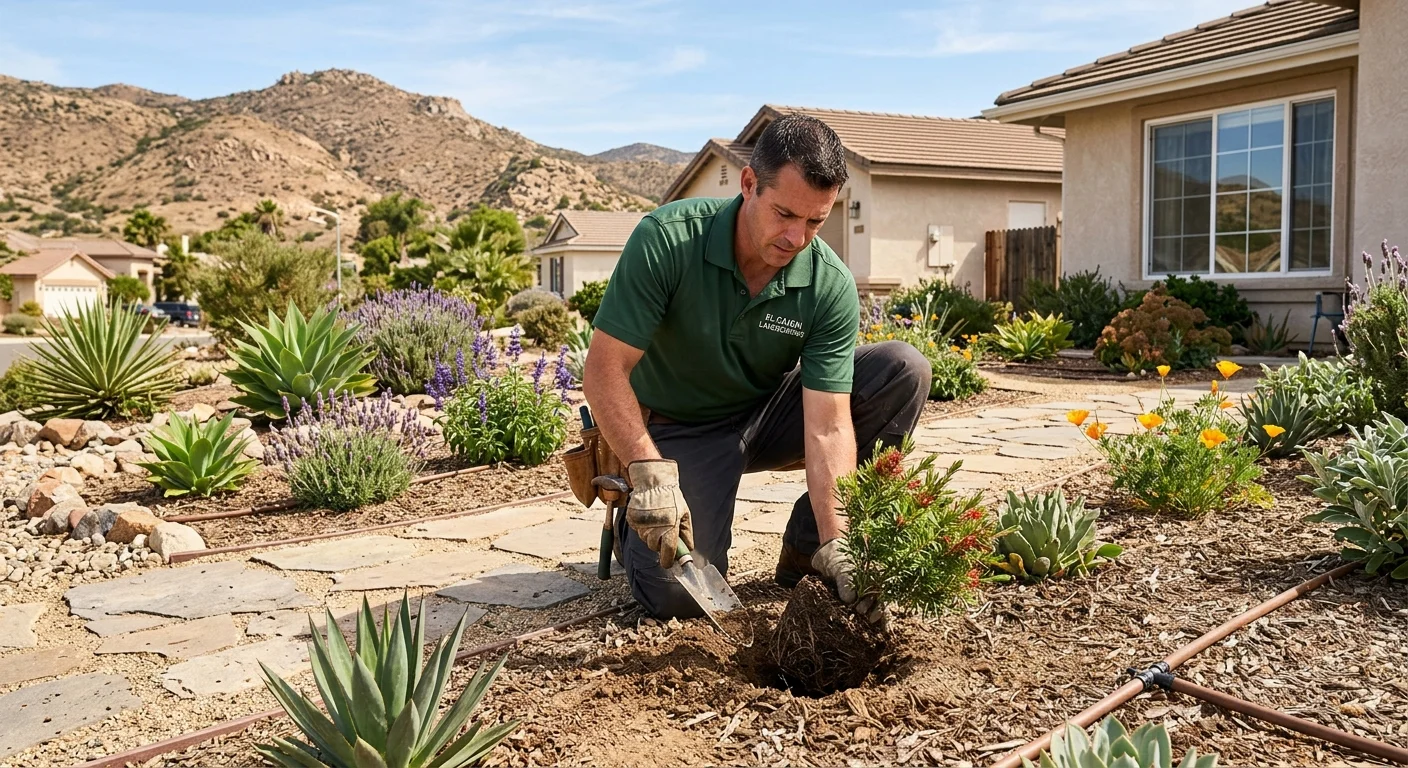
A landscape design pass for an El Cajon lot should zone plants by sun and water need, not by a coastal catalog. West and south beds take the hardest afternoon. North side yards can stay cooler and damper. The contractors we send then install drought-tolerant landscaping that can take valley heat once it is established. Establishment still needs water. Drought-tolerant is not drought-proof.
The design “rule of 3” is a composition habit, not a city code. Designers group plants in odd numbers (3, 5, 7) so a bed looks planted, not gridded. A second useful three is layers: a small tree or large shrub, a mid shrub mass, and a groundcover. That is separate from the SoCal Water$mart turf-replacement rule, which requires at least three plants per 100 square feet of project area. Existing trees that remain count toward that density.
California native plants have adapted to local conditions and need minimum water and little or no fertilizer, according to the UC Master Gardeners of San Diego County. Pair natives with other drought-tolerant shrubs and succulents that handle inland sun. Confirm species against your HOA list and against defensible-space needs on a foothill lot. There is no Cal Fire “approved plant list” in the statute. The law speaks to spacing, dead wood, chimney clearance, and roofs kept free of leaves and needles.
Keep any remaining lawn on its own irrigation zone. Sage, succulents, and natives should not share a clock with turf. For a rebate-bound turf conversion, overhead spray on the converted area must go to drip, micro-spray, bubblers, or rotating nozzles, or the heads must be capped. EPA WaterSense is the federal efficiency baseline for labeled irrigation gear. SoCal Water$mart weather-based controller rebates start at $80 per controller for landscapes under 1 acre, or $35 per station for landscapes over 1 acre, only for active stations physically connected to an in-use system. Amounts vary by water agency and funding.
Hardscape has to work in this heat. Shade, light-colored paving, and a short walk from the door matter more here than on a foggy coastal lot. If you want the turf rebate, replacement surfaces must stay permeable to air and water. Concrete cannot replace turf under that program. Broken concrete pathways with sand filler are acceptable. Synthetic turf is not an approved conversion option. Projects with synthetic turf, live turf remaining, invasive plants, or impermeable surfaces in the converted area are ineligible.
On a slope, walls, steps, and drains are often the real first move. The crews we send build those pieces to the drawings the contractor files. Do not treat a stacked decorative wall as a retaining wall if it is holding a driveway, a walk, or a house pad. Surcharge changes the engineering and, in the unincorporated county, the permit.
Which permit and water-provider questions should you confirm?
Inside city limits, the City of El Cajon Building Division is the desk for building permits. Nearby unincorporated pockets go to County Planning & Development Services. El Cajon is inland. Coastal Zone permits do not apply. If the job touches a driveway apron, sidewalk underdrain, or curb outlet, ask El Cajon Public Works whether an encroachment permit is in play. We could not confirm El Cajon’s exact right-of-way rules from our verified ledger, so the city is the authority, not a copied coastal bulletin.
Do not import City of San Diego patio-cover or fireplace bulletins onto an El Cajon lot. Those documents govern the City of San Diego. For a patio cover, outdoor kitchen, gas line, or lighting circuit in El Cajon, ask the Building Division which permits apply. Electrical, mechanical, or plumbing permits may still be required even when a building permit is not. The matched contractor pulls those permits. Bloom Pro SD does not.
California requires a licensed contractor when the aggregate contract price is $1,000 or more. A narrow exemption under Business and Professions Code section 7048 (amended January 1, 2026) applies only when the work is casual, minor, or inconsequential, does not need a building permit, is not advertised as contracting, and is done without employees. Splitting a job to stay under the number does not create an exemption. Landscape work of this kind sits in the C-27 classification, which covers grounds improved aesthetically, architecturally, horticulturally, or functionally. Verify any firm on the CSLB license lookup before you sign. The lookup shows status, classification, expiration, bond, workers’ compensation, and discipline.
Helix Water District serves much of El Cajon. Some edge parcels may sit in another agency. Read the bill. Then read that agency’s outdoor watering rules. Do not assume the City of San Diego’s before-10:00-a.m. or after-6:00-p.m. potable irrigation window. That window is a City of San Diego Public Utilities rule.
If you are removing turf, check SoCal Water$mart before a shovel hits the sod. Metropolitan Water District’s residential turf replacement rebate is $2.00 per square foot, up to 5,000 square feet of converted yard per year. Your water agency may add a local top-up. Amounts are subject to change at any time and depend on funding at approval. Use the program’s address estimator. You need approval to proceed before any turf is removed. Dead or dying turf and bare dirt do not qualify. Every approved project must include at least three plants per 100 square feet, a stormwater feature that captures rainfall by infiltration or on-site storage, permeable surfaces, and the irrigation conversion described above. State materials on the Model Water Efficient Landscape Ordinance describe compliant landscapes in general as using 80% less water than older, non-compliant designs. Local agencies must adopt MWELO or an equivalent ordinance. Specific square-footage triggers for El Cajon were not confirmed in our ledger, so ask the city or your water agency before you assume a project is in or out.
What should you share before requesting a contractor match?
Send the lot, not a vibe. Front and back photos in midday sun help. Note which beds face west. Note where water stands after a rain. A Granite Hills driveway that drops away from the street is a different access problem than a flat lot off Jamacha Road.
Share the water bill so the agency is named. Share HOA architectural rules if you have them. Say whether you want to keep a warm-season lawn, shrink it, or convert it under the rebate rules. Name the irrigation you have now: clock brand if you know it, spray vs. drip, and any heads that fog or flood. If kids, dogs, or a parking pad have to stay usable, say so. If a wall, drain, or patio is part of the same job, put it in the first note so the contractor does not price planting alone.
Bloom Pro SD is a referral service. We answer the line, take those details, and match you with a licensed local landscaping pro. We do not employ crews, own equipment, or set prices. You contract with the professional directly. The contractor confirms the price with you before any work starts.
How much does a landscaping crew cost in El Cajon?
There is no citywide crew sticker price. Lot size, slope, access, plant size, wall height, and whether irrigation is rebuilt all change the bid. A published Bloom Pro SD neighborhood comparison put inland install-crew hourly rates in Lakeside near $55, versus about $95 in Rancho Santa Fe. El Cajon is inland East County, closer in character to that Lakeside side of the comparison than to a coastal estate. Treat those figures as market context from that article, not a quote for your address.
Weekly lawn care is a different product. Published site content for lots under 1,500 square feet puts weekly lawn service near $120-$180 per month. That band is for recurring mowing and lawn care, not a redesign. For mowing and turf upkeep, use the El Cajon lawn-care guide linked above. For a full landscape rebuild, wait for the contractor’s written scope.
When to call us
A full yard redesign, a turf conversion, a retaining wall on a Granite Hills slope, or a new irrigation layout is licensed C-27 work once the contract is large enough under California law. Call us at (760) 400-6355 and we’ll match you with a licensed local pro.