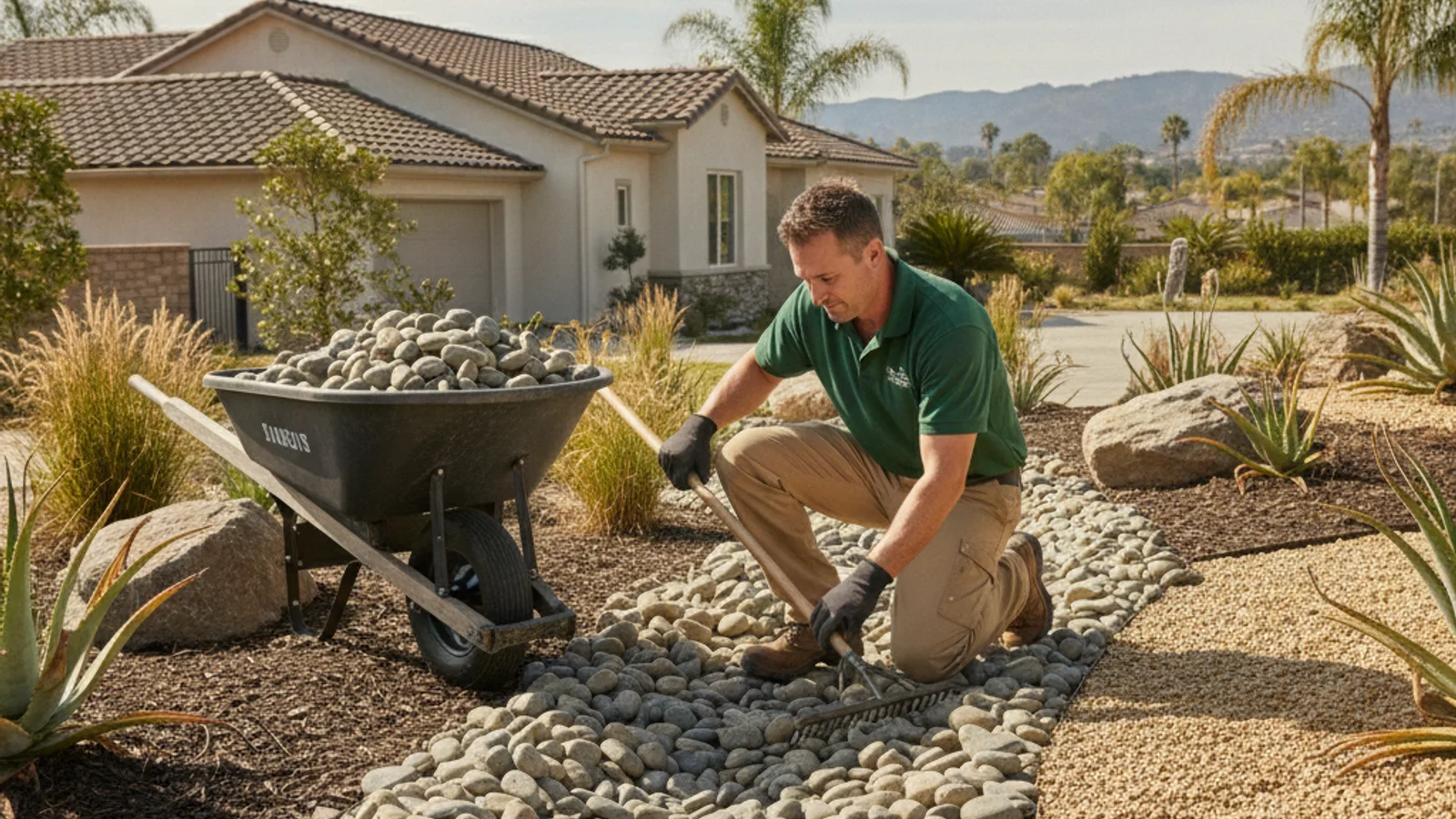
Pea gravel and river rock look similar in a supply-yard photo and behave completely differently once they’re down. One shifts underfoot and works loose from tight spaces. The other stays put on a slope but is too chunky for a path anyone walks barefoot. Here’s how to tell which one fits your yard before a crew shows up with the wrong material.
Where pea gravel works better than river rock
Pea gravel is small, rounded stone. That size is exactly what makes it useful in some spots and wrong in others.
It’s the better choice for walkways, patio infill, and anywhere people sit or set furniture down. The small, uniform pieces settle into a fairly even surface underfoot, closer to walking on packed sand than on loose stone. Under a dining table or a fire pit seating area, that matters. Larger rock never settles the same way; it stays lumpy and shifts when a chair leg presses into it.
Pea gravel also drains fast because it’s small and rounded with a lot of space between pieces, so it works well as a base layer under pavers or as a top dressing in raised planter beds where you want water to move through quickly without washing soil away. Its light, neutral color (usually tan, buff, or grey) also reflects heat better than darker rock, which matters more in San Diego’s inland valleys than people expect.
Where pea gravel struggles: it migrates. Rain runoff, foot traffic, and even wind will walk small stone out of an open bed and onto a lawn or a driveway over time. It needs firm edging to stay contained, and it’s not the right choice for a slope, dry creek bed, or anywhere runoff moves with any force. For those jobs, river rock’s weight and size are the point, not a drawback. If you’re weighing river rock specifically, our full breakdown of river rock landscaping in San Diego covers sizes, uses, and where it outperforms other rock types.
How foot traffic and slopes affect the choice
Think about how the space actually gets used before picking a material, not just how it will look on day one.
High foot traffic, flat ground: pea gravel is the common choice for paths and patio surrounds. It compacts reasonably well when contained by solid edging and a compacted base underneath.
Low traffic, decorative border or accent: either material works, and the decision comes down to look. Pea gravel reads softer and more uniform. River rock, with its range of sizes and colors, reads more natural and textured.
Any real slope: river rock wins, and it isn’t close. Smaller stone has less mass to resist gravity and water, so on a grade it migrates downhill fast, especially after a heavy rain. Larger river rock has enough weight to stay in place and break up the force of moving water instead of sliding with it. Canyon-edge and graded lots across the county lean on this exact property.
Dry creek beds and drainage swales: this is squarely river rock territory. The larger stones handle the volume and speed of storm runoff without scattering, while a mix of sizes mimics a natural streambed. Pea gravel in a drainage channel will wash downstream in the first hard rain and end up in the street.
If your yard has more than a gentle pitch, a licensed pro should look at the grading before either material goes down. Water that isn’t directed correctly finds the lowest point in your yard or your neighbor’s, and no amount of rock fixes bad grading after the fact. Our hardscaping page covers what that kind of grading and drainage work involves.
What edging and base preparation change
Neither material performs well without the right prep underneath it, and the prep differs based on which one you’re using.
Weed barrier: both materials need a commercial-grade barrier underneath, not builder’s plastic, which traps heat and tears. Ask how the barrier will address any existing turf or roots under the project area.
Base compaction: pea gravel used as a walkway or patio surface needs a compacted decomposed granite or road-base layer underneath, or it sinks unevenly and creates soft spots. River rock used purely as a decorative accent or drainage feature doesn’t need the same compacted base, since it isn’t bearing foot traffic the same way.
Edging: this is where pea gravel lives or dies. Because the stones are small and loose, they need continuous, solid edging, metal, concrete, or heavy-duty plastic staked into the ground, on every side. A gap of even a few inches lets gravel walk out over a season. River rock is heavier and holds a line better on its own, but edging still keeps it from spreading into a lawn or a neighboring bed and gives the whole installation a finished edge.
Depth: a universal installation depth couldn’t be confirmed from the approved sources. Ask the pro to specify the planned depth for each path, bed, or drainage section before work starts.
How coastal and inland yards differ
San Diego County isn’t one climate, and rock choice should account for that.
Coastal yards (La Jolla, Del Mar, Encinitas, Carlsbad) run milder temperatures year-round, so heat retention in dark rock is less of a concern. The bigger factor here is salt air, which can dull sealers and coatings faster than inland conditions. Lighter, unsealed natural stone in either pea gravel or river rock tends to hold its look longer near the coast without needing reapplication.
Inland yards (El Cajon, Santee, Escondido, Rancho Bernardo) can have different heat conditions than coastal yards. Dark rock, in either size, absorbs and radiates that heat, which can stress nearby plants and make patio areas uncomfortably hot underfoot. In these microclimates, lighter tan or buff pea gravel and lighter granite river rock are the more comfortable choice, especially anywhere people walk barefoot or plants sit close to the rock’s edge.
Wind is the other inland factor. Santa Ana conditions move loose material more than coastal breezes do, which is one more reason pea gravel needs solid edging in inland yards specifically.
Whichever material and region you’re working with, a design built around drought-tolerant plants alongside the rock, rather than a rock-only yard, holds up better and reads less stark. We can match you with an independent local pro to plan that pairing so the rock and plants work together instead of competing. For more ways to combine rock types across a yard, see our guide to rock landscaping ideas for San Diego.
What to ask before requesting a contractor match
A few questions before work starts save you a redo later.
Ask what base preparation the quote includes, specifically whether compaction and a weed barrier are part of the job or a separate line item. Ask how the edging will be anchored and what material it’s made from, since a thin plastic strip staked every few feet won’t hold pea gravel the way a continuous metal edge will. If your yard has any slope, ask whether grading is included or whether it’s assumed to already be correct, that assumption is where a lot of drainage problems start.
It’s also worth asking whether the design pairs rock with living plants. Many local water agencies, including programs listed through SoCal Water$mart, require a percentage of living, low-water plant coverage for a turf-replacement project to qualify for a rebate. A rock-only yard typically doesn’t meet that bar. The UC Master Gardener Program of San Diego County is a good independent resource for which low-water plants actually perform well alongside rock in this climate.
Finally, confirm the contractor’s license status directly through the state before any work starts, using the CSLB license lookup tool. It takes a minute and tells you whether the license is active, what classification it covers, and whether there’s a bond on file.
When to call us
Whether pea gravel or river rock is the right call depends on slope, traffic, and what’s planted nearby, details that are easier to get wrong from a supply-yard photo than from a walk through your actual yard. Call us at (760) 400-6355 and we’ll match you with a licensed local pro.