A bag of sand and a bag of compost look interchangeable at the garden center, but they solve different lawn problems and can make the wrong one worse. Picking between compost, sand, and screened soil without knowing what your lawn actually needs is how a top dressing project turns into a bigger repair.
What top dressing can and can’t correct
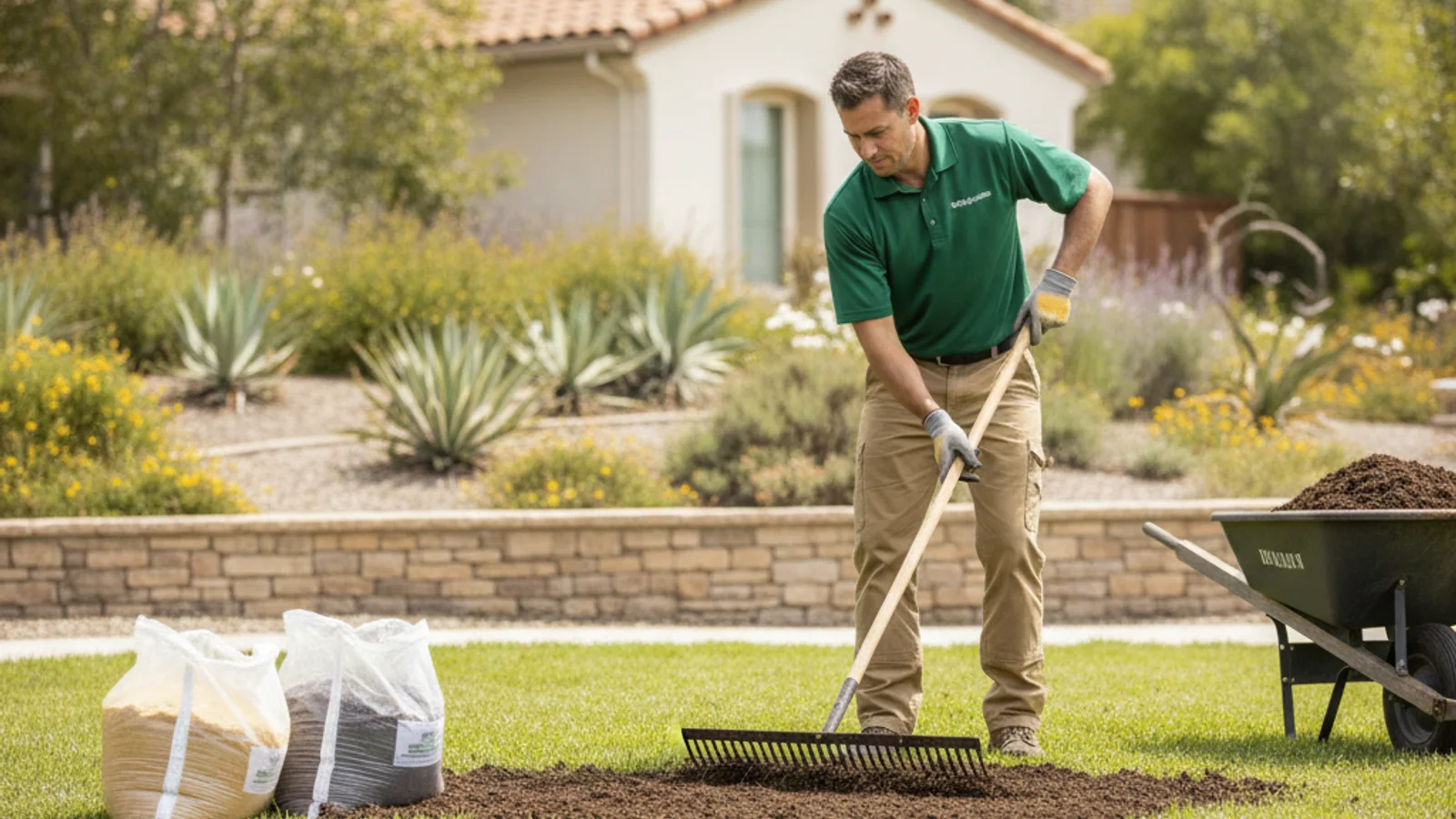
Top dressing spreads a thin layer of material over an existing lawn to change the surface the grass grows through. It can smooth minor low spots, add organic matter, and help new seed make contact with soil after overseeding. Our guide to lawn aeration and overseeding timing in San Diego covers how top dressing usually fits alongside those two steps.
What it can’t do is fix a drainage problem, replace a soil test, or rescue turf that’s dying from an irrigation issue. A thin surface layer doesn’t change the compacted clay six inches down, and it won’t stop runoff if the grade slopes the wrong way. If the lawn has a recurring problem in the same spot every season, the material on top usually isn’t the cause and won’t be the cure.
Top dressing also isn’t one product. “Compost,” “sand,” and “soil” each describe a category with wide variation inside it. Bagged compost from one supplier can differ from another in texture, screening, and what it was made from. The same is true of sand and screened soil. Ask the supplier what’s actually in the bag before assuming any product behaves like the generic name on the label.
The condition of the lawn underneath matters as much as the material on top. A lawn with thin, weak turf and visible bare patches needs a different plan than a lawn that’s healthy but slightly uneven. Matching the material to the actual problem, rather than to whichever bag was on sale, is the decision this whole comparison is really about.
When compost fits the lawn’s condition
Compost adds organic matter to soil that has lost it. Lawns that have been mowed and irrigated for years without any organic input often end up with thin, low-nutrient soil near the surface, even when the grass still looks acceptable most of the year. A screened, finished compost applied as a thin top dressing layer can improve that surface over time as it works into the existing soil.
Compost tends to fit lawns that show gradual, general decline rather than one obvious cause. Thinning turf across a wide area, a lawn that struggles to hold color between fertilizer applications, or soil that feels lifeless and compacted when you dig into it are the kinds of signs that point toward compost rather than sand. Our lawn fertilization service page covers how fertility and soil condition interact, since compost and fertilizer are addressing related but separate problems.
Not every compost product is appropriate for a lawn application. Coarse, unfinished, or unscreened material can smother grass blades instead of settling around them. Compost that still smells strongly or contains visible chunks of undecomposed material hasn’t finished breaking down and can do more harm than good spread over living turf. Ask the supplier whether the product is specifically screened and finished for turf top dressing, not just general garden use.
Compost also isn’t a substitute for diagnosing why the lawn declined in the first place. If watering, mowing height, or an irrigation problem caused the thinning, compost alone won’t reverse it. It works best as one part of a broader plan, applied to soil that’s otherwise being irrigated and fertilized correctly.
When sand creates more problems than it solves
Sand has a narrow, specific use in lawn care: improving surface drainage and firmness on turf that holds water at the surface, most commonly on the sports-field style lawns where consistent footing matters. Applied to the wrong soil, sand can do the opposite of what a homeowner expects.
The risk with sand comes from soil layering. Spreading sand over clay without working it in can create a distinct layer where the two materials meet. Water that reaches that layer can pool instead of draining through, which traps moisture right where roots are trying to grow. A homeowner trying to fix a soggy spot with sand can end up with a soggier one.
Sand also does nothing for a lawn’s fertility. It carries no organic matter and no nutrients, so a lawn that’s struggling because of thin, depleted soil won’t see any benefit from a sand top dressing. Confusing a fertility problem with a drainage problem, and treating it with sand, is one of the more common top dressing mistakes on residential lawns.
Sand type matters too. Fine sand compacts more readily than coarse, angular sand, and using the wrong grade can undo the drainage benefit the material is supposed to provide. If sand genuinely fits your lawn’s situation, that’s a detail worth confirming with whoever supplies or applies the material rather than guessing from a bag label at a hardware store.
How soil testing changes the material choice
Guessing at a top dressing material without knowing what’s actually in the soil is a common way homeowners spend money on the wrong fix. A soil test gives you a report on texture, drainage characteristics, and composition that visual inspection alone can’t provide, and it can shift the recommendation entirely once the results are in.
A lawn that looks like it needs organic matter might actually have adequate organic content and a compaction problem instead, in which case aeration matters more than compost. A lawn with a suspected drainage issue might test as well-draining soil with a surface-level irrigation problem, in which case sand would have been the wrong material entirely. Testing removes the guesswork before you buy anything.
If recurring lawn trouble persists after you’ve ruled out watering and visible site conditions, a soil test is the next step before choosing a top dressing material, not after. The UC Master Gardener Program of San Diego County is a starting point for local horticultural guidance if you want a resource beyond what a testing lab provides. No verified soil testing price or turnaround appears in this site’s approved claims ledger, so confirm both directly with whichever lab you choose.
Timing also interacts with soil condition. Our lawn fertilizer schedule for San Diego explains how feeding windows shift by season, and a top dressing decision made without knowing where the lawn sits in that schedule can work against, rather than with, a recent or upcoming fertilizer application.
When to discuss top dressing with a lawn-care pro
Some situations are straightforward enough to research and decide on your own, especially a healthy lawn that just needs a light compost refresh alongside routine overseeding. Others aren’t. A lawn with uneven drainage, a slope, visible standing water, or a history of repeated problems in the same area benefits from an on-site assessment before any material goes down.
A local pro can also tell you whether the lawn’s current grass type responds well to top dressing at all, since not every variety tolerates a surface layer the same way. Warm-season lawns and cool-season lawns can react differently to timing and material choice, and that’s a detail worth confirming for your specific yard rather than applying a general rule.
If you’re already planning aeration, overseeding, or a fertilization visit, that’s a natural point to ask whether top dressing makes sense as part of the same plan. Combining steps that were going to happen anyway is usually more efficient than treating top dressing as a separate, standalone project.
When to call us
If your lawn’s condition points to something more than a simple material choice, a licensed local pro can walk the yard, look at drainage and soil, and recommend a plan specific to your property. Call us at (760) 400-6355 and we’ll match you with a licensed local pro.