A landscape boulder is a placed stone, not a pile you rake. In San Diego County, large landscaping rocks belong at an entry, on a bank, or in a dry bed. Color is easy, and access and setting decide the job.
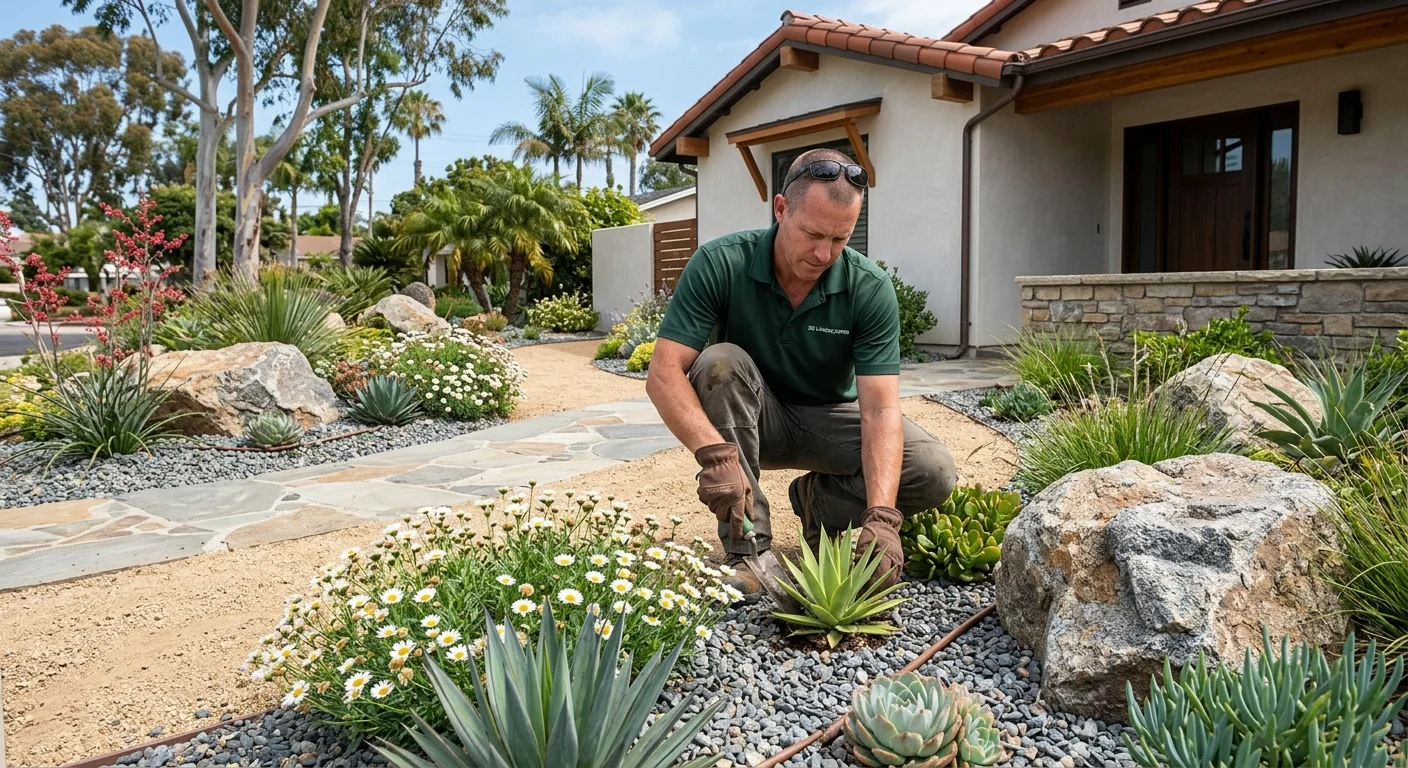
Where large rocks earn their keep in a San Diego yard
Large landscaping rocks, often sold as landscape boulders, earn their keep as structure. They are not ground cover. You place them. You do not spread them.
A front yard in Encinitas or Carlsbad can look finished with three stones and a low planting. A wide inland lot in Escondido or Poway needs a bigger piece to hold the eye along a long drive. East County banks in El Cajon, Lakeside, and Alpine use mass at the toe of a slope. South Bay lots in Chula Vista and National City run tighter. One or two specimen stones usually beat a field of rock.
If you want bed layouts and color mixes, use our rock landscaping ideas guide. This page is about landscape large rocks a crew has to set.
They mark an entry without building a wall. They break a flat parkway strip. They start a dry creek that takes roof water away from a slab. They sit in a drought-tolerant landscaping bed with sage, agave, and buckwheat so the planting has a spine in August.
They can sit close to the house. CAL FIRE’s ember-resistant Zone 0 runs five feet from structures. Zones 1 and 2 make up the 100 feet of defensible space required by law on lots in State Responsibility Areas. Stone does not burn. A boulder in that five-foot band is not fuel. It does not replace brush clearance farther out, and it does not make any plant fire-proof. Not every San Diego County lot is in a State Responsibility Area. Check your own map.
A whole lawn swapped for boulders and nothing else reads as a quarry. It also fights rebate rules. Use large stone as the bones. Let smaller rock and plants do the field.
How placement, access, and slopes change the job
On a boulder job, access and setting drive the work more than the face of the stone.
Walk the path the rock has to travel. Measure the side yard. Note gates, AC pads, pool equipment, and low eaves. Coastal lots in Oceanside, Carlsbad, and Encinitas often have a skinny run along the house. A stone that fits the design can still fail that run. Canyon lots in Mission Hills, Kensington, and parts of La Jolla add stairs and no street staging. East County drives can take a truck, then leave you on a grade that will not hold a machine.
Tell the contractor we match you with about all of that before anyone orders stone. Photos of the gate, the parkway, and the set points save a wasted delivery. HOA streets in 4S Ranch, Rancho Bernardo, and parts of Chula Vista can limit staging.
A landscape boulder should look seated, as if the grade rose around it. Perched stones look like they arrived yesterday. Crews often bury part of the mass and pack the base so it cannot roll. Groups of three or five, with mixed heights, read as an outcrop.
Slopes change the legal picture. A decorative stone on a bank is still decoration. A stack that holds soil is a retaining wall. In the City of San Diego, a building permit is required when wall height exceeds three feet, measured from the top of the footing to the highest point on the wall. Steep backfill, surcharge from a driveway or walk, and some tiered layouts also trigger a permit. In unincorporated county, retaining walls need a permit except those less than three feet in height and not supporting surcharge. The matched contractor, not Bloom Pro SD, pulls that permit when the design needs one.
If the plan is a true wall, treat it as hardscaping, not as a rock drop. Do not dry-stack a tall bank and hope the boulders behave like engineered block.
How boulders compare with river rock and gravel
Boulders, river rock, and gravel all get sold as landscaping rock. They do not do the same work.
Landscape boulders are the large landscaping rocks you place one at a time. Size is a piece decision. You do not order them by the square foot the way you order mulch.
River rock is rounded stone for channels, dry creeks, and the gaps around those big pieces. It moves water along a path. It does not anchor a slope the way a seated boulder can.
Gravel and smaller decorative stone are cover. They hide soil, cut mud, and finish a bed. White landscape rock is a color choice on top of that. On the coast it can look clean against stucco. Inland in El Cajon, Escondido, and Ramona it throws glare and stored heat onto plants and glass. Earth-tone granite and mossy pieces sit more quietly next to San Diego hillsides.
There is no single county price we can publish, and yards change stock. Covering rock is sold as a load that fills area. Boulders are sold as pieces, then set. The low-cost path for a wide bed is usually smaller stone plus plants. The low-cost path for a focal point is often one well-chosen boulder instead of a mixed pile you do not need. Confirm current pricing with the yard that will load the stone. The contractor confirms the full job price with you before work starts.
Bagged patio stone from a home center is for edging and thin cover. It will not do boulder work.
What drainage and planting need around big stone
A boulder is a dam if you set it wrong. Water has to move around it, not against the house.
Coastal sandy lots drink. Clay in East County and parts of the South Bay does not. If your yard already ponds after a winter storm, fix the path of water first. Roof leaders, patio drains, and grade away from the slab all matter more than rock color.
Inside the City of San Diego Public Utilities service area, potable irrigation may not cause runoff onto sidewalks, streets, or the neighbor’s lot. Watering with potable water is allowed only before 10:00 a.m. or after 6:00 p.m. It is prohibited during and within 48 hours after measurable rain. Other water agencies in the county set their own rules. Plantings around stone should be on drip or another low-volume method, not a spray head hitting the rock face.
SoCal Water$mart’s turf replacement program pays $2.00 per square foot of removed turf, up to 5,000 square feet of converted yard per year. Local water agencies may add to that, and amounts can change. Rock gardens and dry river beds are listed as stormwater features that can help a project meet the on-site capture rule. That does not mean a yard of boulders and no plants qualifies. Approved projects need at least three plants per 100 square feet, a permeable surface, and overhead spray converted or capped. Concrete cannot replace the turf. Synthetic turf is not an approved conversion. You need approval to proceed before any turf comes out. Dead lawn and bare dirt do not qualify.
If you hope the rock work counts, run your address through the SoCal Water$mart estimator and ask your water agency before you demo. We could not confirm a separate, automatic rebate for landscape boulders alone.
Plant on the cool side of the stone inland. South and west faces bake. Pair boulders with natives and other drought-tolerant plants the UC Master Gardener Program of San Diego County already recommends for our climate. Keep soil in the planting pockets.
What to confirm before requesting a contractor match
Have a short list ready when you call. It keeps the match honest.
Where each stone will sit, and the path from the street. Photos of gates, slopes, and overhead lines. Whether the stone is decoration or is holding soil. HOA color and material rules. Whether the lot sits in a fire hazard area, and how Zone 0 is being handled. Whether you plan to apply for a turf rebate, and which water agency serves the meter. Who is buying the stone, who is setting it, and who is restoring irrigation and plants.
Bloom Pro SD is a referral service. We match you with licensed, independent landscaping pros. We do not own a yard, a loader, or a stockpile. You contract with the contractor directly. The pros we send are licensed and insured. Verify the license number on the CSLB license check before you sign. The contractor confirms the price with you before any work starts.
What are big rocks for landscaping called?
Yards and crews usually call them landscape boulders or large landscaping rocks. Flagstone, chopped stone, and patio slabs are flat. They are a different product.
Where do San Diego yards get large rocks?
Local stone yards and landscape suppliers stock them. Some contractors pick with you. Some source and set as one job. Pickup only works if you can haul and offload legally. For anything that needs a machine, let the matched pro handle the stone.
What is the average cost of large landscape boulders?
No single San Diego County average is in our verified figures. Price depends on stone type, size, piece count, delivery, access, and whether a machine has to set them. If the layout is a retaining wall, permitting enters the quote. Ask the yard for the stone and the contractor for the placement.
What is the cheapest rock to buy for landscaping?
The lowest-cost covering rock is usually a common local gravel or decomposed granite sold in bulk, not a specimen boulder. The lowest-cost focal stone is the smallest boulder that still reads from the street. Confirm both at a local yard.
When to call us
Call when the stone is too large to roll by hand, when a slope is part of the plan, or when rebate and drainage have to be designed together. Call us at (760) 400-6355 and we’ll match you with a licensed local pro.