Choosing muhly grass starts with the exact plant and planting site. Before adding it to a San Diego yard, confirm its mature size, drainage needs, irrigation plan, and status with reliable authorities.
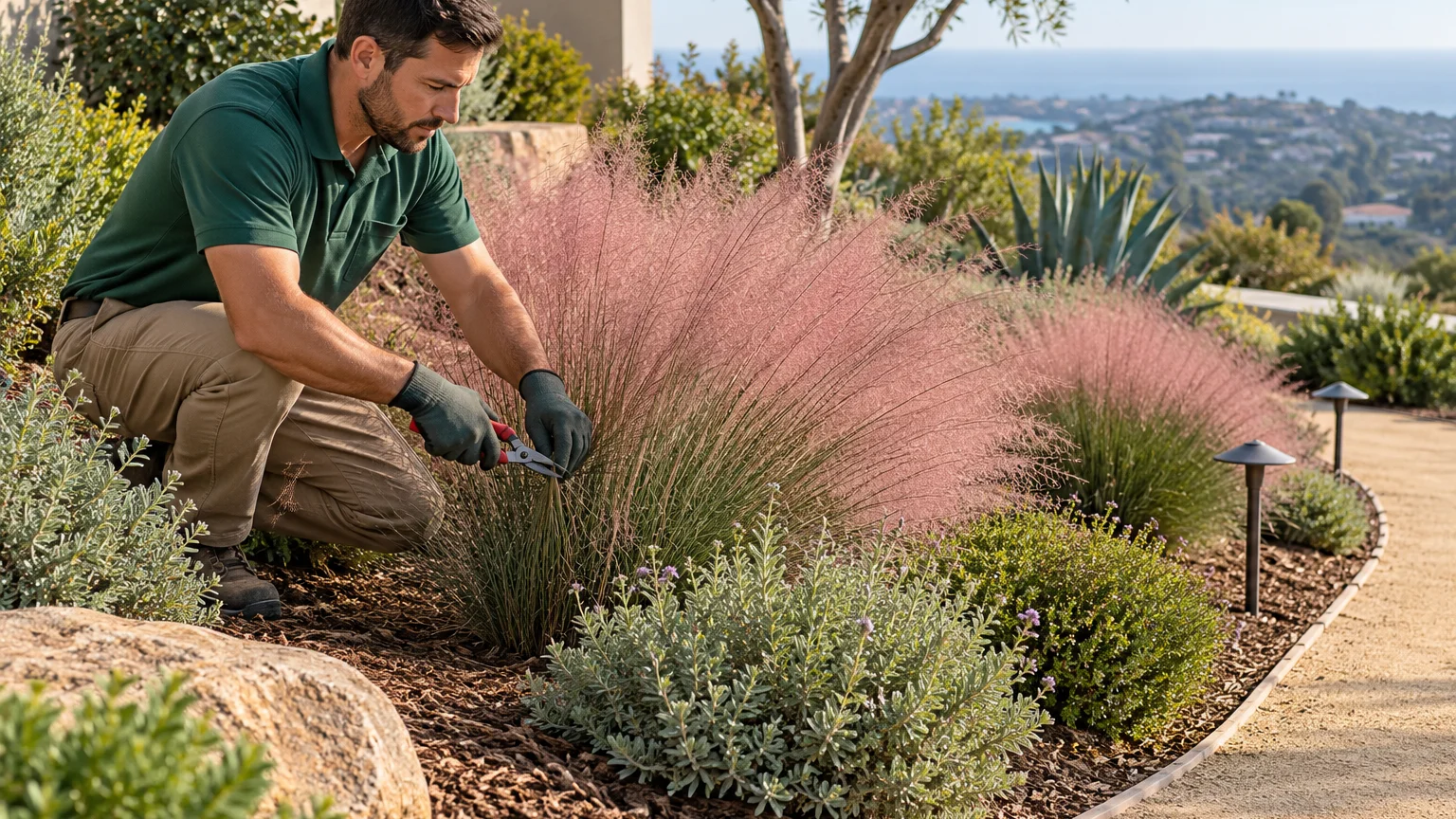
What muhly grass is, and what it isn’t
“Muhly grass” alone isn’t a precise plant selection. Nursery labels, landscape proposals, and HOA submissions should include the botanical name. Without that name, you can’t reliably verify the plant’s mature dimensions, regional fit, water needs, or invasive status.
Bloom Pro SD’s approved research doesn’t currently confirm those details for a specific muhly species. It also doesn’t establish whether every plant sold under this common name is perennial, native to a particular state, evergreen, pet-safe, or suitable for every San Diego property. Those points need species-level verification before planting.
That limitation matters when answering common questions. Is pink muhly grass an annual or perennial? What does it look like outside its bloom period? Does white muhly spread? The available ledger doesn’t support one answer for every plant carrying a muhly name. Check the botanical name against a current university, government, or recognized botanical source.
The UC Master Gardener Program of San Diego County is a useful local starting point. Bring the complete nursery label, not just a sales photo. Ask about the exact plant’s mature form, seasonal appearance, and care requirements.
Don’t assume “native” means native to San Diego County. The ledger confirms that California native plants are adapted to local conditions and generally need minimal water and little or no fertilizer. It doesn’t classify a specific muhly grass as a California native.
The same caution applies to drought claims. “Drought-tolerant” doesn’t provide an irrigation schedule or prove that a plant fits a particular soil. A contractor should identify the plant, examine the site, and set expectations before it becomes part of a drought-tolerant landscape.
Where coastal and inland conditions change the fit
A plant recommendation shouldn’t be copied across San Diego County without a site review. A yard near Carlsbad’s coast and a property in El Cajon present different exposure questions. The exact effects on a muhly species weren’t confirmed in the approved research, so they should be assessed at the property.
Start with sunlight across the proposed bed. Note nearby walls, fences, trees, and rooflines. Record when the area receives direct sun and when it falls into shade. A photo taken once won’t show the full pattern.
Next, look at wind exposure and reflected conditions. A bed beside open coastal exposure isn’t the same setting as one enclosed by masonry. Inland walls and paving may also change what a plant experiences. These observations help a contractor compare the property with the grower’s instructions for the exact plant.
Drainage deserves its own check. Don’t infer it from the neighborhood or the surface appearance. Share whether water collects after irrigation or rain. Note downspouts, low spots, slopes, and runoff toward paving. A contractor can then decide whether the bed layout or irrigation needs adjustment.
If the address lies within the City of San Diego Public Utilities service area, permanent watering rules apply. Potable landscape watering is permitted only before 10:00 a.m. or after 6:00 p.m. Watering is also prohibited during measurable rainfall and for 48 hours afterward. Other San Diego County water agencies may set different rules, so confirm the current requirements for the service address.
These checks don’t prove that muhly grass will fit. They produce the information needed for a defensible selection. A local landscape design plan should connect the chosen plant with exposure, drainage, irrigation, and surrounding materials.
How mature size affects paths and planting beds
Mature size should guide placement, even when the nursery plant looks compact. Bloom Pro SD’s ledger doesn’t contain verified dimensions for a muhly species. Use the current grower label or an authoritative species reference for the expected height and spread.
Measure the usable bed, not the entire open area. Edging, irrigation hardware, utility access, downspouts, and neighboring plants reduce that space. Record the narrowest point when a bed follows a curved path or driveway.
Paths need special attention. Compare the verified mature spread with the walking surface available after growth. A plant that extends into a route may require repeated correction or make the original layout impractical. The same concern applies beside gates, steps, seating areas, and vehicle doors.
Don’t choose spacing from a styled photo. Perspective can hide the distance between plants. It can also conceal immature growth. Put the verified mature footprint onto a simple scaled sketch. That reveals whether a single plant, repeated grouping, or different species makes sense.
Allow for access behind the planting. Irrigation components and exterior equipment shouldn’t disappear inside a crowded bed. Contractors also need a practical route for future landscape care.
A slope requires more review. The City of San Diego defines grading broadly as earthwork involving grubbing, excavation, embanking, or filling. Some grading conditions trigger permit review, including certain changes in height, steepness, drainage, acreage, or sensitive areas. Planting a grass isn’t automatically a grading project. However, reshaping a slope or changing drainage can expand the scope.
Share the existing grade and planned soil work with the contractor. For City of San Diego properties, confirm the live requirements with Development Services before major earthwork starts. Other cities and unincorporated areas have their own authorities.
How it compares with other ornamental grasses
Muhly grass shouldn’t win a place based only on a bloom photo. Compare it with other ornamental grasses using the same site questions. That makes the decision about function, not novelty.
Begin with verified mature height and spread. Then compare seasonal appearance, irrigation instructions, drainage needs, maintenance directions, and the botanical identity listed by the seller. If any detail can’t be confirmed, mark it as unresolved instead of filling the gap with a guess.
Our San Diego ornamental grass guide provides a broader starting point. This page serves a narrower purpose: deciding whether a specific muhly plant fits one property. The fountain grass guide addresses another commonly searched grass and the checks needed before selection.
Invasive status must be checked by botanical name. The approved ledger doesn’t verify the status of a muhly species, so this article can’t label one invasive or noninvasive. Ask the nursery for the exact name, then compare it with the current California Invasive Plant Council records and applicable local guidance.
Pet concerns need the same precision. The ledger contains no verified toxicity finding for muhly grass. Don’t treat the absence of a warning as proof of safety. A veterinarian or recognized animal-poison authority should review the botanical name when pets may chew plants or contact seed heads.
HOA approval also remains property-specific. No blanket HOA rule for muhly grass was confirmed. Request the current landscape standards and application form from your association. Submit the botanical name, mature dimensions, location, irrigation changes, and any required images. Written approval is more useful than a neighbor’s recollection.
This comparison may point toward muhly grass, another ornamental grass, or a non-grass plant. The right result is the one supported by the site and verified plant information.
What to share before requesting a contractor match
A useful contractor match begins with clear property details. Tell us the service address and whether the planting area is in a front yard, side yard, slope, courtyard, or backyard. Include approximate bed dimensions and several current photos.
Share the plant’s full label if you’ve already selected one. The botanical name matters more than a general “pink muhly” or “white muhly” description. Include any grower instructions supplied with it.
Describe the site’s direct sun, shade, wind, and visible drainage. Mention standing water, runoff, downspouts, nearby paving, and existing irrigation. Also identify gates, stairs, parking areas, utility equipment, and narrow paths that affect access or plant placement.
Tell us what you want the planting to accomplish. It may need to soften a wall, mark an edge, replace lawn, or add seasonal texture. Those goals shape the layout and help the contractor compare alternatives.
If you’re replacing turf, check the current SoCal Water$mart requirements before removing it. The verified program rules require approval before turf removal. Qualifying projects also need at least three plants per 100 square feet, a stormwater feature, permeable treatment, and qualifying irrigation changes. Synthetic turf isn’t an approved conversion option. Funding and local additions can change, so use the program’s address tool before starting.
Provide any HOA documents, design rules, or written approvals already received. If the project involves slope reshaping, drainage changes, retaining work, or another permit-sensitive element, say so during intake. The contractor can define the work and identify which authority should confirm current requirements.
Bloom Pro SD takes these details and matches homeowners with licensed independent landscaping professionals. The homeowner contracts with and pays the selected professional directly. The contractor confirms the price before work begins.
When to call us
Call when plant selection connects with irrigation changes, bed construction, drainage, grading, or a larger landscape plan. A licensed landscaping professional can assess the property and verify the project scope.
Call us at (760) 400-6355 and we’ll match you with a licensed local pro.