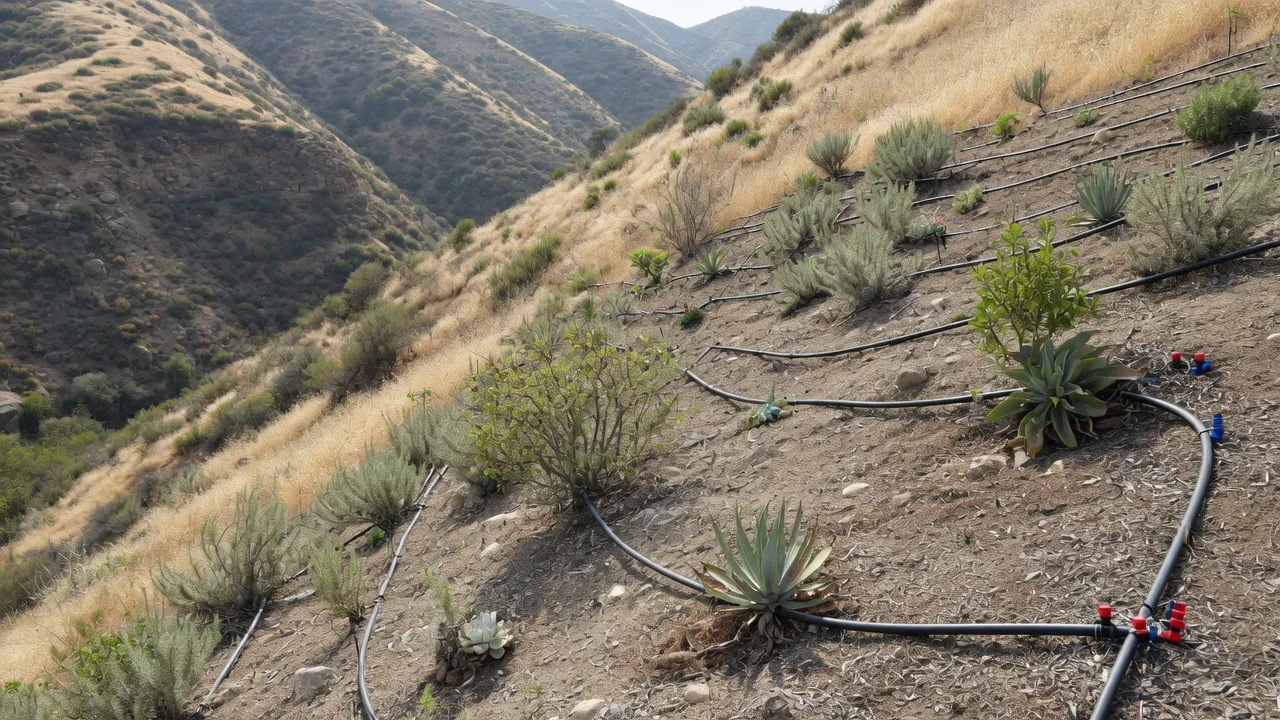
A slope changes drip pressure. It does not just look steep. UCCE irrigation advisor Michael Cahn’s paper on drip uniformity on sloped fields puts a number on it: an elevation change of 2.3 feet causes a 1 psi change in a drip line. Non-compensating emitters then water the bottom more than the top. After the valve shuts off, leftover water can drain to the low end and saturate it. That is why a hose-bib kit that worked on a flat Clairemont bed fails on a La Mesa bank or a Poway canyon. This page is the slope layout. What a drip install should include is the written-scope checklist for a new system.
Bloom Pro SD matches homeowners with licensed independent irrigation contractors. We do not design or install systems.
Why does a slope change how drip behaves?
Water in a pipe gains or loses pressure with elevation. Down the hill, pressure rises. Up the hill, it falls. Cahn’s 2.3 feet per 1 psi is the conversion. A 10-foot bank is already a several-psi swing, enough to matter on low-pressure drip.
On a 5% agricultural slope, Cahn calculated that medium-flow drip tape could apply about 25% more water at the low end than at the top when the manifold sat at 10 psi. Your backyard is not a strawberry field. The physics is the same. The downhill iceplant or rosemary gets extra water. The uphill ceanothus stays dry. Then the downhill soil stays wet and the plants fail from the other direction.
Inland clay in El Cajon and Santee holds that extra water. Sandy coastal fill lets it run. A north-facing Encinitas bluff stays cooler and wetter than a west-facing Escondido cut. The layout has to match the bank you have, not a kit drawing of a level bed.
City of San Diego potable watering hours still apply inside that service area: before 10:00 a.m. or after 6:00 p.m., not during measurable rain or for 48 hours after. Other agencies set their own rules. A slope does not get you a different clock. It gets you a different hydraulic design.
Should laterals run with the slope or across it?
Across it, as much as the planting allows. Cahn’s first move for beds on a slope is to orient them with the contours so elevation change along each lateral stays small. A supply line can run up or down the bank. The drip laterals then branch off and stay as level as the grade lets them.
Running one long 1/4-inch line from the top plant to the bottom plant is the failure mode. Every emitter on that line sees a different pressure. The bottom plants dump. The top plants starve.
Point-source drippers at individual shrubs, on contour laterals, fit a mixed hillside planting. Inline dripline along a contour terrace fits a tight groundcover band. Mixing a lawn leftover, a vegetable box, and a slope shrub on one valve is how the garden loses. Zone by plant group and by elevation band when the bank is tall.
What do pressure-compensating emitters and check valves actually do?
Pressure-compensating (PC) emitters are built to hold a stated flow across a pressure range. Cahn treats PC tape as one tool for elevation change. He also says to check the product: emitter discharge exponent, manufacturing variation, and filtration mesh. A small discharge exponent means it compensates better. This site will not pick a brand or invent a psi window. The contractor names the product sheet.
PC does not fix drain-down. Drain-down is what happens when the valve closes and water still in the lines runs to the lowest outlets. Cahn describes soil saturation at the low end after shutoff. Flush valves that close at a set pressure (the paper’s usual range is 2 to 6 psi) are one way to hold water in the line. As the elevation change gets larger, valves that close at higher pressure are the better match. Manufacturer dripline with a built-in check function is the landscape version of that idea. Match the hold-back rating on the sheet to the elevation change on the bank. Do not copy an eight-foot marketing number from a catalog onto a 20-foot cut.
Filtration still matters. Slope laterals clog like flat ones. Gophers in Poway and Lakeside chew tubing. A failed downhill emitter is easy to miss because the rest of the bank looks wet. Uneven drip flow is the diagnostic page when an existing line is already wrong.
What belongs in the written slope-drip scope?
The install-scope page lists connection, filter, regulator, zones, flush points, and exclusions. On a slope, add these lines so they cannot be hand-waved:
- Elevation change from the valve to the highest and lowest emitter, in feet, measured on site.
- Whether laterals are laid on contour.
- Emitter type: PC or not, and the product sheet.
- Check or anti-drain hardware, with the hold-back rating matched to that elevation.
- How many elevation bands get their own valve.
- Filter location you can actually reach on the bank.
- Restoration of the slope face, because a trench on a grade is an erosion cut until it is closed.
If the slope is also a fire-hazard parcel, irrigation is not a substitute for defensible space. Wet plants in Zone 0 are still plant mass. Confirm the fire authority for the address.
A boxed kit on a hose bib can still water one terrace. A whole-bank conversion off a spray valve is spray-to-drip plus this slope layout. DIY is the kit page. Do not bury a slope run until a full cycle has been walked from top to bottom.
Frequently asked questions
Can I use regular drip emitters on a hillside?
You can. Uniformity suffers as elevation change grows. Cahn’s 2.3 feet per 1 psi is why. PC emitters and contour laterals are the usual correction. A contractor should measure the bank instead of guessing.
Why is the bottom of my slope always soggy after the timer stops?
Drain-down. Water left in the lines runs to the lowest outlets. Check-valve dripline or flush hardware that closes at a stated pressure is the designed fix. A shorter lateral and a separate lower valve are the layout fix.
Do I need a permit to drip a slope?
A dedicated residential drip permit was not confirmed as a county-wide rule on the install-scope page. Grading, drainage onto a neighbor, or a bank steep enough to trigger City grading rules is a different paper trail. See land grading. The matched contractor checks the address.
When to call us
If the yard is a bank, a canyon edge, or a terraced pad, send photos from the top and the bottom plus the valve location. Call (760) 400-6355 and we will match you with a licensed local pro. The independent contractor quotes the work.