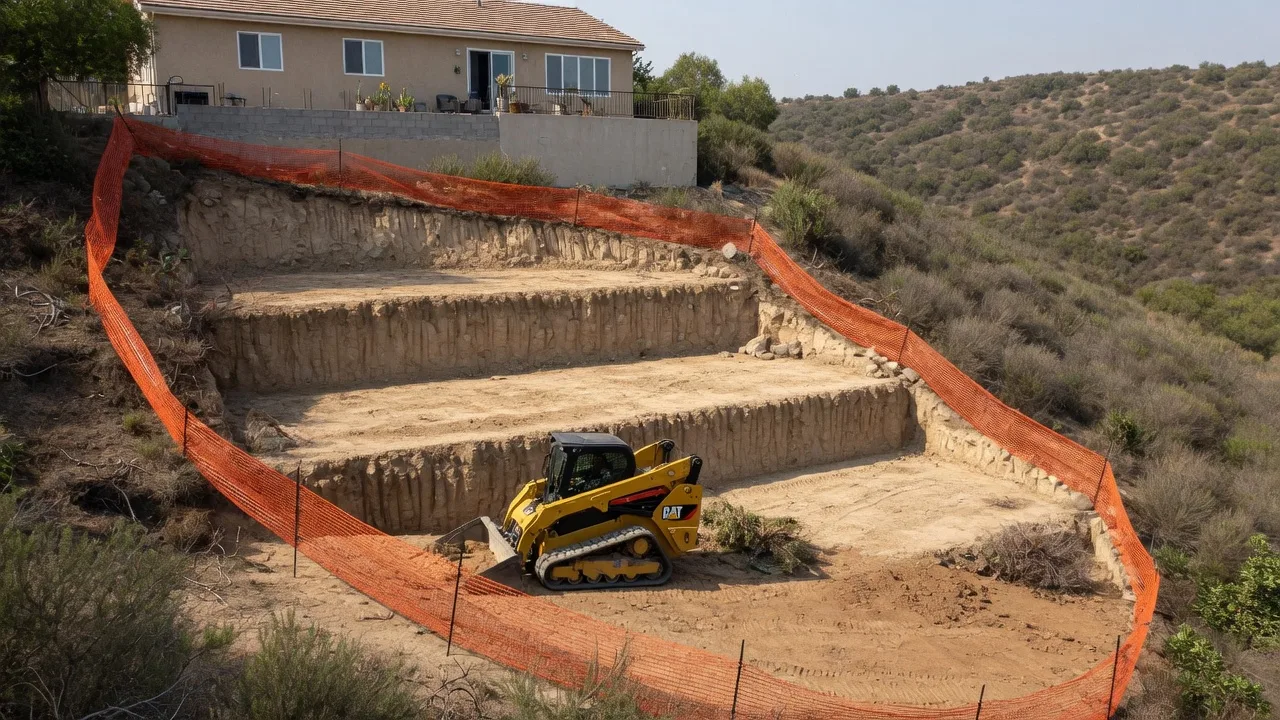
Land grading in a San Diego backyard is a permit question before it is a tractor question. The City of San Diego defines grading as any earthwork that involves grubbing, excavating, embanking, or filling. Grubbing is removing vegetation by disturbing roots or the soil surface. That definition catches a “just flatten the lawn” job, a slope cut for a patio, and a fill pad for a putting green. A Site Development Permit is required when grading creates a slope steeper than 25% (4 horizontal to 1 vertical) and 25 feet or more high. Smaller jobs can still need a Grading Permit under SDMC §129.0602. Other cities in the county write their own rules. Confirm the agency that actually issues the permit for the address.
This page is the permit-and-scope conversation. Yard drainage is the water-after-the-grade conversation. Retaining wall repair is the wall that holds the grade. Hydroseeding after a permitted grade is a different article.
What counts as grading on a residential lot?
People say “grading” when they mean a scraper on a hillside. The City’s words are broader.
- Grubbing: killing or stripping vegetation in a way that disturbs roots or soil. A full lawn kill plus soil scrape can qualify. See how to kill grass before landscaping.
- Excavating: cutting soil, including a pad for a patio or a lowered planter.
- Embanking / filling: placing soil to raise a pad or bury a slope.
Steep hillsides in the City’s materials are lands with a natural gradient of 25% and at least 50 feet of elevation change, or a 200% gradient with 10 feet of change. Environmentally sensitive lands add another overlay. This page does not map ESL for your APN. The City’s grading permit page and the Development Services counter do.
An exemption exists for excavation under a building, retaining wall, or pool when a valid building permit already covers that structure and the spoils go to a legal disposal site. Fill made from that excavation can still trip the grading thresholds. Do not treat a building permit as a blanket backyard-grade exemption.
Which City of San Diego triggers show up on backyard jobs?
SDMC §129.0602 lists when a Grading Permit is required. Selected residential-relevant triggers, from the City’s published materials:
- Grading in open space easements or City-owned open space
- Restoration of unauthorized grading
- Grading in a Special Flood Hazard Area
- Grading required as a condition of another development permit
- Excavation or fill that makes a 25% or steeper slope more than 5 feet high, measured on the face
- Excavation or fill more than 5 feet from lowest to highest grade at any time during the work
- Manufactured slopes steeper than the City’s slope-gradient standards
- Graded area more than 1 acre
- Grading that adversely changes drainage to adjacent properties: altering pattern, concentrating runoff, or increasing quantity or velocity
A Site Development Permit is a separate, higher review when the new slope is steeper than 25% and 25 feet or more high (SDMC §142.0103), with an exception the code states for underground parking.
Read the live ordinance. This site’s claims ledger records those triggers as of 2026-10-28. It is not a substitute for a plan check.
Unincorporated county land (4S Ranch, parts of Lakeside, Ramona, Alpine) goes through the County, not the City. Encinitas, Oceanside, Chula Vista, El Cajon, and the other incorporated cities have their own counters. A Carlsbad lot is not a City of San Diego handout.
How should a homeowner scope the work without guessing cubic yards?
Do not invent a “small backyard exemption” in cubic yards. The City did not publish one in the materials cited here.
Instead, describe the job in photos and measurements the contractor can take to the counter:
- Existing slope, measured, not guessed
- Cut and fill you want, in feet of height, not “a little”
- Where water currently leaves the lot, and where you want it to leave
- Distance to property lines and to the neighbor’s pad
- Whether a retaining wall will hold the new face
- Whether the lot sits in a canyon, a floodplain, or an open-space easement
Drainage is the fight people skip. A pad for a DG patio or a putting green that sheds onto the downhill house is how neighbors, and then the City, get involved. A rain garden can be the on-lot place that water goes. It is not a license to concentrate flow at the fence.
Bloom Pro SD is a referral service. We match you with licensed, independent landscaping professionals. The pro you hire pulls the permit when the job needs one. We do not pull permits, and we do not publish a grading price. Call (760) 400-6355 with the measurements above. Unauthorized grading is its own restoration permit. That is a worse day than asking first.
Frequently asked questions
Do I need a grading permit to flatten a bumpy lawn?
Maybe. If the work is only thin topdressing, maybe not. If you cut or fill more than the City’s height triggers, change drainage, or grub a slope, you may. Measure the height change and ask Development Services for that address. This page will not invent a “two-inch” exemption.
Is a Site Development Permit the same as a Grading Permit?
No. A Grading Permit is the construction permit for earthwork that meets §129.0602. A Site Development Permit is an additional development permit for creating a slope steeper than 25% and 25 feet or more high, among other ESL and slope rules.
Who issues the permit in Poway or unincorporated Lakeside?
Poway is its own city. Unincorporated Lakeside is the County of San Diego. The City of San Diego handout does not apply. Have the contractor name the jurisdiction in the bid.