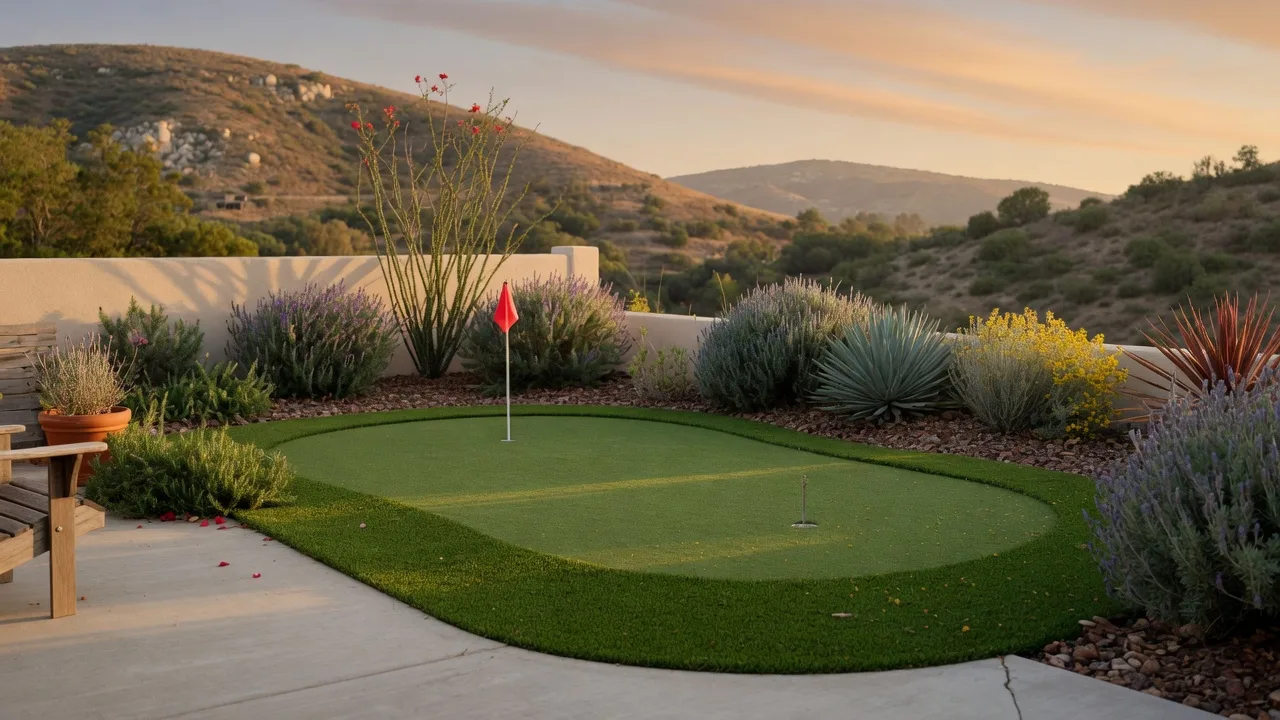
A backyard putting green in San Diego is a constructed playing surface, not a leftover strip of lawn you mow shorter. Most residential greens here are synthetic turf systems on a compacted base. That choice collides with two local rules people miss: SoCal Water$mart does not rebate synthetic turf, and a real-grass green still drinks like a specialty lawn in a climate that is trying to retire specialty lawns. Get the construction and the water story straight before anyone orders cups and a flag.
This is not the artificial turf cost article and not the turf maintenance schedule. Those pages cover yard-scale lawn substitutes. A green is a smaller, tighter-spec surface with roll, edge, and often a chipping collar.
What are you actually buying?
Three products get sold under the same name.
Synthetic putting green. Nylon or polyethylene turf, usually with a sand or mixed infill, on a graded, compacted base with drainage. Cup kits and a fringe of longer turf are add-ons. This is the common San Diego backyard product because it holds a roll without daily mowing.
Real-grass green. Bentgrass or another fine turf cut at putting height. It needs frequent mowing, consistent irrigation, and usually more nitrogen than a fescue lawn. Coastal marine layer helps the grass. Inland heat in Escondido or El Cajon cooks a bent surface. This site does not publish a water-budget number for a green. Ask the contractor to name the species and the irrigation design.
Portable or kit green. A rolled product on existing concrete or lawn. It is a practice mat, not a site-built green. Drainage, edge, and HOA appearance are different problems.
HOA documents often treat a green as artificial turf even when it is 400 square feet. Read the CC&Rs. Coastal cities and planned inland communities both reject “it is not a lawn” as an argument.
Why does the turf rebate not pay for this?
SoCal Water$mart’s turf replacement program pays for living turf converted to an eligible planted, permeable landscape. Synthetic turf is not an approved conversion option. Projects with synthetic turf, remaining live turf in the project area, invasive plants, or impermeable surfaces replacing the turf are ineligible. Confirm the live eligibility page for the year you apply.
If you strip a lawn to install a green, that square footage is a landscape project, not a rebate project. A planted buffer around the green can still follow rebate rules if it is a separate, qualifying conversion. Do not assume the green “sort of counts.”
A real-grass green also fails the direction of the program. You are adding a high-input turf, not removing one. City of San Diego potable landscape watering is limited to before 10:00 a.m. or after 6:00 p.m., and watering is prohibited during and within 48 hours after measurable rainfall, inside that utility’s service area. Other agencies set their own rules. A bentgreen’s daily syringe cycle has to live inside those rules or it is a code problem, not a golf problem.
How do coastal and inland yards change the build?
Base and drainage. A green that ponds in January is a failed green. San Diego winter rain is short and hard. Clay in Chula Vista and the South Bay needs a designed drain path, not hope. Sandy coastal lots drain, then the infill migrates if the edge is weak. The contractor should show how water leaves the surface and where it goes. Dumping onto a neighbor is how you meet the City’s grading trigger for changing drainage to adjacent property. See land grading if the yard has to be reshaped to host the green.
Heat and UV. Inland north county and East County bake synthetic blades. Color fade and heat at the surface are product and infill questions. Ask for the manufacturer’s UV warranty in writing. Do not take a remembered year-count from a national ad. Rinsing to cool the surface uses water. That is a household decision, not a published Bloom Pro SD figure.
Salt and wind. Point Loma, Coronado, Imperial Beach, and Encinitas add salt air and, on bluff lots, wind that moves infill. Specify an edge that holds. A green that sheds pellets into a native bed becomes a weeding and cleanup job.
Fire. CAL FIRE Zone 0 is the first 5 feet from structures. A synthetic surface in that band is a product and insurance conversation with the fire authority and the HOA, not a blog rating. Do not invent a “fire-safe putting green” claim.
For the rest of the yard, drought-tolerant landscaping and a decomposed granite patio are the usual companions so the green is a feature, not a leftover lawn.
What should a quote include?
Bloom Pro SD matches you with licensed, independent landscaping professionals. We do not install greens, hold turf inventory, or publish a per-square-foot price. Install It Direct and specialty green companies bid this work in the same market. Compare written scopes, not homepage numbers.
A useful quote names: square footage of green and collar, turf product and pile height, infill, base section (depth and material), edge restraint, cup count, drainage path, irrigation changes, demolition of existing lawn, disposal, and whether permits or HOA submittals are in the contractor’s scope. The pro you hire pulls any permit the city requires. We do not.
Call (760) 400-6355 with a measured sketch, photos of the slope, and the HOA page if you have one. The independent professional quotes the surface.
Frequently asked questions
Can I convert part of my lawn to a putting green and still get a turf rebate on the rest?
Maybe, if the planted portion is a separate qualifying conversion with its own plant density, stormwater feature, and no synthetic in that project area. The green itself does not qualify. Confirm with the program before demolition.
Is a real-grass putting green realistic inland?
It is a high-input lawn at putting height. Inland heat and water rules make it a specialist job. Most residential installs in this county use synthetic systems for that reason. Neither option has a price on this page.
Do I need a permit for a backyard putting green?
A green on existing grade with no retaining wall and no drainage change may be unpermitted work in some cities. Regrading, walls, or altered runoff can trigger grading or building permits. Confirm with the city or county that issues permits for the address. This site will not invent a countywide exemption.