A San Diego retaining wall that leans, bulges, or weeps muddy water is a failed structure, not a landscaping cosmetic. Repair starts with why it moved: water with nowhere to go, a load the wall was never built for, or material that has rotted or cracked through. Permit height, surcharge, and City Information Bulletin 220 already live on the retaining wall permit page. Use that page for the 3-foot-from-footing rule. Use this page when the wall you already have is telling you it is done.
Retaining wall cost is the quote checklist for a new hillside wall. Materials compares block, wood, and concrete. Do not treat those as a diagnosis of a rotating stem.
What is the wall actually doing?
Walk it after a rain, from a safe place.
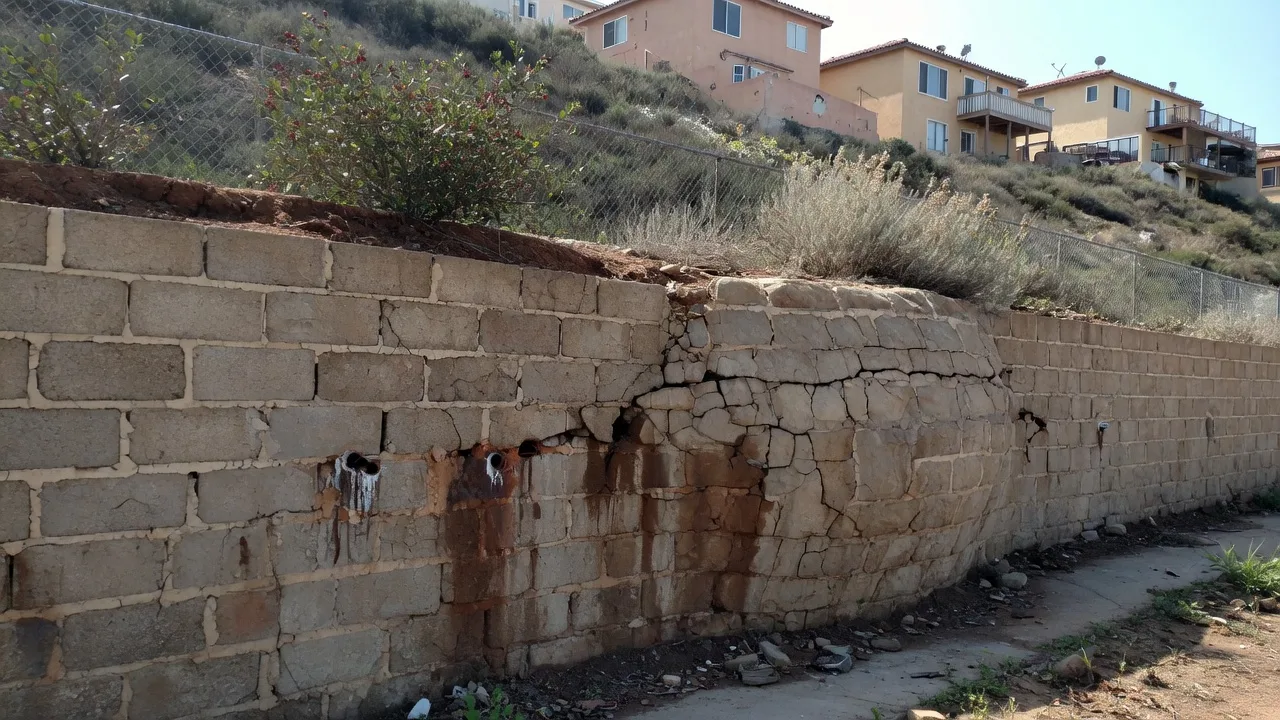
Weeps running muddy, or no weeps at all. A wall without a drain path is a dam. Hydrostatic pressure rotates block and bows timber. Soil-stained streaks on the face mean the backfill is piping through the joints. Cleaning the face and leaving the drain clogged is a one-season stall.
A bulge or a lean toward the low side. Courses that used to be level now belly out. Gaps open at the cap. A fence on top pulls the stem. That is movement. Tuckpointing a moving wall hides the crack until the next storm.
A wet band at the toe, or a patio that ponds above the wall. Water is stacking on the high side. Inland clay in El Cajon and Lakeside holds that water. Coastal sand can wash the backfill out from behind the face and leave a hollow you cannot see from the yard.
Timber that is soft at grade. Wood walls in this climate fail at the soil line first. A new face on rotten posts is not a repair.
Something new on the high side. A driveway, a spa, extra fill, or a heavy planter added after the wall was built is a surcharge. Even a short wall can be overstressed. The permit page is explicit: surcharge triggers a building permit on a new wall. On an existing wall it is why the stem rotated.
If the wall is moving toward a house, a sidewalk, or a neighbor’s pad, that is a building-department and structural-contractor day, not a blog timeline.
Repair versus rebuild
Repair is for a plumb wall with a local defect: a clogged drain you can reach, a cap that shifted, a short run of mortar loss with no rotation. The crew names the defect and the fix. They do not “resurface” a leaning wall.
Rebuild is for rotation, a growing bulge, separated courses, failed timber, or a surcharge the old wall cannot carry. Rebuild includes excavation, drainage (gravel, pipe, weeps), a footing that matches the design, and backfill placed in lifts. Copying the old face height without draining it repeats the failure.
Do not stack a second short wall against a rotating stem and call it a terrace. Tiered walls load each other. The permit page covers the City’s combined-height and slope-stability tests. A new wall in front of a failing one can surcharge the old one.
A geogrid or engineered masonry design belongs on the bid when the height, soil, or surcharge is outside a prescriptive handout. Bloom Pro SD does not engineer walls.
What local soils and water do to a weak repair
East County expansive clay moves with the seasons. A wall that looked fine in September can show a new crack after a wet January. South Bay clay in Chula Vista sits wet behind the stem. Canyon lots in La Mesa and El Cajon add surcharge from the slope itself. Coastal walls in Point Loma and Imperial Beach add salt to unprotected steel.
A repair that does not name drainage is incomplete in all of those soils. If the rebuild also changes grade or sends water to the neighbor, that is a land grading question on top of the wall permit.
Ice plant on the high side does not hold the bank. It can add wet weight. See ice plant.
What to send before a contractor match
Photos of the whole wall, both faces if you can do it safely, close-ups of cracks and weeps, the slope above, and anything sitting on the high side. A tape on the exposed height helps. Do not dig out the footing yourself to “measure for the permit.”
Name the city on the tax bill. City of San Diego uses IB 220 and 221. Unincorporated lots use County PDS forms. Encinitas, Poway, Chula Vista, and the rest have their own counters. The permit page is the rule sheet. This page is the failure sheet.
Bloom Pro SD is a referral service. We match you with licensed, independent hardscape professionals. The crews we send rebuild or repair. We do not. There is no wall-repair price on this site. Call (760) 400-6355. You contract with the pro. That pro pulls the permit when the job needs one.
Frequently asked questions
Can I just patch the cracks and wait a season?
If the wall is plumb and the weeps run clear, a mortar repair can be maintenance. If it has moved, a patch is a cover. Photograph the bulge against a fixed point (a post, a house corner) and compare after the next storm. Movement is a rebuild conversation.
Is adding gravel behind the wall enough?
Gravel without a pipe and an outlet still holds water. Drainage is a system: collection, pipe, weep or daylights, and backfill that does not turn to mud. Ask the contractor to draw that path.
Do I need a permit to repair an existing wall?
Sometimes. Rebuilding to a new height, adding surcharge, or replacing a permitted wall can put you back in IB 220 or the County forms. Confirm with the counter for the address. The permit page is the checklist. Do not assume a “repair” label skips plan check.