Highway iceplant is a San Diego slope problem wearing a drought-tolerant costume. Carpobrotus edulis, also sold as Hottentot fig or freeway iceplant, is rated High by the California Invasive Plant Council. Surfrider San Diego documented a west-facing 30th Street slope, north of Laurel, where an iceplant planting slid more than 100 feet in a rainstorm. The adjacent stretch renovated with natives did not slide. Shallow roots, a water-heavy mat, and a Cal-IPC listing are the three reasons this plant does not belong on a bluff, a canyon edge, or a rebate conversion.
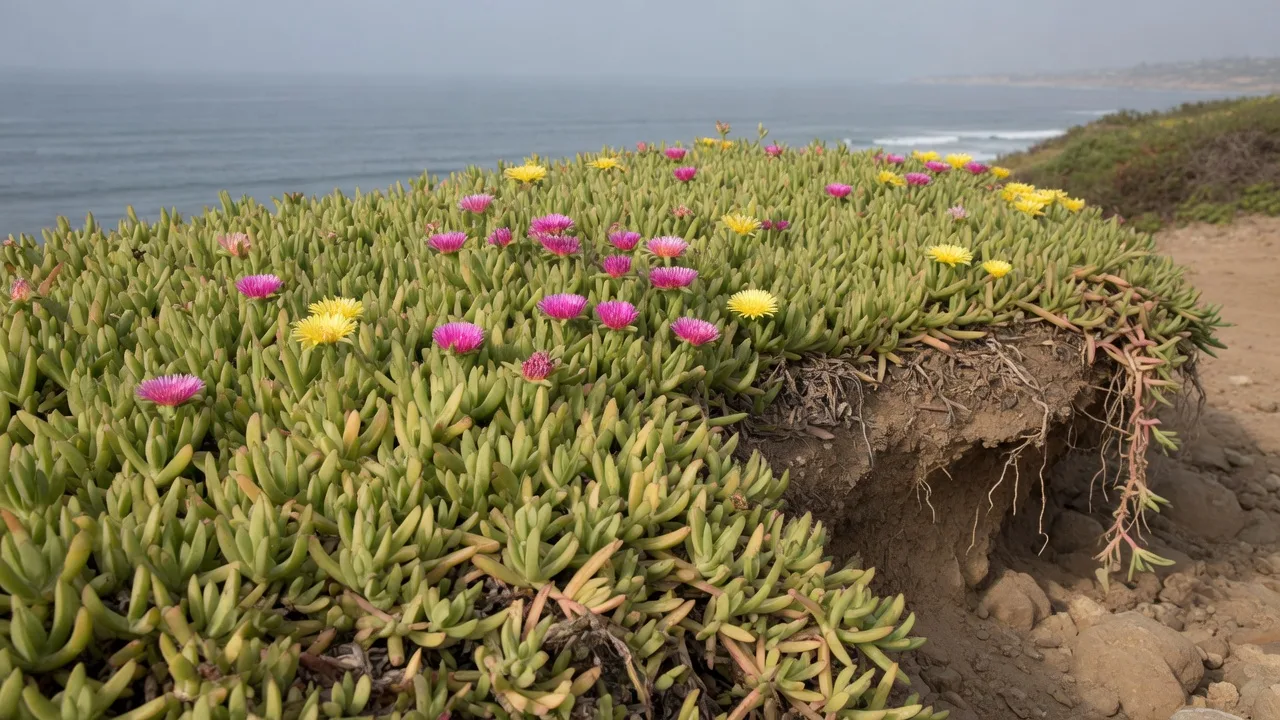
Nursery tags still say “ice plant” for several genera. This page is about Carpobrotus edulis and close Carpobrotus relatives used as highway mats. It is not a catalog of every succulent sold as ice plant. Drought-tolerant groundcovers for slopes is the planting alternative. Fountain grass is a different invasive-status decision.
What plant are people actually looking at?
Highway iceplant is a ground-hugging succulent from South Africa. Leaves are thick and three-sided. Flowers are yellow to pink. It roots along the stems and forms a closed mat. Calflora lists it as not native to California, with a Cal-IPC High rating.
Other plants share the common name. Delosperma, Drosanthemum, Malephora, and Mesembryanthemum show up in San Diego nurseries. Some are still invasive. Some are smaller ornamental succulents. Read the Latin name on the tag. The common name is too loose to make a slope decision.
Caltrans and railroads planted C. edulis for cheap cover. That history is why it still lines I-5, I-8, and coastal bluffs from Imperial Beach through Encinitas. Escape into dune scrub and coastal sage is the Cal-IPC impact, not a garden-center debate.
SoCal Water$mart makes conversions with invasive plants ineligible. If the invoice lists iceplant in the project area, the rebate can fail even if the rest of the bed looks right.
Why is ice plant a bad slope plant in this county?
The Surfrider San Diego note is the local picture. After rain, iceplant “inflates like a water balloon.” The extra weight pulls loosened soil downhill. On 30th Street the slide traveled more than 100 feet and threatened the guardrail and sidewalk. Native-renovated ground on the same slope, directly north, did not produce mudslides in that account.
That matches the plant’s architecture. Roots are shallow compared with native shrubs used on San Diego bluffs. The mat looks like erosion control because it hides the soil. Gullies can run underneath. Coastal winter storms, not summer drought, are the failure season.
Fire talk is not a rescue. Succulent leaves hold water, so iceplant has been treated as low-fuel cover. CAL FIRE’s Zone 0 is still the first 5 feet from structures, and Zones 1 and 2 make up 100 feet of defensible space required by law. A closed iceplant mat against siding is still plant mass in the ember zone. It is also an invasive. Do not treat it as a listed “firewise” stamp. This site does not invent a Cal Fire species approval.
Inland lots in Lakeside or Ramona are not a free pass. The plant is a coastal invader, but a neglected side-yard mat still spreads by stem pieces and fruit. Birds move seed. A “just on the parkway” planting is how canyon edges get it.
What should you plant instead, and how do you remove it?
Removal is a landscape job, not a Saturday pull on a steep face. Stems root at the nodes. Any live piece left behind can restart. On a stable, modest bank, hand pulling and piling the plants to dry is a common method described in local replacement flyers. On a steep or failing slope, killing in place and planting through the dead mat can be the erosion plan. Glyphosate, if used, is a labeled pesticide applied by someone allowed to apply it. Bloom Pro SD does not spray.
Replacement plants belong on a San Diego slope list, not a national succulent list. Surfrider’s local note points at deep-rooted natives such as San Diego marsh elder (Iva hayesiana) and dwarf coyote bush selections. Confirm current availability and the lot’s exposure with a designer who works this county. California native plants and the slope groundcover guide are the next reads. The UC Master Gardener Program of San Diego County will ID a bagged sample if the tag is missing.
If the iceplant is the only cover on a graded bank, do not strip it bare before a planting and irrigation plan exists. Bare soil in a January storm is how you meet the City’s definition of a drainage problem. Grading and grubbing rules are on the land grading page.
What should you send before a contractor match?
Bloom Pro SD matches homeowners with licensed, independent landscaping professionals. We do not remove iceplant or warrant a slope. The pro you hire prices access, disposal, irrigation, and planting. Steep lots may need fall protection and a different crew than a flat North Park parkway.
Send: a wide shot of the slope, a close shot of the leaves and flowers, the distance to the house and to the sidewalk, whether the lot sits in a high fire hazard area, and whether a rebate is in play. Call (760) 400-6355.
Frequently asked questions
Is all ice plant invasive in California?
Carpobrotus edulis is Cal-IPC High. Other iceplant-named succulents have their own ratings. Check Cal-IPC for the Latin name on your tag. Do not plant C. edulis on a San Diego lot.
Does ice plant stop erosion?
Not reliably, and local documentation shows it can add weight and slide. Deep-rooted natives are the slope plants to shortlist. A geotechnical issue still needs an engineer, not a groundcover.
Can ice plant stay if I want the turf rebate?
Projects with invasive plants in the converted area are ineligible under SoCal Water$mart rules. Confirm the live eligibility list before you keep a mat “for erosion” inside a rebate boundary.