The nursery tag says drought-tolerant and the seed heads look like a fountain. Fountain grass is not a lawn, and it is not a California native. The real question is whether this species belongs on your coastal or inland lot, given California’s invasive-status rules.
What is fountain grass, and what is it not?
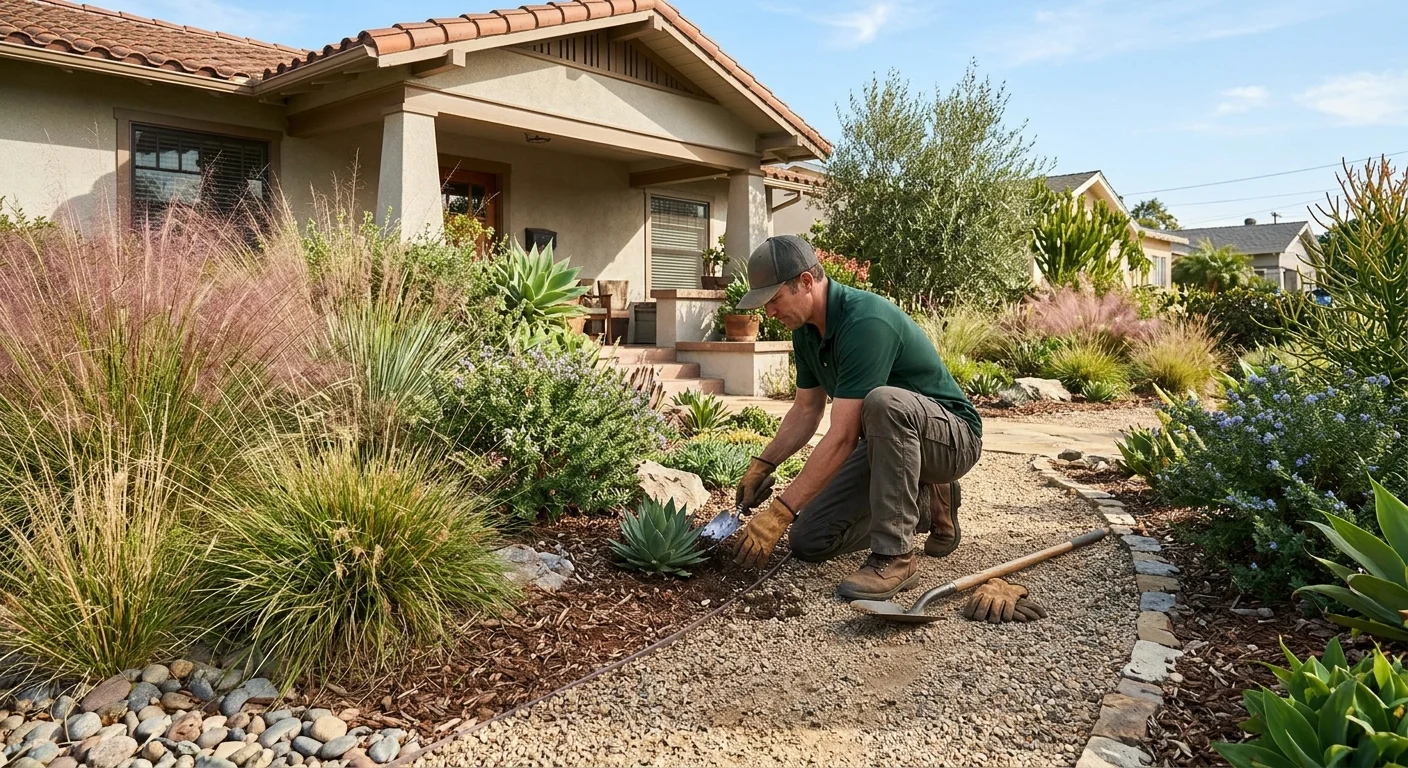
Fountain grass is a warm-season ornamental grown for an arching clump and bottlebrush flower heads. It is not turf. You do not mow it like Bermuda or tall fescue. It is not a groundcover that knits a slope together. One plant is a specimen, not a lawn substitute.
Two botanical names show up on San Diego tags, and they are not interchangeable. Crimson fountain grass, also sold as African fountain grass, is Pennisetum setaceum, now often listed as Cenchrus setaceus. Chinese fountain grass is Pennisetum alopecuroides, a different species. Purple fountain grass sold as ‘Rubrum’ is usually a named selection of the crimson type. Read the Latin name on the tag. The common name is too loose to make a planting decision.
It is a clumping grass. It does not run by stolons the way Kikuyu does. It spreads by seed. That is the issue on dry slopes, road cuts, and canyon edges from the South Bay through inland north county. A tidy clump in a Carlsbad parkway can still throw seed into open ground.
Mature size depends on the cultivar, sun, and water. Confirm height and width on the tag in your hand. A national catalog size is not a San Diego measurement, and this page will not invent one.
It is often grouped with other low-maintenance ornamental grasses in San Diego, which is a category roundup. This page is the species decision. Fountain grass is also not automatically a rebate plant. If you are converting lawn, SoCal Water$mart requires at least three plants per 100 square feet of project area, a stormwater feature, permeable surfaces, and no invasive plants in the converted area. A single fountain-grass clump does not meet that density rule on its own.
Establishment still takes water. No ornamental grass is drought-proof. City of San Diego Public Utilities rules allow potable landscape watering only before 10:00 a.m. or after 6:00 p.m., and watering is prohibited during and within 48 hours after measurable rainfall. Those timing rules apply inside that service area. Other county water agencies set their own rules. Check yours.
What invasive status should you confirm before planting?
Crimson fountain grass is listed as invasive in California. Confirm the live rating on the California Invasive Plant Council inventory before you buy. Search Pennisetum setaceum and Cenchrus setaceus. Treat that inventory as the authority, not a garden-center card.
Also check the California Department of Food and Agriculture noxious-weed materials for the same names. CDFA, not a blog, decides the state’s weed list. A specific CDFA letter grade is not logged in this site’s verified claims file, so this page will not invent one. Look the names up on CDFA’s site and follow what you find that day.
Nurseries often sell purple ‘Rubrum’ as a sterile selection. Sterility is a grower claim. This page cannot confirm that every purple clump on a San Diego lot is sterile, or that it stays sterile in the field. Escaped seedlings along Southern California roadsides usually come from the seeded crimson species. A purple leaf does not close the invasive-status question. Ask the nursery for the cultivar, the botanical name, and any sterility documentation, then still check Cal-IPC.
HOA rules are not countywide. No verified HOA plant ban for fountain grass sits in this site’s claims ledger. Check your CC&Rs and the association’s plant palette in writing. Communities in 4S Ranch, Scripps Ranch, Rancho Bernardo, and coastal Carlsbad often keep approved-plant lists. An HOA can reject a plant that a nursery will happily sell.
Turf replacement is a separate filter. SoCal Water$mart makes projects with invasive plants ineligible. If crimson fountain grass is the species on the invoice, the conversion can fail the program even if the rest of the bed looks right. Confirm plant eligibility with the program and your water agency before anyone digs.
If you want low-water structure without that listing fight, look at drought-tolerant plants for San Diego and at California native plants first. The UC Master Gardener Program of San Diego County is the local place to take a tag photo and get an ID, not a sales pitch.
Where do coastal and inland yards change the choice?
San Diego County is not one climate. A clump that holds in Encinitas can fail, or seed more aggressively, a few inland ridges away.
Coastal north county, from Oceanside through Carlsbad, Encinitas, Solana Beach, and Del Mar, sits in marine layer, milder nights, and salt air. Bluff lots in Encinitas add wind and spray. Plants often stay greener with less irrigation. That milder moisture can also keep flower heads producing seed for a longer stretch of the year. Salt and sandy soils are the coastal stress, not inland oven heat.
The central city and South Bay run warmer once you leave the first coastal ridge. Point Loma and Pacific Beach still feel the ocean. Chula Vista, National City, and San Ysidro pick up more heat and, on many lots, heavier clay. A fountain-grass clump in poorly drained clay sits wet after a winter storm, then bakes in July. That is a different plant problem than a sandy Carlsbad parkway.
Inland north county and East County change the choice again. Escondido, San Marcos, Poway, El Cajon, Lakeside, Santee, and the I-15 corridor take summer heat, Santa Ana winds, and colder winter nights in the valleys. A west-facing Lakeside bed is not a La Jolla courtyard. Heat and wind dry the clump and the seed heads. Dead thatch and plumes then sit as fuel on lots near wildland.
Fire spacing is about maintenance and distance, not a Cal Fire species stamp. CAL FIRE’s Zone 0, the ember-resistant zone, extends 5 feet from structures. Zone 1 extends to 30 feet. Zone 2 runs from 30 feet to 100 feet. Zones 1 and 2 make up the 100 feet of defensible space required by law. Keep dried ornamental-grass thatch out of Zone 0. Well-maintained, well-spaced plants can belong farther out. The statute does not publish a “Cal Fire approved” fountain-grass list, and this page will not invent one. For the wider clearance job, see defensible space and brush clearance in San Diego.
Irrigation design follows the microclimate. Coastal lots may need less summer water. Inland lots need a plan that does not fight the City of San Diego timing rules, or your own district’s rules, while the plant is getting established. EPA WaterSense is the federal reference for efficient irrigation hardware. The pros we send size that system to the bed, not to a nursery tag.
How does fountain grass compare with other ornamental grasses?
Compare function, not just the flower. Fountain grass is a showy clump with a seed-spread risk. Other grasses solve the same “soft texture in a dry bed” job with a cleaner California status.
Deer grass, Muhlenbergia rigens, is a California native bunchgrass. It makes a large, fine-textured clump without the crimson fountain-grass listing. It is the first native to put next to fountain grass on a shortlist when the lot sits near open space or a canyon. Pink muhly, Muhlenbergia capillaris, is the pink cloud people stack against fountain grass in photos. It is native to the eastern and southern United States, not California. Still check Cal-IPC the same way you would for fountain grass. A pretty inflorescence is not a local-origin certificate.
Purple needlegrass, the California state grass, reads as meadow, not fountain. Sedges and other native bunchgrasses fit coastal and inland palettes when the goal is a local plant community. Those options live in the native-plant guide linked above. They are not a second copy of the ornamental-grasses roundup.
Maintenance differs. Fountain grass asks for spent flower-head removal because those heads are the spread path. Native bunchgrasses still need a seasonal cutback. They do not carry the same Cal-IPC listing for the crimson species. Water needs during the first seasons are real for all of them. After establishment, natives selected for this county generally ask for less help than a thirsty ornamental, though this site does not publish a gallons-per-year figure for any one species. That number was not verified here.
Site fit still wins. A sterile-looking purple clump in a contained La Jolla courtyard is a different risk than the same common name on a slope above a Ramona chaparral edge. If the job is a full dry-garden redesign, the crews we send work from drought-tolerant landscaping and from landscape design, not from a single impulse buy at the nursery.
What should you share before requesting a contractor match?
Bloom Pro SD is a referral service. We take the job details and match you with a licensed, independent local landscaping professional. We do not plant, design, or warrant the grass. The contractor you hire confirms the price with you before any work starts. You contract with that pro directly.
Send what lets that pro judge the species, not just the photo of a flower head. A wide shot of the bed and a close shot of the tag. Sun hours, including afternoon west sun inland. Soil notes if you have them: clay in Chula Vista, sand near the coast, decomposed granite in East County. Your water agency, because City of San Diego timing rules are not the whole county. Whether the bed is a turf conversion that needs to stay rebate-eligible. Whether the lot sits in a high fire hazard area, and how close the planting is to siding, fences, and eaves.
Share HOA documents if you have a plant palette or a past violation letter. Share whether open space, a canyon, or a road cut sits downslope, because seed moves. Share the botanical name, not only “fountain grass.” If a nursery promised a sterile ‘Rubrum’, include that paperwork.
Ask the matched contractor to design around Cal-IPC and CDFA status, not around the prettiest clump on the bench. You can verify any California contractor license at the CSLB license check. The pros we connect you with are licensed and insured. They pull any permit the city or county actually requires for the larger job. Fountain grass in an existing bed rarely triggers a building permit on its own. A wider landscape remodel can.
If the right call is “do not plant this species,” that is a successful consult. A native bunchgrass or another ornamental already in your HOA palette is often the cleaner answer.
When to call us
Call when you want a licensed landscaping pro to judge fountain grass against your microclimate, HOA palette, fire spacing, and rebate rules, or to plant a different clumping grass instead. Call us at (760) 400-6355 and we’ll match you with a licensed local pro.