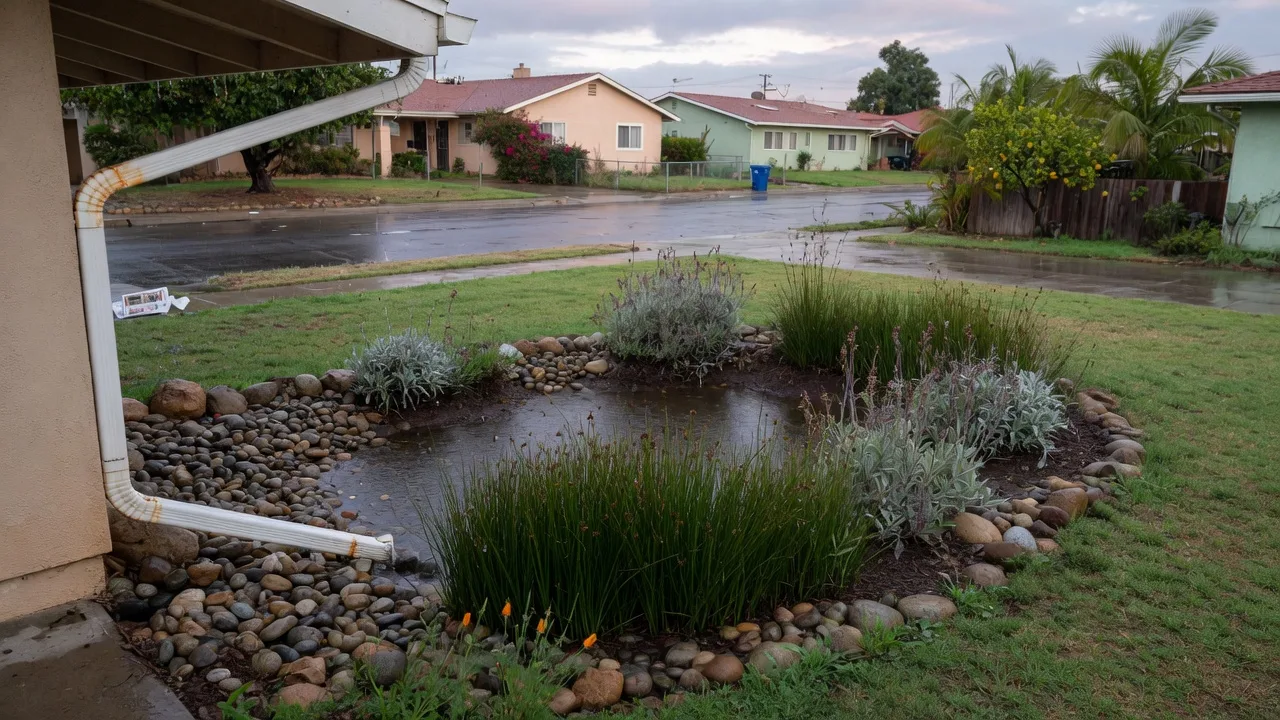
A rain garden in San Diego is a shallow planted basin that takes roof or driveway water and soaks it on the lot. SoCal Water$mart lists rain gardens among the stormwater features a turf-rebate conversion must include: the project has to capture rainfall by infiltration or on-site storage. That is the local reason this page exists. It is not a French drain, not a dry well you cannot inspect, and not a pond. County stormwater outreach (CleanSD) pushes the same idea: let rain do some of the watering, then give the extra a safe overflow.
Yard drainage problems covers French drains, channel drains, and wet slabs. Use that page when water is against the house. Use this page when you want a planted sink for roof water that also satisfies a rebate checklist.
What is the basin, and what is it not?
A working rain garden has:
- A contributing surface (roof downspout, patio, or short drive)
- An inlet that slows water (rock, cobble, or a splash pad)
- A depressed planting area with soil that can soak
- Plants that tolerate winter wet and summer dry
- An overflow that sends extra water to a safe place on your lot, not to the neighbor
It is not a hole lined with plastic. Plastic makes a pond, then a mosquito problem, then a failure when the liner sits in inland clay. It is not a substitute for a footing drain. If the crawl space is wet, fix that as drainage, not as a garden.
SoCal Water$mart also accepts rock gardens, dry river beds, swales, berms, rain barrels, and cisterns as stormwater features. A rain garden is the planted version. You still need the rest of the rebate rules: three plants per 100 square feet of project area, permeable surfaces, no invasive plants, drip instead of overhead spray or heads capped, approval before turf comes out.
How do coastal sand and inland clay change the soak?
San Diego County is not one infiltration rate.
Coastal sand in Ocean Beach, Pacific Beach, and parts of Encinitas takes water fast. The basin can be shallower. The risk is that water disappears before plants use it, and that fine mulch washes. An inlet of cobble and a basin planted with natives that can take both drought and a January pulse is the usual coastal picture.
Inland and South Bay clay in Chula Vista, National City, El Cajon, and Santee soaks slowly. A basin that is too deep sits as a bathtub for days. That is nutsedge habitat (see nutsedge) and a mosquito complaint. A wider, shallower basin, a longer swale, or a dry creek that spreads water may be the honest clay design. If clay will not take the roof, the overflow has to be designed, not hoped.
Hillside lots in La Mesa, El Cajon foothills, and the canyons add a grading question. Concentrating roof water and sending it downslope can be the City’s “adversely affects existing drainage” trigger. Read land grading before you pipe a downspout to the top of a bank.
City of San Diego watering rules still apply to any supplemental irrigation inside that utility: potable landscape watering only before 10:00 a.m. or after 6:00 p.m., and no watering during or within 48 hours after measurable rainfall. A rain garden that needs summer drip is still a drip zone on the controller, not a second lawn.
Skip ice plant in the basin. It is Cal-IPC High and a rebate disqualifier. Ice plant explains why it also fails as “erosion control.”
What plants and details belong on the quote?
Name plants that are used in San Diego rain gardens and native palettes, then confirm them with the designer: rushes and sedges that take seasonal wet, sage and buckwheat on the upper rim, existing trees that already count toward rebate density. This page will not invent a species list as a guarantee. The native plants guide and the water agency’s plant checker are the authorities.
A useful contractor scope names: basin size relative to roof area, soil amendment if any, inlet and overflow elevations, mulch that will not float away in the first storm, irrigation for establishment only, and how the overflow is protected. Overflow onto a DG path is a different section than overflow onto a neighbor’s slab.
Bloom Pro SD is a referral service. We match you with licensed, independent landscaping professionals. We do not size basins or stamp hydrology. Call (760) 400-6355 with a photo of the downspout, the slope, and the rebate status. The independent professional quotes the basin.
Frequently asked questions
Does a rain barrel replace a rain garden for the rebate?
SoCal Water$mart lists both as stormwater features. One qualifying feature is required. A barrel that overflows onto the sidewalk is not a finished plan. Confirm the live program language for your application year.
Will a rain garden fix a wet crawl space?
Usually no. Water against a foundation is a drainage and grading job. A rain garden handles roof or surface water you can aim into a basin. Do not treat it as a French drain.
Can I put a rain garden in Zone 0?
Zone 0 is the first 5 feet from structures. Keep plant mass, mulch, and standing water decisions inside current CAL FIRE defensible-space rules. A basin farther from the house, with an inlet from the downspout, is the usual layout. Confirm for the address.