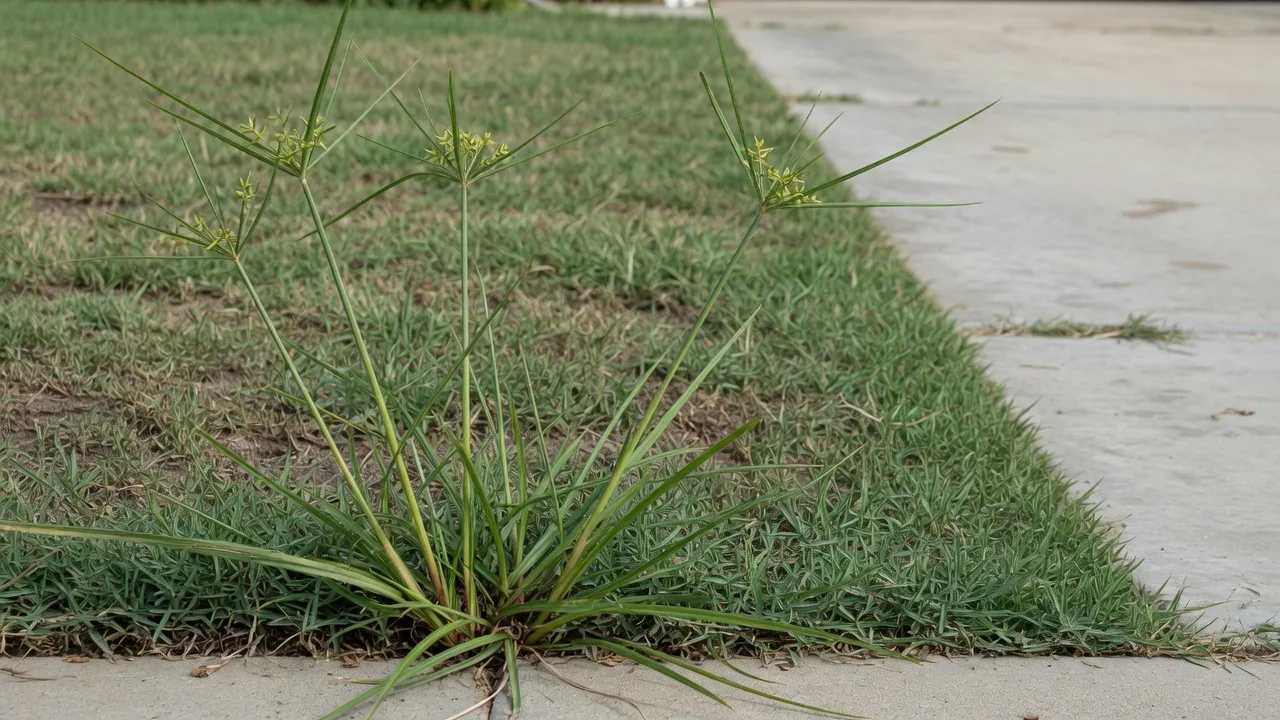
Nutsedge does not die like crabgrass, because it is not a grass. UC IPM Pest Note 7432, written by C.A. Wilen of UCCE San Diego, is the local authority: nutsedges are sedges with triangular stems, tubers on rhizomes as deep as 8 to 14 inches, and a habit of thriving in waterlogged soil. Yellow nutsedge (Cyperus esculentus) grows throughout California. Purple nutsedge (C. rotundus) is more common in southern coastal, desert, and Central Valley ground, which includes much of this county. Pull or treat before the plant has 5 to 6 leaves, before new tubers form. Glyphosate on a mature clump usually fails to move into those tubers.
The weed identification guide tells crabgrass from nutsedge. This page is the control job after you know it is nutsedge. Crabgrass is a different chemistry and a different life cycle.
How do you tell yellow from purple, and why does it matter?
Roll a stem between your fingers. Grasses are round or folded. Sedges are triangular. Leaves come in threes at the base. Flower heads sit on a stem with three long bracts.
Yellow nutsedge: light brown flowers and seeds, a single tuber at the end of a rhizome, tubers up to about 7/16 inch, often described as almond-scented if you cut one. Purple nutsedge: reddish flower heads, dark seeds, tubers in chains on one rhizome, bitter tubers, more common on the southern coast and low desert.
ID matters because drying tubers in summer sun, after cultivation, is a UC method that works on purple nutsedge and is not effective on yellow. Preemergent products UC lists for yellow (dichlobenil, dimethenamid-P, S-metolachlor) are not a purple-nutsedge preemergent toolkit. Home-garden labels still have to match the turf species. Most of those preemergents are not for lawns.
Tall flatsedge and green kyllinga get misidentified as nutsedge. They lack the deep tuber system. If you do not have a tuber in your hand, you may not have nutsedge. UC Master Gardeners of San Diego County will look at a sample.
Why does San Diego irrigation keep feeding it?
UC IPM: nutsedges thrive in waterlogged soil, and their presence often means poor drainage, too-frequent irrigation, or leaky sprinklers. Once established they tolerate ordinary irrigation and even drought. The leak is the opening. The tuber is the staying power.
Coastal lawns that get a daily six-minute spray to “beat the marine layer” stay wet at the surface. Inland lawns with a sunken head along the driveway make a nutsedge patch you can set a clock by. Fix the leak and the low spot as part of the weed job. Irrigation repair is the matching service when the sedge is a symptom.
Shade reduces nutsedge. A tall, dense shrub bed can starve it. A low groundcover will not. Mulch alone will not. Polyethylene sheets get pierced by the leaf tips. Thick nonwoven polypropylene under bark or gravel can suppress it. Emerging shoots still get pulled. See weed barrier under mulch.
Solarization is inconsistent on nutsedge even in inland July heat. Do not count on a tarp as the only nutsedge plan. The kill-grass page covers solarization for lawn conversion, with that caveat.
What control sequence actually depletes tubers?
UC’s cultural sequence is the one that matches a home lawn.
- Remove shoots before 5 to 6 leaves, about every 2 to 3 weeks in summer. At that stage the plant has not formed new tubers. Each flush spends tuber energy: UC cites about 60% of reserves on the first sprout and 20% on the second. Mature tubers can resprout more than three times.
- Hand-pull or hoe the basal bulb, 8 to 14 inches down if you are digging. A tiller on mature plants spreads tubers. Repeated tillage of small plants before six leaves can reduce a patch.
- Dig small turf patches at least 8 inches deep, refill, seed or sod, then watch the hole through spring and summer.
- Herbicides, if used, go on young plants. Halosulfuron (Sedgehammer and similar) is the home-lawn selective class UC lists. Sulfentrazone products labeled for nutsedge are another. Glyphosate is nonselective and, on mature nutsedge, a common miss. Apply when plants are young, actively growing, and not freshly mowed. Follow the label, including surfactant rules. Bloom Pro SD does not apply pesticides. Independent licensed applicators do.
No preemergent that controls nutsedge is labeled for turfgrass in the UC table. Preemergents around ornamentals are a bed conversation, not a fescue conversation.
Do not mow and hope. Nutsedge grows faster and more upright than the turf, so mowing without a tuber plan just keeps a light-green stubble in the lawn.
What should you send before a contractor match?
Bloom Pro SD matches you with licensed, independent landscaping professionals. We do not spray, and we do not guarantee a tuber-free lawn. A season of timed pulling plus leak repair is a realistic plan. A one-visit “nutsedge killer” is usually a top-kill.
Send photos of the patch, a pulled plant if you have one (stem, leaves, any tuber), irrigation notes, and whether the lawn is fescue, Bermuda, or mixed. Call (760) 400-6355. The independent professional quotes the work after seeing the stand.
Frequently asked questions
Will Roundup kill nutsedge in my lawn?
Glyphosate can suppress young, actively growing nutsedge. UC IPM says it needs repeat applications and only limited suppression, and that mature plants do not move the herbicide well into tubers. It also kills the turf it touches. It is the wrong mental model for a mixed fescue lawn.
Does nutsedge die in winter here?
Leaves and flowering stalks generally die back as temperatures drop. Tubers and rhizomes survive. Yellow nutsedge sprouts when soil stays above 43°F, purple when soil stays above 59°F. San Diego winters are mild enough that inland and coastal lots both see return flushes.
Can I just cover it with landscape fabric?
Not as a stand-alone fix. Leaf tips pierce polyethylene. Thick nonwoven fabric plus mulch can suppress, and you still pull what comes through. Treat fabric as a bed tool, not a lawn tool.