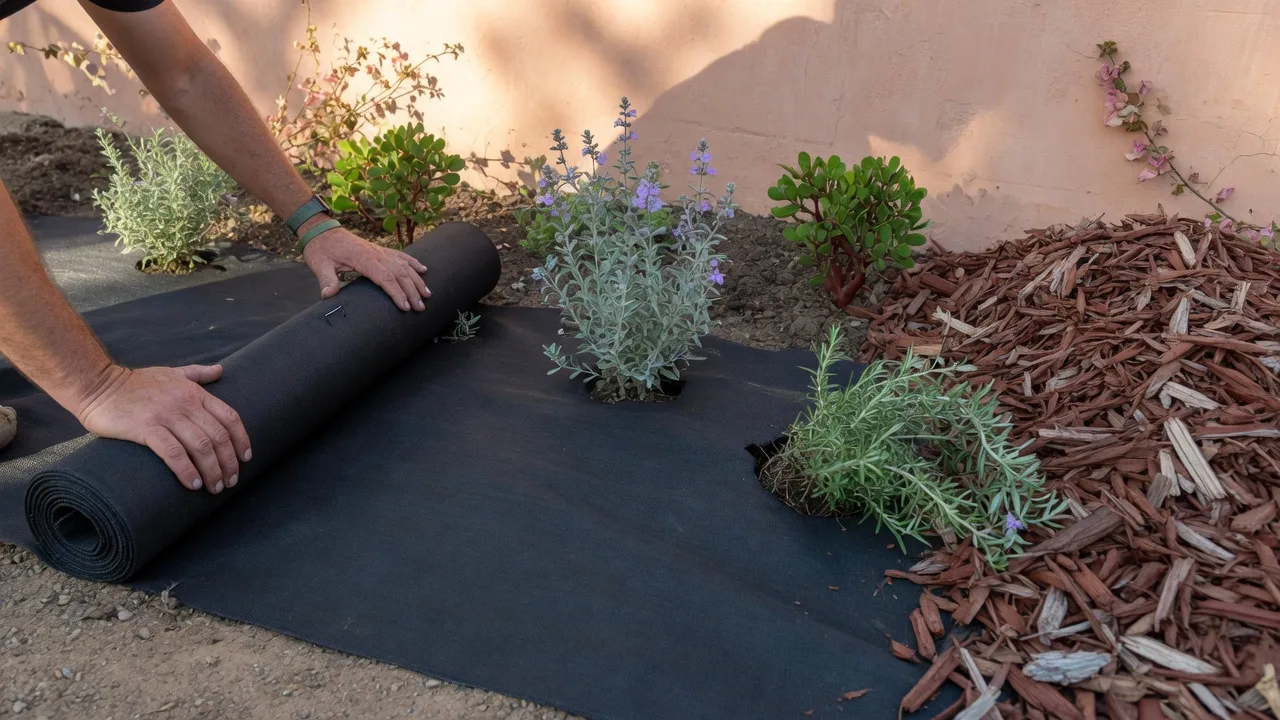
Landscape fabric under mulch can slow weeds that sprout from soil. It does not stop weeds that germinate in the mulch on top of it, and it is the wrong tool for nutsedge. UC IPM treats geotextiles (spun or woven polypropylene or polyester) as air- and water-permeable covers that outperform black plastic in planting beds. The same program notes that yellow nutsedge grows through most geotextiles. UC Master Gardeners separately warn that fabric is a temporary suppressant: windblown seed lands in the bark, sprouts, and then the rotting mulch clogs the weave.
This page decides fabric versus no fabric. Does mulch stop weeds covers mulch as a surface. Mulch types compares bark, chips, gorilla hair, and DG. Those are different jobs.
What is a weed barrier, and what is it not?
“Weed barrier” in a hardware aisle is usually a geotextile landscape fabric. UC IPM groups those manufactured sheets as synthetic mulches. They let water and air through. Black polyethylene does not. That difference matters in San Diego, where drip lines sit under the mulch and roots need oxygen through long dry stretches.
Fabric is not a herbicide. It is not a grade. It is not a substitute for pulling perennials before you cover the bed. UC IPM is blunt on woody beds: control perennial weeds before planting. Fabric over oxalis, Bermuda, or nutsedge just hides the fight.
Sheet mulch (cardboard or newspaper plus chips) is a different stack. It breaks down into the soil. Fabric does not. Do not talk about them as the same product.
Why does fabric fail in San Diego beds after a season or two?
Two local facts stack against a “lay it and forget it” install.
First, our weed seed does not only live in the original soil. Santa Ana winds, irrigation splash, and bird droppings put new seed on top of the bark. UC Master Gardeners of San Mateo and San Francisco Counties describe the same failure mode: the fabric blocks the old seed bank at first, then the mulch layer becomes a seedbed, and pulling those weeds tears holes that let more light through.
Second, organic mulch on fabric cannot do the soil job people buy mulch for. The chips sit on plastic instead of contacting native soil. They break down into fines that clog the weave. Inland summer irrigation on a Carlsbad-to-Escondido drip zone, then a January rain, pushes that sludge into the fabric. The bed then sheds water or stays oddly wet at the surface.
Nutsedge makes it worse. UC IPM: black or clear polyethylene does not stop yellow or purple nutsedge because the leaf tips pierce the sheet. Thick nonwoven polypropylene plus bark or gravel can suppress growth. Emerging plants still have to be pulled. Yellow nutsedge grows through most geotextiles. Thicker fabrics suppress it better than thin open mesh. If the bed already has nutsedge, read the nutsedge control guide before anyone unrolls a roll from the warehouse.
When is fabric still the right call?
UC IPM still recommends geotextile plus a shallow mulch on some woody tree and shrub beds, and it recommends fabric under rock so soil and stone do not mix. That mixing problem is real on San Diego decomposed-granite and gravel beds. Once DG sifts into loam, you are weeding a hybrid mess. Fabric, or another separator the contractor names, is a construction layer there, not a weed myth.
Closely woven or nonwoven (spunbonded) fabrics outperform thin, lightweight, open-mesh products. Brands differ in UV resistance. UC IPM notes that after about five years, roots can knit through fabric, and removing it can damage those roots.
Skip fabric in:
- Vegetable beds and annual color you will turn every year
- Beds you want to feed with decomposing chips
- Nutsedge-infested soil until the tubers are in a real management plan
- Zone 0 (the first 5 feet from structures), where the mulch choice is a fire conversation, not a fabric conversation. CAL FIRE’s Zone 0 is ember-resistant space. Combustible organic mulch does not belong against siding. Confirm current defensible-space rules for the address.
Gorilla hair and thick arborist chips without fabric remain a valid UC alternative: a thicker organic layer and no geotextile. That is often the cleaner long-term bed in a native or drought planting. See mulch types for the material, not a second fabric lecture. Recycled-tire rubber is a different inorganic; rubber mulch in San Diego is that product, including the playground-label trap.
How should a San Diego install be scoped?
The crews we send should write the stack, not just “weed barrier included.”
Ask them to name: perennial weeds already present, whether those get removed first, fabric product type (woven vs nonwoven) and overlap, how drip stays above or below the sheet, plant-hole cutting method, mulch type and depth on top, and the plan for weeds that germinate in the mulch. If the bed is a turf conversion, fabric does not replace the kill-the-lawn step or rebate plant-density rules.
Coastal sand in Ocean Beach or Imperial Beach drains fast. Inland clay in Chula Vista and El Cajon sits wet. A non-permeable plastic sheet is the wrong answer in both, for opposite reasons: it ponds on clay and it cooks sand. Geotextile is the UC category that at least passes water. It still is not magic.
Bloom Pro SD is a referral service. We match you with licensed, independent landscaping professionals. We do not sell fabric or warrant a weed-free bed. Call (760) 400-6355 with photos of the bed, the irrigation layout, and any nutsedge or Bermuda already in it. The independent professional quotes the stack.
Frequently asked questions
Does landscape fabric stop weeds permanently?
No. UC sources describe suppression, not elimination. New seed germinates in the mulch on top. Perennials already in the soil can punch through. Plan on hand weeding the surface.
Should I put fabric under gorilla hair or bark?
Only if the contractor can explain why this bed needs a separator. UC IPM allows fabric plus decorative bark. Master Gardeners warn that organic mulch on fabric clogs and stops feeding the soil. Many San Diego drought beds do better with chips on soil and a refresh cycle.
Can I put new fabric over old mulch?
That traps the old seed and debris between layers. UC guidance is to control existing weeds, then place fabric on prepared soil, then mulch. Over old mulch is a shortcut that becomes a weeding problem.
Is black plastic the same as weed barrier?
No. Black plastic restricts air and water. Geotextiles are made to pass both. UC IPM prefers geotextiles in landscape beds for that reason.