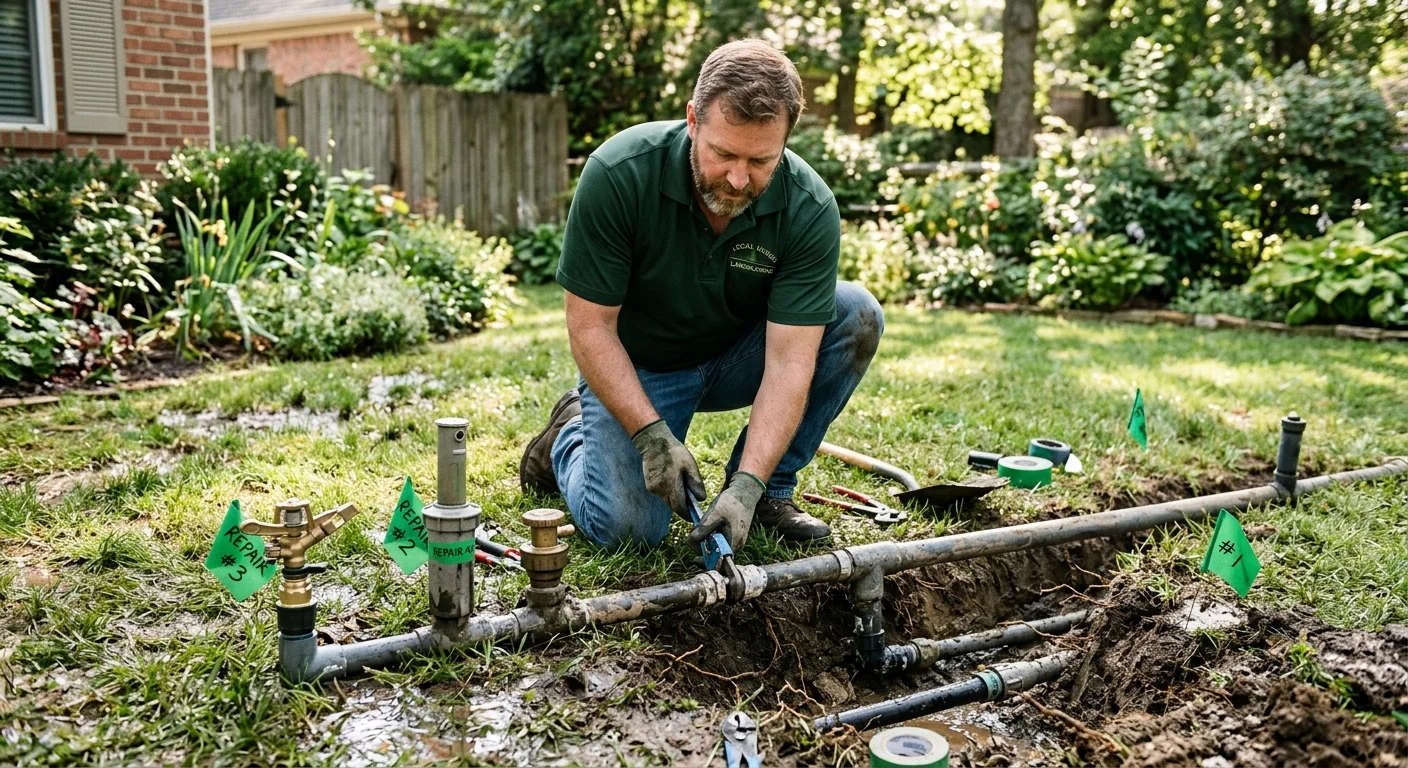
Repeated failures across several watering areas are the clearest reason to discuss replacement. One damaged head may need a focused repair, but recurring leaks, uneven coverage, and mismatched parts can make a system-wide review more useful. The final choice should follow a contractor’s on-site assessment, not one symptom.
When do repeated failures point to replacement?
Start with the pattern, not the latest broken part. A single failure tells you what happened today. A repair history shows whether the same lawn sprinkler system keeps creating new problems.
Write down each issue as it appears. Note the affected watering area, visible symptom, and whether an earlier repair involved the same location. Include leaks, heads that don’t rise, spray that misses the lawn, and areas that remain dry. Also record controller problems and valves that don’t behave as expected.
Replacement becomes worth discussing when problems appear across several areas. The same applies when one repair exposes another damaged section. That pattern doesn’t prove the entire system must go. It does give a contractor a reason to compare broader options.
Don’t make the decision from system age alone. The condition of accessible parts, buried lines, controls, and coverage matters more to the current scope. Ask the contractor to explain which components remain usable and which ones are driving the recommendation.
San Diego County properties also need address-specific context. A narrow lawn in Encinitas won’t present the same layout as a larger yard in El Cajon. Slopes, planting beds, paved areas, and separate lawn sections can change what needs attention. Water providers and local requirements may also differ across the county.
A useful replacement conversation should end with two clear pictures: what a focused repair would address, and what a larger replacement would change. If those pictures remain vague, ask for a more detailed scope before deciding.
Is the problem isolated or system-wide?
Treat each symptom as evidence, not a final diagnosis. A visible leak, dry patch, or incorrect start time can begin with one component. The important question is whether correcting that component resolves the broader pattern.
A timer that runs at an unexpected hour doesn’t automatically justify replacing buried irrigation. Begin with the controller settings and symptoms described in our sprinkler timer troubleshooting guide. If the controller issue is separate from the field problems, it should be listed separately in the contractor’s findings.
The same principle applies to unexplained wet areas. Record where the water appears, when it appears, and which watering area was active. Our sprinkler leak detection guide explains what information helps narrow the problem. Don’t assume one wet spot reveals the full route of a buried line.
Look for separation between symptoms. One damaged head beside a driveway may support a targeted repair. Trouble appearing in several unrelated lawn sections calls for a wider assessment. If valves, controls, heads, and buried lines all enter the discussion, ask which findings are confirmed and which remain possibilities.
Compare both scopes in writing. A repair option should identify the specific problem being corrected. A replacement option should identify every area and component included. The contractor should also explain what stays in place.
Our sprinkler repair cost guide discusses factors that can shape contractor pricing. Bloom Pro SD doesn’t publish a price list or set contractor prices. The contractor confirms the price with you before any work starts.
How do coverage and pressure affect the decision?
Coverage is about where the water lands. Pressure is about how the system behaves while a watering area runs. Both can help a contractor separate a localized defect from a layout that needs broader changes.
Observe each watering area during a permitted watering period. Record heads that don’t rise, streams that fall short, misting, overspray, and water reaching pavement. Mark dry sections and places where water collects. A short video can preserve details that disappear when the system stops.
Don’t diagnose the cause from appearance alone. Similar symptoms can appear in different parts of a sprinkler system. Ask the contractor to explain what was tested and how the finding affects the repair-versus-replacement choice.
Within the City of San Diego Public Utilities service area, permanent rules limit potable landscape watering to before 10:00 a.m. or after 6:00 p.m. Watering is prohibited during measurable rainfall and for 48 hours afterward. Irrigation also must not cause runoff onto adjoining property, walkways, roads, parking areas, structures, or places that aren’t being irrigated. The city says water leaks must be repaired or stopped within 72 hours of discovery or notification. Review the current wording on the City of San Diego water-use restrictions page.
Those City rules don’t cover every San Diego County address. If another agency supplies your water, check that agency’s current restrictions before running test cycles.
Coverage trouble alone doesn’t settle the replacement question. Ask whether adjustments or limited component changes can address it. If several watering areas can’t cover their intended sections consistently, request a written comparison of a targeted repair and a redesigned scope.
What should a replacement scope explain?
A replacement scope should define the proposed result without hiding behind the phrase “new system.” It should identify the watering areas involved, the components being removed, and anything remaining in service.
Ask the contractor to mark the affected areas on a simple property sketch. Lawn sections, planting beds, slopes, walkways, driveways, and hardscape edges should be easy to distinguish. The sketch doesn’t need polished artwork. It needs enough detail to connect the written scope with the actual yard.
The document should answer practical questions:
- Which existing components will remain?
- Which watering areas will change?
- Will the controller stay or be included in the work?
- How will lawn areas and planting beds be treated?
- Does the scope include surface restoration where access is needed?
- How will completed watering areas be checked?
- Are controller wiring or a backflow assembly involved?
- Which items are excluded from the contractor’s price?
Ask for repair and replacement options to use matching boundaries. Otherwise, one option may include work that the other leaves out. That makes the comparison harder to understand.
We couldn’t confirm one irrigation permit rule that applies to every sprinkler replacement across San Diego County. Requirements can depend on the address and exact scope. Ask the contractor to check with the city or county authority governing the property before work begins. If electrical, plumbing, or backflow work enters the scope, ask who will handle it and which local requirements apply.
Bloom Pro SD matches homeowners with licensed, independent landscaping contractors. Before signing a contract, you can check a contractor’s current record through the California Contractors State License Board. The official lookup accepts a license number, business name, or personnel name.
What should you report before requesting a contractor match?
Good intake notes help the matched contractor understand the decision you’re facing. Start with the service address and city. Add the water provider if you know it, especially when the property isn’t served by the City of San Diego Public Utilities Department.
Describe the yard by watering area. Note which sections serve lawn, planting beds, side yards, slopes, or other spaces. If you know the number of programmed areas, include it. Don’t guess when the controller labels are missing or unclear.
Then describe the failure pattern in plain language. Useful details include:
- Where visible water appears
- Which heads don’t rise or spray correctly
- Whether trouble affects one area or several
- Whether the controller starts at an unexpected time
- Which parts were repaired before
- Whether the same symptom returned
- Where dry spots, overspray, or runoff appear
- Which areas you want to keep irrigated
Photos should show both the problem and its surroundings. Include the controller display, visible damaged parts, wet locations, and wider lawn sections with uneven coverage. If a symptom only appears while watering runs, a short video can help document it.
Also explain your goal. You may want to preserve the current lawn, change the planting layout, separate lawn from beds, or compare repair against replacement. That context keeps the conversation focused on the intended yard, not just the latest failed part.
When you contact Bloom Pro SD about sprinkler and irrigation repair, we’ll take the job details and refer you to a licensed local contractor. The contractor assesses the property, recommends the scope, and confirms the price with you before work starts.
When to call us
System-wide irrigation work needs a licensed landscaping pro when failures cross several watering areas or the proposed scope includes buried lines, controls, or multiple lawn sections. We answer the line and match San Diego County homeowners with licensed, independent local contractors. Call us at (760) 400-6355 and we’ll match you with a licensed local pro.