September can leave San Diego homeowners facing a faded lawn and too many fertilizer choices. Start by checking the grass, soil, irrigation, and exact product label. Bloom Pro SD doesn’t diagnose lawns or apply treatments, but we connect homeowners with licensed local landscaping professionals.
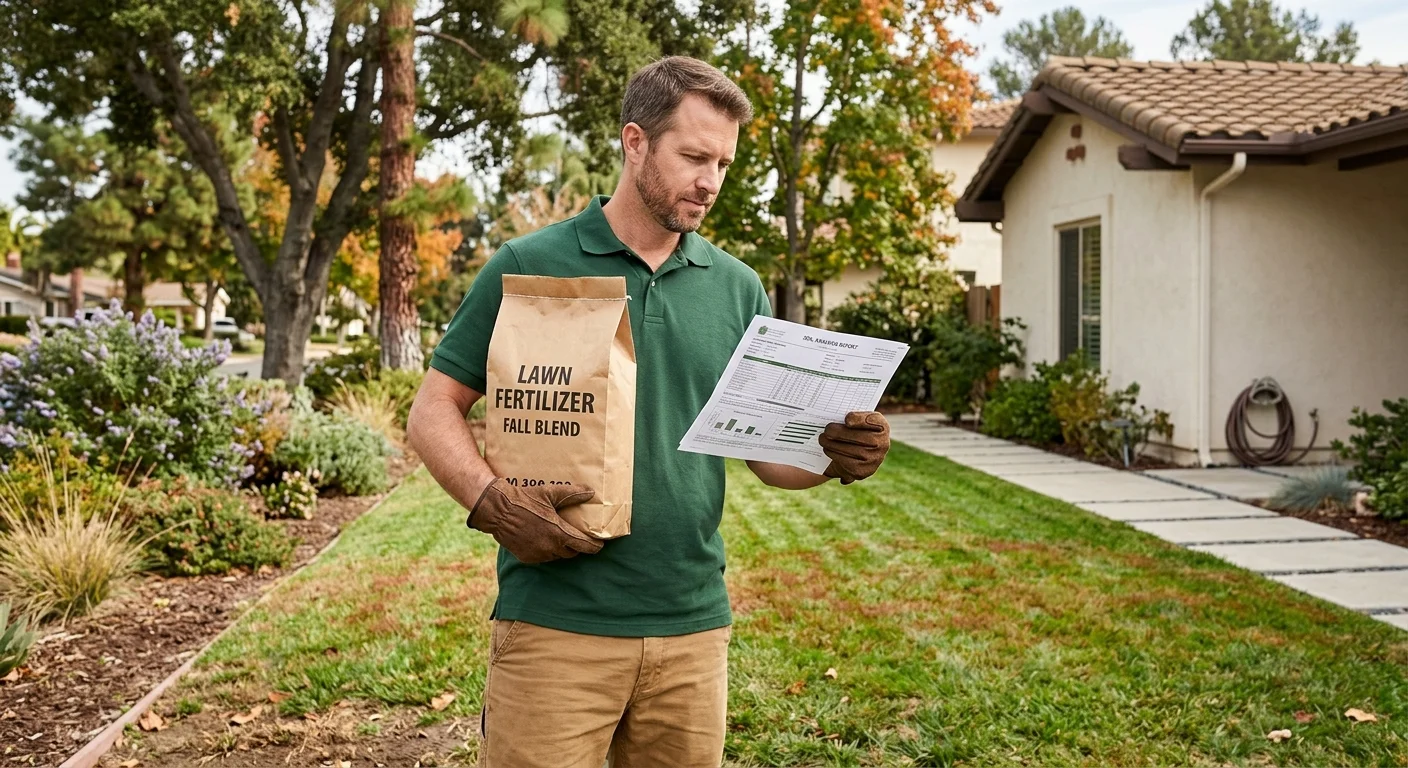
How does fall growth differ among San Diego grass types?
Start with the grass identity, not the season printed on a bag. A fall lawn fertilizer isn’t automatically suitable for every lawn in San Diego County.
The verified local guidance supports one broad comparison. The UC Master Gardener Program reports that warm-season Bermuda and Zoysia grasses need 25% less water than cool-season varieties. That comparison doesn’t establish a universal fall feeding date, product, or application rate.
The approved claims ledger also doesn’t confirm exact fall growth patterns for each grass. Those details need to be checked for the grass growing on your property. If the variety is unknown, don’t guess from color alone.
Record what you know before choosing a treatment:
- The grass name, if it was documented
- Whether the lawn was seeded, sodded, or patched
- Which areas look different from the rest
- Where shade and direct sun fall
- Which sprinkler zone covers each section
- Any recent lawn products and their application dates
Photographs can help a qualified professional review the lawn. Include close views of the blades and wider views of the affected area. Keep any old sod invoice, seed package, or maintenance record available.
Local context matters too. Don’t copy a treatment merely because it worked on another property. An Encinitas lawn and an El Cajon lawn shouldn’t be treated as interchangeable without checking their actual conditions.
Our broader San Diego lawn fertilizer schedule explains how to organize seasonal decisions. It isn’t a product prescription. For local educational help, the UC Master Gardener Program of San Diego County is another place to check current guidance.
Until the grass is identified, keep the product choice open.
When should a soil test guide the fertilizer choice?
A soil test should guide the decision when the treatment depends on conditions you can’t confirm by looking. It gives you a report to discuss instead of relying only on appearance.
Consider testing when the grass type is known but the treatment choice remains unclear. It can also make sense when different sections behave differently, previous applications aren’t documented, or someone recommends a product without explaining the basis.
The approved claims ledger doesn’t establish universal nutrient targets, soil pH ranges, sample depths, or testing intervals for San Diego lawns. It also doesn’t confirm one laboratory method for every property. Get those instructions from the chosen laboratory or a qualified professional before collecting samples.
Ask what the test is meant to answer. Useful questions include:
- Which part of the lawn does this sample represent?
- Should visibly different areas be sampled separately?
- Which results affect the fertilizer decision?
- Does the report support adding a particular nutrient?
- Does it indicate that the proposed product isn’t a match?
- How does the recommendation connect to the product label?
- Who can explain any result that isn’t clear?
Don’t turn an unexplained number into a treatment plan. Ask the laboratory or contractor to connect each recommendation to the tested area. Keep the report beside the exact product information so the two can be compared.
A test also has limits. It shouldn’t be presented as proof of every possible lawn problem. The approved ledger doesn’t support that claim. If the report doesn’t explain what you’re seeing, keep the diagnosis open.
Our guide to when a lawn needs a soil test offers a fuller decision checklist. The goal isn’t to test by habit. It’s to get evidence when evidence can change the choice.
How do irrigation and lawn stress change the decision?
Check irrigation before treating a lawn that looks stressed. Fertilizer shouldn’t become the default explanation for every pale, thin, or uneven area.
Begin with a visual review of each sprinkler zone. Note broken heads, blocked spray, overspray, and areas that stay noticeably different. Bloom Pro SD doesn’t inspect irrigation. A contractor can review the system and explain whether an irrigation issue should be handled before treatment.
Watering rules also affect the plan. Within the City of San Diego Public Utilities service area, potable landscape watering is allowed only before 10:00 a.m. or after 6:00 p.m. It’s prohibited during measurable rain and for 48 hours afterward. Irrigation also can’t create runoff onto adjacent property, non-irrigated areas, walkways, roads, parking areas, or structures.
Those are City of San Diego rules, not a countywide schedule. Properties served by another water agency may have different restrictions. Confirm the current rules for the agency serving the property. The city publishes its requirements on the official water use restrictions page.
Recent mowing belongs in the review as well. UC Statewide IPM says no more than one-third of the grass blade should be removed during one mowing. Removing more stresses the plant and depletes root reserves. Record the recent mowing pattern before treating appearance as evidence of a fertilizer need.
Also note recent heat exposure, foot traffic, pet activity, sprinkler repairs, and any product already applied. These observations don’t establish a diagnosis. They give the contractor a clearer starting point.
If irrigation performance or lawn condition remains uncertain, pause the fertilizer choice. Our lawn fertilization and care service can connect you with a licensed independent pro who can review the property and discuss the next step.
What can product labels and application limits confirm?
The exact product label should control the product-specific decision. Don’t substitute a general online schedule for the directions printed on the package you intend to use.
Before opening the product, locate every relevant section of the label. Look for:
- Grass types named on the label
- Listed application rates and limits
- Timing or frequency directions
- Watering and rain instructions
- Warnings involving people or pets
- Protective equipment directions
- Storage and disposal instructions
- Any restrictions tied to the treatment area
- Manufacturer contact information for unclear directions
The approved claims ledger doesn’t confirm a universal fertilizer rate, maximum application amount, rain interval, or pet reentry time. It also doesn’t approve one storage method or protective equipment rule for every product. Those details must come from the exact label.
If the label is missing, damaged, or unreadable, don’t improvise. Find the official label for that exact product or contact its manufacturer. A similar bag isn’t a substitute.
Terms such as organic and synthetic also don’t replace label review. Each product still needs to be evaluated on its own directions and restrictions. Our organic versus synthetic lawn fertilizer guide can help organize that comparison without prescribing one category for every yard.
Write down the lawn area being considered and the specific sections being treated. Ask a qualified professional to explain any calculation they use. The explanation should match the label rather than a generic habit or an unlabeled scoop.
Keep people and pets away according to the exact label directions. The ledger doesn’t support a single waiting period that applies to every fertilizer. When the label isn’t clear, ask the manufacturer or a qualified professional before proceeding.
What should you ask a lawn care contractor before treatment?
A contractor should be able to explain why the proposed treatment fits the observed lawn. You don’t need a sales pitch. You need a clear connection between the grass, available evidence, irrigation, and product label.
Start with these questions:
- What grass type do you believe this is?
- What evidence supports that identification?
- What conditions are you trying to address?
- Could irrigation or mowing be affecting what we see?
- Would a soil test change the treatment choice?
- Which exact product would be used?
- Which label directions determine the application?
- How will treatment boundaries be marked or explained?
- What should residents know about people and pets?
- What preparation is expected from the homeowner?
- What work is included in the proposed scope?
- Who confirms the final price before work begins?
Ask the contractor to separate observations from conclusions. If something hasn’t been confirmed, it should stay unconfirmed. A responsible discussion can include uncertainty without filling the gap with a guess.
Bloom Pro SD is a referral service. We take the job details and match homeowners with licensed, independent local landscaping professionals. The homeowner contracts with and pays the professional directly. The contractor confirms the price before any work starts.
You can also verify a contractor through the official CSLB license lookup. It accepts searches by license number, business name, or personnel name. Its records show items including license status, classification, expiration, bond status, workers’ compensation information, and disciplinary actions.
Before approving treatment, make sure you can repeat the contractor’s reasoning in plain language. You should know what was observed, what remains unknown, which label applies, and why that choice was proposed.
When to call us
Call when the grass type, soil evidence, irrigation condition, or product choice needs review by a licensed landscaping professional. Call us at (760) 400-6355 and we’ll match you with a licensed local pro.