A moss lawn shows where moss has found room to grow. It doesn’t prove why the nearby grass is thin. In San Diego, the useful next step is documenting the patch before changing water, soil, or lawn products.
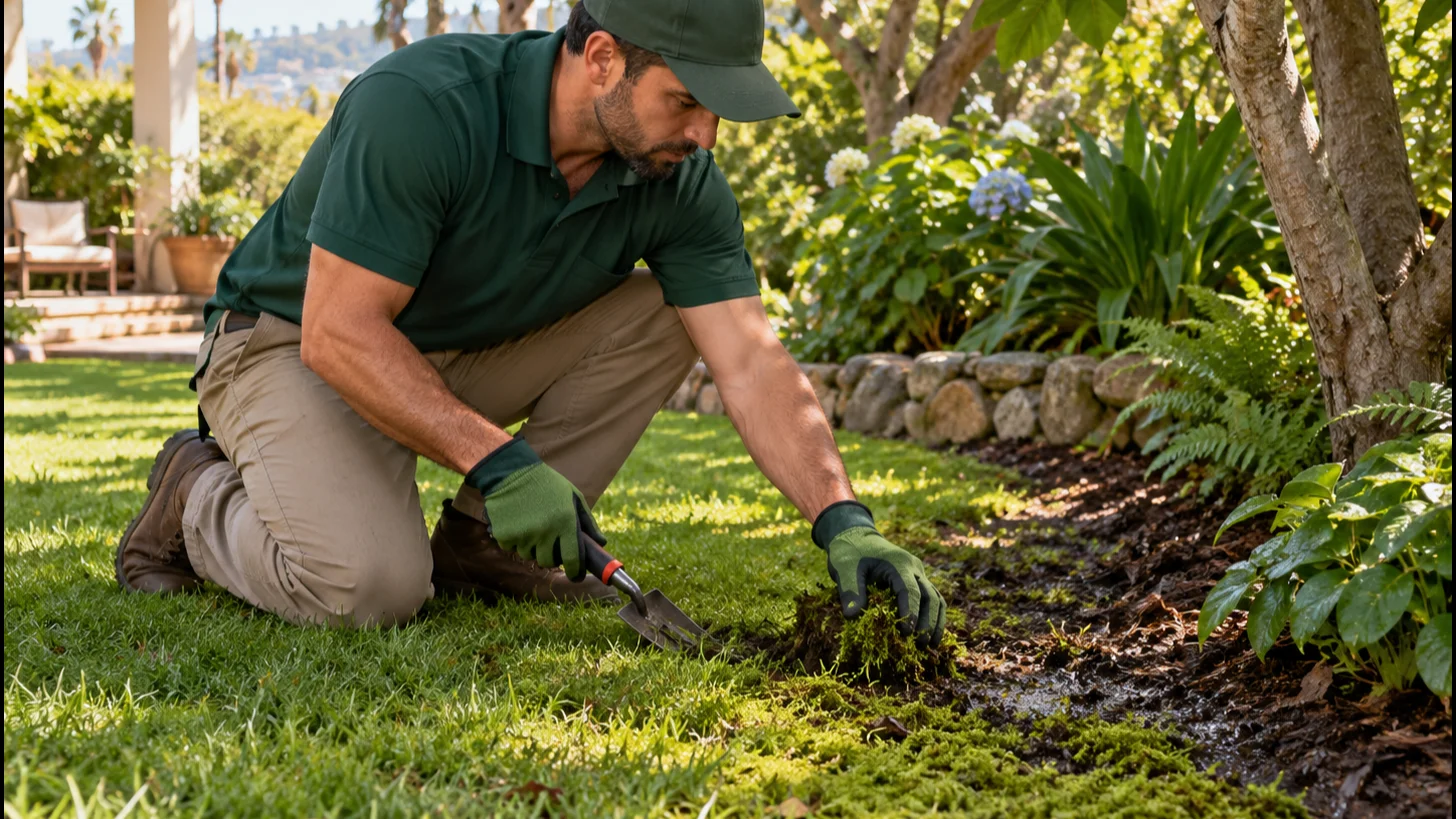
What moss in a lawn can indicate
Treat moss as a visible clue, not a complete diagnosis. The approved research for this site doesn’t confirm one universal cause for moss growing in lawn areas. It also doesn’t establish that moss causes the surrounding grass to decline.
Start with the pattern. Mark whether the moss appears beneath a tree, beside a wall, near a sprinkler, or across an open area. Note whether the grass around it looks thin, bare, discolored, or normal. These details help distinguish a small site issue from a broader lawn concern.
Compare the patch with a healthy part of the same yard. Look at light, surface moisture, foot traffic, irrigation coverage, and grade. Don’t assume one difference explains everything. The comparison simply gives a contractor better information to evaluate.
A moss in San Diego lawn concern can look different across one property. A north-facing side yard may receive different light than an open front lawn. A strip beside a fence may also dry differently from turf near a driveway. Those observations matter more than applying one generic answer countywide.
Moss isn’t automatically better or worse than grass. “Better” depends on how you use that area and what appearance you want. A play area, formal lawn, and shaded ornamental corner have different needs.
The approved claims ledger doesn’t confirm how quickly lawn moss spreads or provide a moss-care schedule. It also doesn’t contain a verified botanical description for what moss is made of. For those questions, contact the UC Master Gardener Program of San Diego County or ask a qualified local professional to identify the growth.
How shade, moisture, and soil conditions interact
Shade, moisture, and soil are reasonable conditions to investigate. Moss alone doesn’t confirm that any one of them is the cause. Check each condition separately before deciding what needs to change.
Observe the patch at several points during the day. Record when direct light reaches it and what creates the shade. A house, fence, hedge, or tree canopy can produce different patterns. Don’t remove plants or branches based only on the presence of moss.
Next, inspect moisture without guessing below the surface. Note whether the area remains visibly wet after irrigation or rain. Compare it with nearby turf at the same time. Photograph standing water, runoff, muddy soil, or a sprinkler stream hitting the patch.
Soil appearance doesn’t establish its chemistry. Moss isn’t a substitute for a soil test, and visible growth doesn’t confirm acidity or a nutrient shortage. The approved UC IPM guidance says soil analysis can identify nutrient and amendment needs. It also says phosphorus and potassium shouldn’t be assumed necessary when existing levels are already high.
Our guide to when a lawn needs a soil test explains how testing fits into a broader lawn review. Use the laboratory’s results and product directions rather than choosing an amendment from appearance alone.
Routine mowing deserves context too. UC IPM advises removing no more than one-third of the grass blade during one mowing. Removing more can stress the plant and deplete root reserves. That rule supports grass care, but it doesn’t diagnose moss or prove why a patch developed.
Why removing visible moss may not solve the cause
Removing what you can see answers one narrow question: whether the surface growth is still present. It doesn’t establish why that location supported moss or why the grass became sparse.
Before disturbing the patch, photograph its boundaries. Include nearby sprinkler heads, roof drains, downspouts, walls, trees, slopes, and worn paths. Those reference points disappear once the surface has been raked or covered.
The claims ledger doesn’t contain an approved moss-removal method, product recommendation, application rate, or re-entry period. It also doesn’t verify household mixtures as lawn treatments. Don’t treat an online recipe as safe for grass, pets, children, or nearby planting beds without checking its label and an authoritative source.
If you use a labeled lawn product, follow that specific label. Product directions govern application, handling, and re-entry. Don’t combine products or invent a waiting period.
A soil amendment presents the same problem. Adding lime, fertilizer, or another material without test results can turn an unknown condition into a second unknown. A laboratory result can show whether an amendment is supported. It can’t replace an on-site review of irrigation, drainage, shade, and lawn use.
Physical removal can also make later evaluation harder. A contractor may need to see the transition between moss, bare soil, and turf. Leave one representative section untouched when practical, or take clear close-up and wide-angle photos first.
If the lawn receives regular service, share the observation with the provider. A lawn maintenance professional can review mowing practices and the surrounding turf. Bloom Pro SD only makes the referral. The independent contractor evaluates the property and confirms any proposed work with you.
When irrigation or drainage needs a closer look
Irrigation deserves attention when the moss pattern overlaps a wet area, sprinkler stream, or recurring runoff path. That overlap is useful evidence, but it still doesn’t prove the irrigation system caused the moss.
Run each irrigation zone only while you’re present to observe it. Watch where water lands and where it travels. Record misting, blocked spray, water striking a wall, visible pooling, or a head that doesn’t match nearby coverage. Don’t dismantle pressurized or unfamiliar components just to investigate moss.
The City of San Diego has permanent water-use restrictions within its Public Utilities service area. Potable landscape watering is permitted only before 10 a.m. or after 6 p.m. Watering is also prohibited during and within 48 hours after measurable rainfall. Irrigation can’t cause runoff onto walkways, roadways, structures, adjacent property, or non-irrigated areas.
Those rules don’t automatically apply in the same form across every San Diego County water district. Confirm the current requirements with the agency serving your address.
An irrigation repair contractor can assess coverage, leaks, valves, heads, and controller settings. The contractor should confirm what was found before recommending repairs. Moss by itself isn’t proof that the controller needs more or less runtime.
Drainage needs separate attention when water repeatedly collects or crosses the lawn. Note where it enters and exits, especially near buildings, walls, and neighboring property. Our guide to yard drainage problems in San Diego explains what to document before requesting help.
Grading can involve permits within the City of San Diego. The exact requirements depend on the work and property. Don’t reshape a slope or redirect drainage across a property line based only on a moss patch. Ask the applicable city or county department about the address before earthwork begins.
What to report before requesting a contractor match
A clear intake helps us match the concern with the right type of professional. You don’t need to diagnose the moss. Describe what you can see, where it occurs, and what changes around it.
Include these details:
- The property city and neighborhood
- The patch location within the yard
- Whether the area is flat, low, or sloped
- Nearby trees, walls, fences, drains, and sprinkler heads
- When direct light reaches the area
- What happens during an irrigation cycle
- What the area looks like after rain
- Whether water pools, runs off, or reaches pavement
- Whether the grass nearby is thin, bare, or discolored
- Recent mowing, irrigation, or landscape changes
- Any soil-test results or product labels
- Clear photos from close range and across the yard
Report timing without trying to calculate a spread rate. State when you first noticed the patch and whether its outline changed. The approved research doesn’t provide a verified timetable for how quickly moss spreads.
Also explain what outcome you want. You may want to preserve a conventional grass lawn, investigate irrigation, correct recurring drainage, or reconsider a difficult corner. That goal affects which professional is a sensible match.
Don’t remove the moss, change several controller settings, fertilize, and alter drainage at once. Multiple changes make it harder to tell what condition mattered. Keep notes when you make any adjustment.
Bloom Pro SD answers the line and gathers these details. We then match you with a licensed, independent local landscaping professional. The homeowner contracts with and pays that contractor directly. The contractor confirms the scope and price before work starts.
When to call us
Call when moss appears with thin turf, recurring wetness, questionable irrigation coverage, or a drainage pattern that needs an on-site review. Bloom Pro SD doesn’t diagnose lawns or perform treatments, but we can connect you with an independent landscaping contractor.
Call us at (760) 400-6355 and we’ll match you with a licensed local pro.