Weeds between San Diego pavers are a joint-and-base problem. They are not a lawn-weed problem that happens to sit on the patio. Seed germinates in open sand, in dusty fines that collect after Santa Ana winds, and in joints that opened when the pad settled. Pulling the green top and walking away leaves the root in a moist crack. A winter storm then restocks the sand. If the pavers rock, the base failed, and weeding is a stall.
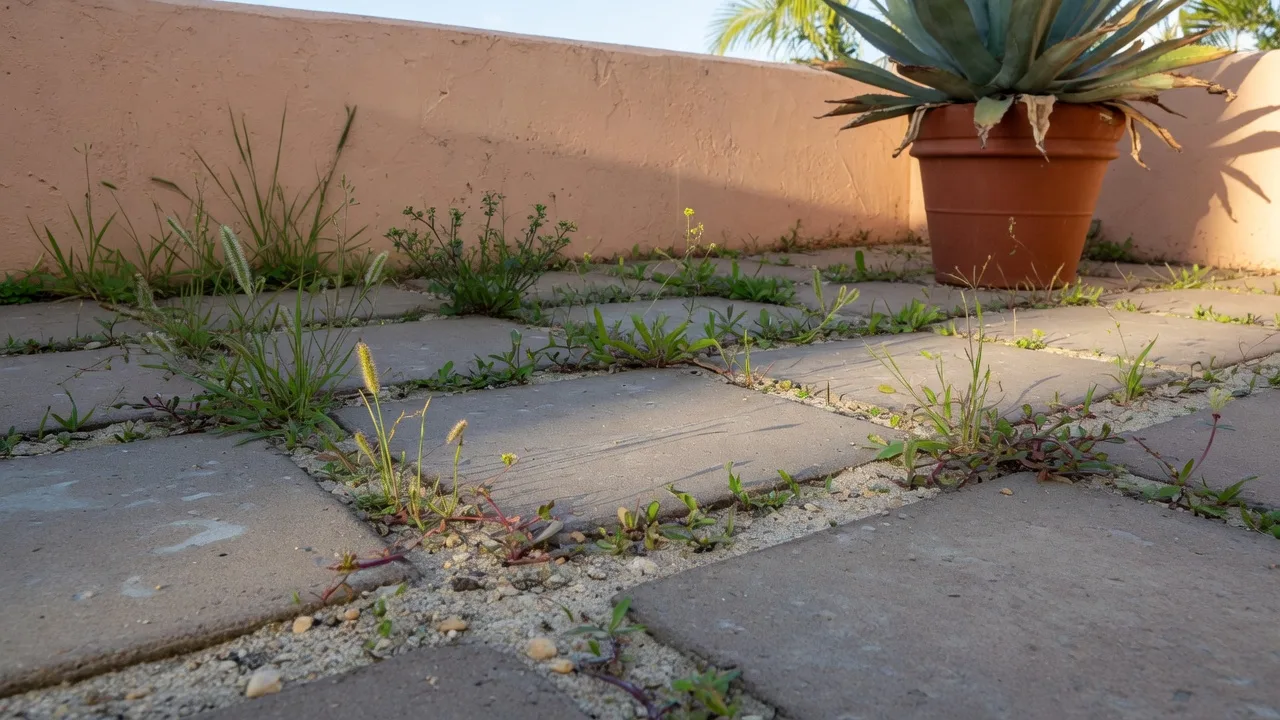
This is not common weeds in lawns and not paver patio cost. Those pages identify turf weeds and price a new patio. This page is the existing patio whose joints grew a meadow.
Why do joints in this climate fill so fast?
Three local conditions feed the crack.
Open sand. Many DIY and older installs use plain joint sand. It is a seedbed. Irrigation overspray from a fescue strip, plus January rain, keeps that sand wet at the surface. Nutsedge and Bermudagrass from the lawn will exploit any joint that stays moist. Nutsedge leaf tips even pierce plastic, so a “barrier” under the patio does not save a wet joint. See nutsedge if the plant in the crack is a sedge.
Wind and fines. Santa Ana winds drop dust and seed onto the patio. Coastal lots add sand from the street. Those fines sit in the joints on top of whatever sand was swept in at install. UC’s landscape-fabric caution is the same physics: new seed germinates in the layer of organic junk on top of a barrier.
Movement. A patio without a locked edge, or with a washed-out base, opens joints every summer. Inland clay shrinks. Coastal sand migrates. Once a joint is wider than the original sand joint, weeds win. DIY paver mistakes covers the construction errors. Repair starts by asking whether the pad is still true.
Polymeric joint sand is a product class that hardens in the joint when installed to its label. This site does not publish a brand or a failure rate. Ask the contractor for the product data sheet, the joint width the product allows, and whether the existing pavers are clean enough for it to bond. Installing polymeric sand over dirty, damp, or too-wide joints is a common redo.
Boiling water, flame, and vinegar show up in forum threads. They can scorch the top growth. They do not reset a joint. They can stain or spall some pavers. A labeled herbicide in a crack is still a pesticide job with drift risk onto the lawn and the vegetable bed. Bloom Pro SD does not apply pesticides.
What is the repair sequence that actually holds?
Work from structure to surface.
-
Decide if the pad is still a patio. Rocking pavers, sunken runnels, or a slope toward the house are a reset: lift, fix base and drainage, re-lay, then joint. Weeding a moving pad is a subscription.
-
Clear the joints. Mechanical removal of plants and loose sand, deep enough that you are not leaving roots in a half-inch of grit. On a small patio this is a knife and a shop vac. On a driveway it is a crew.
-
Fix the water. Overspray, a downspout dumping on the pad, or a grade that ponds will refill the joints. Aim roof water at a rain garden or another on-lot sink. Do not concentrate flow onto the neighbor, which is a grading trigger in the City of San Diego.
-
Re-joint with a named product. Sand, polymeric sand, or a mortar joint are different systems. Match the paver type. Permeable paver systems are designed to take water through the joints. Filling those with an impermeable mix fights the product. Ask which system you have.
-
Edge and sweep. A missing edge restraint is why the whole field creeps. After a Santa Ana, sweep fines off the surface so they do not become the next seedbed.
If the patio is actually a DG pad, there are no joints. Weeds there are a different maintenance (rake, preemergent in the DG if labeled, or a stabilizer refresh). Do not treat DG like pavers.
When do you call a hardscape crew instead of weeding again?
Call when the pad moves, when joints reopen within a season of a polymeric sand job, when water runs under the field toward the slab, or when the patio is large enough that a weekend of knife work is a fantasy. The crews we send work under hardscaping. Bloom Pro SD is a referral service. We do not reset pavers or warrant a weed-free joint. There is no joint-repair price on this site.
Send photos of the whole pad, a close-up of the joint, and a note about irrigation overspray. Call (760) 400-6355. The independent professional quotes lift-and-reset versus joint-only.
Frequently asked questions
Will more mulch around the patio stop joint weeds?
Mulch at the edge can reduce seed splash from beds. It will not close an open sand joint. Keep organic mulch off the paver surface so it does not become compost in the cracks.
Can I put landscape fabric under existing pavers to stop weeds?
Not without lifting the field. Fabric under a new install is a separator, and nutsedge can still pierce many sheets. Under an existing patio it is not a retrofit you shove in from the side.
Is a pressure washer enough?
A washer can blast sand and plants out of joints. It can also empty the joints and erode the bedding. If you wash, plan to re-joint the same day, and keep the spray off neighboring stucco and soil.