A lawn that fries by July in El Cajon is not the same job as a salt-sprayed strip in Imperial Beach. Kurapia is the living carpet many people want when they still want green, without a full grass habit. The right call is a site-fit check on sun, water, feet, and the rules on your lot.
What is kurapia, and what is it not?
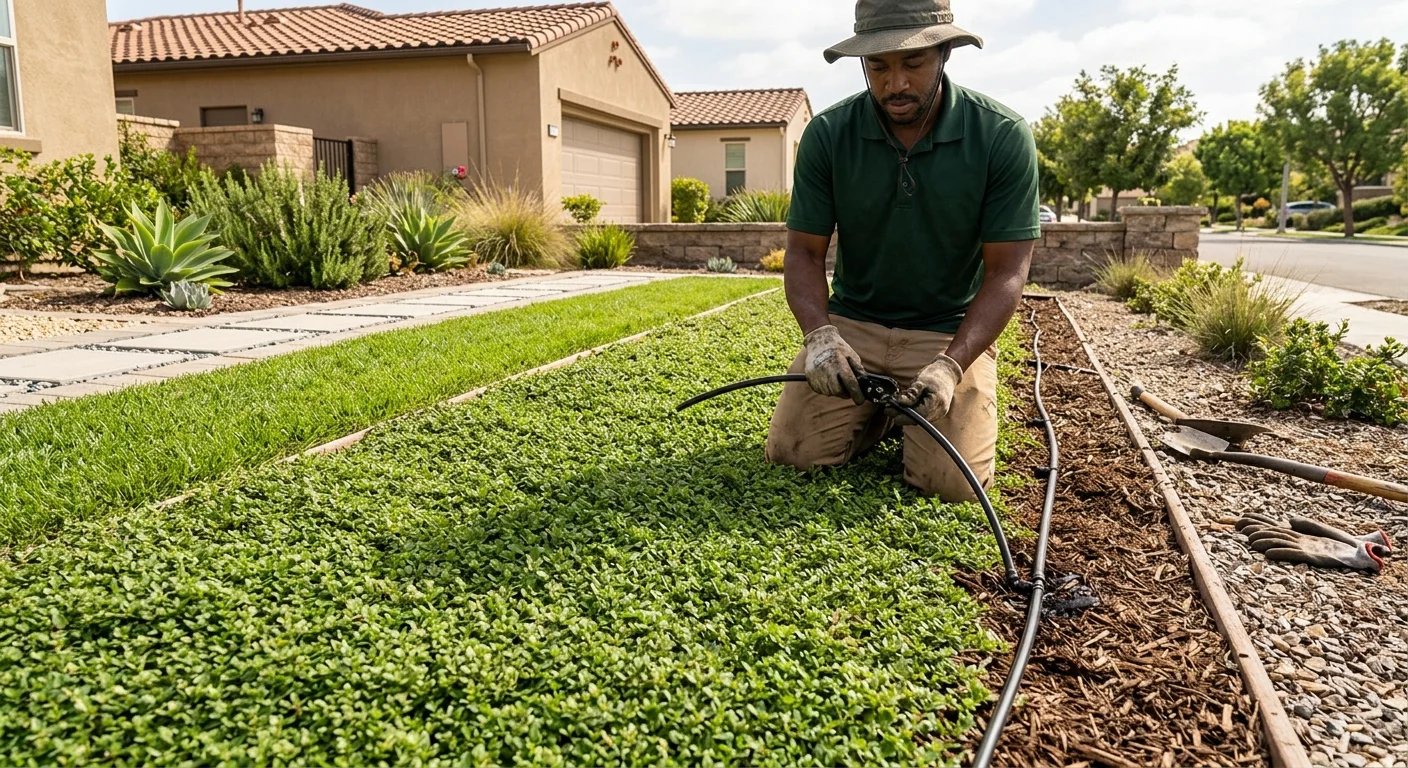
Kurapia is a low, mat-forming groundcover sold as a lawn look-alike. Crews plant it from plugs, not from a pallet of sod. The producer’s install guide spaces those plugs 12 to 15 inches on center. In warm weather, that grid can fill in within about two months.
It is not a California native plant. If you want a native palette, use our California native plants guide. It is not artificial turf. It is not tall fescue, and it is not a mulch bed you ignore after week one.
It is also not a verified water-savings number. No gallons-per-square-foot figure, and no percent cut versus bermuda, sits in the claims we can publish. Treat grower copy as a starting point. Confirm irrigation with the contractor who will plant it, and with the water agency on your bill.
Is kurapia a good ground cover?
It can be, on the right San Diego patch. Full sun, light paths, and a converted irrigation plan are the usual fit. Deep shade under a dense tree, daily soccer, or a low spot that ponds in February are common misses. We could not confirm a published traffic rating, an invasive listing, or a winter-color guarantee against the primary sources this site uses. Read the current producer spec. Check the California Invasive Plant Council list before you plant a large area. Ask your city or water district if they restrict the species.
Bloom Pro SD does not grow, stock, or install plants. We match you with licensed independent landscaping pros. Those crews source the plugs and do the work. You contract with the pro directly.
Where can coastal and inland yards support it?
San Diego County is not one climate. A Mira Mesa courtyard, a Ramona slope, and a Solana Beach parkway ask different things of a low green mat.
Coastal north county, from Oceanside through Encinitas and Del Mar, sits in marine layer more often. Summer heat is milder. Salt and wind are real on Imperial Beach, Coronado, and open bluff lots. Ask the pro how close the planting sits to a street, a bluff, or a two-story wall that throws afternoon shade. A Pacific Beach parkway is a different light pattern than a bare pad in Otay Mesa.
Inland valleys run hotter. Escondido, San Marcos, El Cajon, Santee, and Lakeside bake through late summer. Heat off stucco and concrete can cook a new plug grid. Establishment water still matters, even on a drought-minded plant. Inside the City of San Diego Public Utilities service area, outdoor watering with potable water is allowed only before 10:00 AM or after 6:00 PM. Watering is prohibited during and within 48 hours after measurable rainfall. Other agencies in the county set their own rules. Check the name on your water bill.
East County lots near wildland can sit in defensible-space country. CAL FIRE’s Zone 0, the ember-resistant zone, extends 5 feet from structures. Zone 1, lean, clean, and green, extends 30 feet. Zone 2, reduce fuel, runs from 30 feet to 100 feet. The statute speaks to fuel and maintenance, not a species blessing. Don’t treat kurapia as fire-proof. If the yard is in a State Responsibility Area or a local fire-hazard overlay, ask the fire authority first. Our defensible space guide covers the zone names and distances.
Have the contractor check drainage and compaction, especially on graded fill lots in Chula Vista and National City. A winter wet spot that turns hard in August will stall a plug grid. If the planting is in the public strip between sidewalk and curb, ask the city before anyone digs. Right-of-way rules are local, and we could not confirm a countywide parkway plant list.
How does kurapia compare with grass, turf, and groundcover?
Most searches land on one of four looks: living grass, a living carpet, mixed drought planting, or plastic turf.
Living grass still wins for hard play. If kids need a true sports surface, the crews we send install sod, not a groundcover plug grid. Start with sod installation and a grass-type match for coastal or inland heat. Warm-season grasses such as bermuda need 25% less water than cool-season varieties, per UC Master Gardeners of San Diego County. That comparison is grass versus grass. It is not a kurapia number.
A kurapia carpet aims at a low, walkable green sheet. A path to the trash cans is a different load than weekend soccer. We do not have a verified pressure rating, pet-traffic rule, or mow schedule in the claims ledger. Ask for the producer’s current care sheet. Have the contractor write the expected use into the scope.
Mixed drought-tolerant landscaping is the other living path. Sage, buckwheat, succulents, and gravel do not read as a lawn. They do read as a San Diego yard. If the goal is less water and less weekly mowing, a designed planting often beats a single-species mat.
What are some low-maintenance ground cover options?
Kurapia is one species decision. Other living carpets, including plants that handle slopes or light foot traffic, sit in the walkable ground-cover roundup. Use that piece when you are still choosing among plants. Stay here when you already have kurapia in mind.
Artificial turf is the non-living fork. Synthetic turf is not an approved conversion under SoCal Water$mart turf replacement. Projects that put synthetic turf in the old lawn area are ineligible. If you are weighing plastic against plants, read artificial turf versus drought-tolerant landscaping.
Low-maintenance is a relative phrase. Plugs still need weed control while they fill. Irrigation still needs a working clock. Edges still need a hard line so the mat does not wander into beds. The weekly mow-and-stripe habit can drop. The plant does not disappear.
What do irrigation, traffic, and HOA rules change?
Overhead spray is a lawn habit. A plug grid often wants a tighter drink. For a SoCal Water$mart turf replacement, overhead spray must convert to drip, micro-spray, bubblers, or rotating nozzles, or the heads must be capped. EPA WaterSense is a fair place to learn efficient controllers. SoCal Water$mart’s weather-based controller rebate starts at $80 per controller for landscapes under 1 acre, or $35 per station over 1 acre. Amounts vary by water agency and funding. Eligible devices are rebated only for active stations on an in-use system.
Don’t assume the carpet qualifies for the turf rebate. SoCal Water$mart pays $2.00 per square foot of removed turf, up to 5,000 square feet of converted yard per year. Your water agency may add more. Amounts change, and they depend on funds at the time of approval. Check your address in the program’s rebate estimator. Synthetic turf is ineligible. The converted area must stay permeable to air and water. Concrete cannot replace the turf. Broken concrete paths with sand filler can be acceptable. The project needs at least three plants per 100 square feet of project area. Existing trees that remain count. It also needs a stormwater feature that captures rainfall by infiltration or on-site storage, such as a rain garden, rock garden, dry river bed, swale, berm, rain barrel, or cistern. You need approval to proceed before any turf comes out. Dead or dying turf and bare dirt do not qualify.
Whether a continuous kurapia mat meets the three-plants-per-100-square-feet rule is not confirmed in our ledger. Call your water district and get the plant list in writing before demolition.
HOA rules are local paper, not county law. Boards in places like Carmel Valley, 4S Ranch, Scripps Ranch, and Rancho Bernardo often police how a front yard reads from the street. Some want green. Some want drought planting. Some want a list from an approved palette. We could not confirm a countywide HOA rule for kurapia. Pull the CC&Rs and get architectural approval in writing. If a notice already arrived, see HOA landscaping violations.
Traffic is the other silent rule. Delivery paths, dog runs, and gate swing arcs wear a mat thin. Tell the contractor those paths. A stepping-stone spine is a design choice, not a failure of the plant.
What should you share before requesting a contractor match?
We answer the line and match you with a licensed local pro. Clear intake makes a better match.
Send photos of the whole yard, not one corner. Name the city, and say coastal or inland. Count sun hours on the actual patch in August, not in March. Name kids, dogs, and where people walk. Say whether you want a lawn look, a mixed drought bed, or a split yard.
Share irrigation type: clock, drip, spray, or none. Share HOA docs if they exist. If you want a rebate, say which water district is on the bill. Don’t pull turf first. Program rules require approval before removal.
If the work is large, hire a licensed landscaping contractor. Verify the license on the CSLB lookup. The pros we send are licensed and insured. You contract and pay them directly. Bloom Pro SD holds no contractor license and owns no crews, trucks, or nursery stock.
Where can I get kurapia in San Diego?
We do not sell plugs. Nursery shelves and online listings change. The contractors we match you with source current stock and plant it. Ask the pro for the variety name on the order, the plug count, and the spacing. The producer spec we can cite is 12 to 15 inches on center, with fill-in in about two months in warm weather.
Frequently asked questions
What are some common plants found in San Diego?
California natives and other Mediterranean-climate plants carry a lot of San Diego yards: sages, ceanothus, buckwheat, succulents, and dry-summer trees. Kurapia is a commercial groundcover, not that native palette. For plant lists, use the native guide above and our drought-tolerant plants article.
When to call us
A kurapia conversion is still a landscape install. Grading, irrigation changes, and large plantings belong with a licensed landscaping pro, not a weekend plug drop. Call us at (760) 400-6355 and we’ll match you with a licensed local pro.