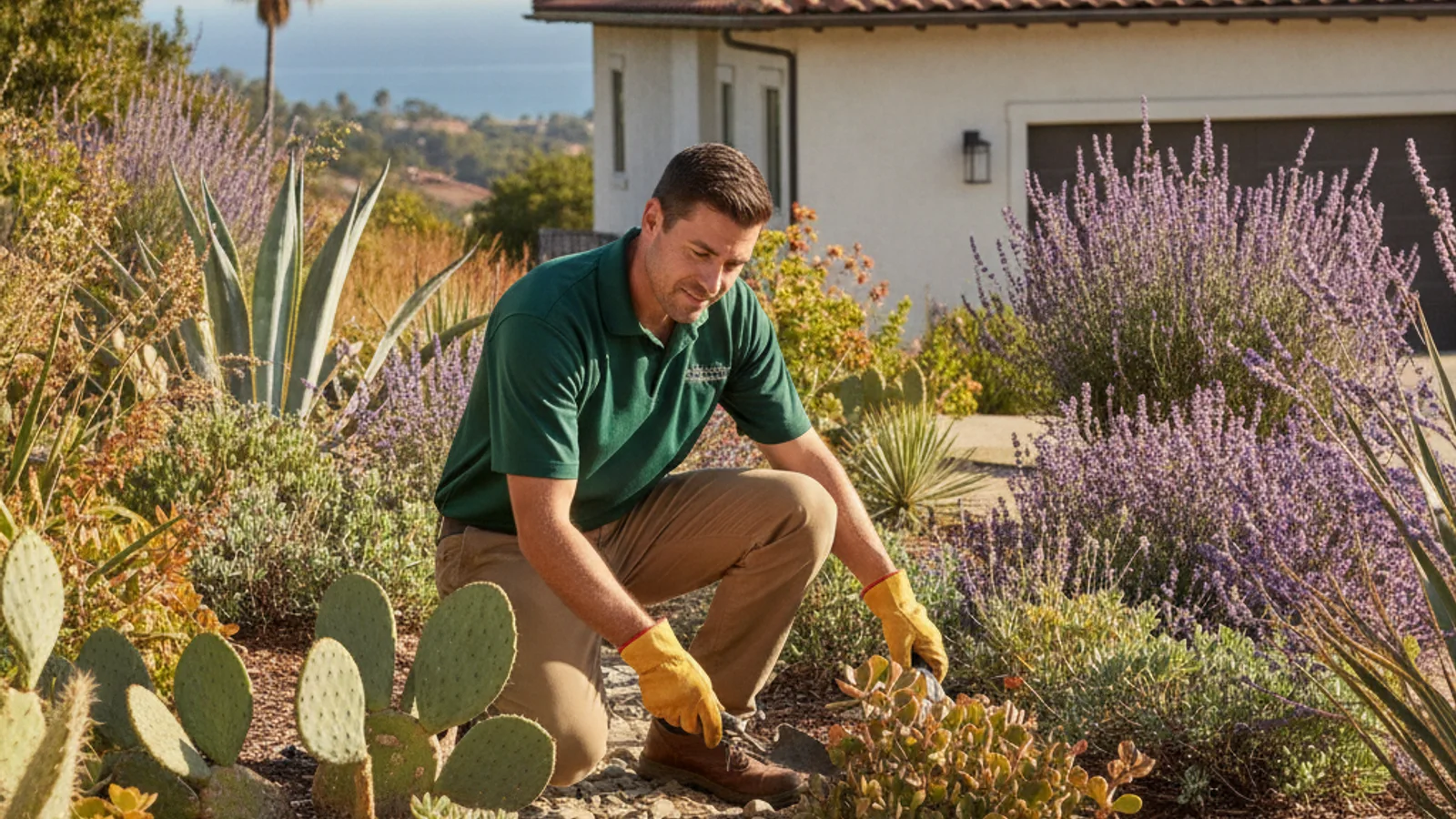
Xeriscaping is a landscape design method that groups plants by water need and cuts irrigation to the minimum the plants still need. In San Diego it often pairs with live-turf removal. SoCal Water$mart amounts, caps, and funding change. Use the current estimator. Synthetic turf is not eligible on the regional path. Reservation before turf removal. This guide covers the seven principles, plant grouping, and how to compare conversion bids.
What is xeriscaping, exactly?
Xeriscaping is landscaping built around water conservation. The word comes from the Greek “xeros,” meaning dry, and it means designing a yard so it thrives on rainfall and minimal irrigation. It’s not a cactus-and-gravel look unless you want it to be. A good xeriscape can be lush, colorful, and layered. The difference is in the planning: every plant is chosen for the local climate, grouped with others that drink the same amount, and watered by an efficient drip system instead of thirsty spray heads.
People often use “xeriscaping” and “drought-tolerant landscaping” as if they mean the same thing. They overlap, but xeriscaping is the broader system. Drought-tolerant landscaping usually describes the plant choices. Xeriscaping describes the whole approach, from soil prep to irrigation to maintenance.
Why xeriscaping makes sense in San Diego
San Diego imports most of its water, and rates keep climbing. Outdoor watering is the single biggest use for a typical home, so it’s also the biggest place to save. Trade a lawn for a xeriscape and the water bill can fall by half or more, year after year. For a closer look at the math, see our breakdown of San Diego water rates and lawn economics.
The climate does most of the work for you. San Diego’s dry summers and mild, wet winters match the natural rhythm of California native and Mediterranean plants. Those species evolved to green up in winter rain and coast through summer drought. A lawn fights that rhythm and needs constant water to survive it. A xeriscape works with it.
There’s a financial push too. Local water agencies want lawns gone, so they pay you to remove them. The turf rebate alone can cover a meaningful share of a conversion, which we cover below.
The seven principles of xeriscaping
Xeriscaping rests on seven principles. Follow them and you get a yard that looks good, saves water, and stays low-maintenance for years.
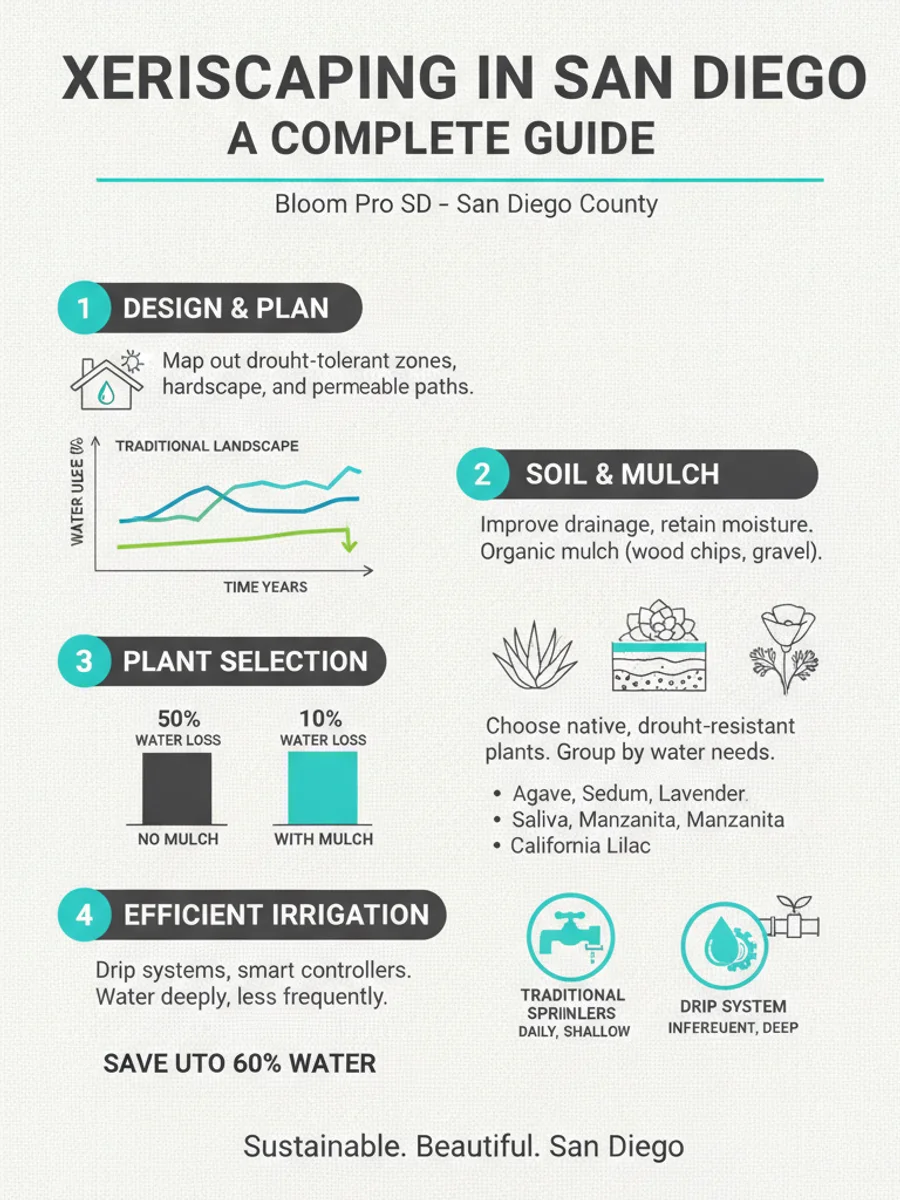
- Plan and design first. Map sun, shade, slope, and how you actually use the yard. A plan on paper prevents expensive changes later.
- Improve the soil. San Diego soils run heavy on clay or sand. Working in compost improves drainage and helps roots reach water, so plants need less of it.
- Group plants by water need. Put thirsty plants together and dry plants together. This is the core idea. It lets you water each zone correctly instead of over-watering half the yard to keep the other half alive.
- Limit turf. Keep grass only where you’ll use it, like a small play area, and choose a warm-season variety that handles heat. Everywhere else, use groundcovers, beds, or hardscape.
- Water efficiently. Drip irrigation delivers water straight to the roots with almost no evaporation or runoff. A smart controller adjusts to the weather. Our guide to drip irrigation conversion in San Diego walks through the switch.
- Mulch generously. A three-inch layer of mulch holds moisture, blocks weeds, and cools the soil. See our guide to mulch types for San Diego beds for what works here.
- Maintain thoughtfully. A xeriscape needs care, just far less of it. Seasonal pruning, occasional weeding, and a controller check each season keep it looking sharp.
How much does xeriscaping cost in San Diego?
Bloom Pro SD does not publish a county xeriscape rate card. Conversion bids move with turf removal, soil prep, plant sizes, irrigation rebuild, and hardscape. For a line-item comparison checklist, read drought-tolerant landscaping costs in San Diego.
DIY can lower the number, but the biggest cost mistakes come from skipping soil prep or building the wrong irrigation. Both are hard to fix once the plants are in.
What rebates can offset the cost?
San Diego homeowners can sometimes stack regional and local incentives. The turf replacement path through SoCal Water$mart is the starting estimator. Amounts, caps, and funding change. Synthetic turf is not eligible on the regional path. Most programs require reservation before you remove the lawn.
There are separate rebates for smart irrigation controllers, rain barrels, and rotating sprinkler nozzles. The catch is that most turf rebates require pre-approval before you touch the lawn, so the paperwork has to come first. We cover the current programs and how to apply in our post on drought-tolerant rebates in San Diego and the specific turf rebate per square foot. The San Diego County Water Authority is the authority for eligibility and current rates.
Best low-water plants for a San Diego xeriscape
The strongest xeriscapes mix a few plant types so the yard has structure, color, and texture across the seasons. Good San Diego choices fall into a handful of groups.
- Succulents like agave, aloe, and sedum give bold shape and store their own water. Our list of the best succulents for San Diego landscaping is a good place to start.
- California natives such as ceanothus, manzanita, and salvia are built for this climate and feed local pollinators. See our guide to California native plants for San Diego.
- Groundcovers cover bare soil, fight weeds, and handle slopes. For hillsides, read our guide to drought-tolerant groundcovers for San Diego slopes.
- Ornamental grasses and shrubs add movement and privacy without much water.
Group these by water need, and the yard stays healthy on a fraction of what a lawn drinks.
Xeriscaping vs. drought-tolerant landscaping vs. artificial turf
These three get mixed up often. Xeriscaping is the full design system, water-wise from soil to sprinkler. Drought-tolerant landscaping usually points to the low-water plants inside that system. Artificial turf is a separate choice that swaps living grass for synthetic, which cuts water to zero on that patch but doesn’t cool the yard or support wildlife the way plants do.
Many San Diego yards use all three together: a xeriscape design, drought-tolerant plants in the beds, and a small strip of artificial turf where kids or pets need a soft surface. If you’re weighing the last one, our comparison of artificial turf versus drought-tolerant landscaping lays out the trade-offs.
How to start your xeriscape project
Start with a plan, not a plant list. Walk the yard, note where the sun hits, and decide which areas you actually use. Then set your budget, confirm your rebate eligibility before removing any turf, and sequence the work: remove the lawn, amend the soil, install drip irrigation, plant, and mulch.
That order matters. Get the soil and irrigation right before anything goes in the ground, and the plants take care of themselves. At Bloom Pro SD, the landscapers in our San Diego landscaping network handle the design, the turf removal, the drip conversion, and the rebate paperwork as one project, so you’re not juggling contractors or missing a deadline. Coverage runs across all of San Diego County.
Frequently asked questions
Is xeriscaping cheaper than a regular lawn?
Upfront, a xeriscape costs more to install than sod. Over time it’s far cheaper. You save on water every month, skip weekly mowing, and the rebates offset a large part of the install. Most San Diego homeowners recover the difference within a few years and keep saving after that.
Does xeriscaping have to look like rocks and cactus?
No. That’s one style, not the rule. A xeriscape can be full of color, with flowering natives, ornamental grasses, and layered shrubs. The only requirement is that the plants are chosen for low water and grouped by need. The look is up to you.
How much water does xeriscaping actually save in San Diego?
A well-designed xeriscape cuts outdoor water use by 50 to 75 percent compared with a traditional lawn. Since outdoor watering is the biggest use for most homes, that often shows up as a noticeable drop on the total bill.
Do I need a permit to xeriscape my yard?
A standard xeriscape conversion doesn’t need a permit. Permits come into play only for structural work like tall retaining walls or major grading. The rebate program, though, usually requires pre-approval before you remove the lawn, so start that paperwork first.
How long does a xeriscape conversion take?
Most residential conversions take one to three weeks, depending on yard size and how much hardscape is involved. Turf removal and soil prep move fast. Planting and irrigation take the most care, since that’s what determines whether the yard thrives.
When to call us
Xeriscaping pays off most when the design, soil, and irrigation are right from day one. If you’d rather not guess at rebate rules or drip layouts, we can help. Bloom Pro SD connects you with San Diego landscapers who design water-wise yards, handle the turf rebate paperwork, and build the whole thing in one project. Explore our drought-tolerant landscaping service or call us at (760) 400-6355 to get matched. The independent professional quotes the work.